
Open House London 2025
I took a slightly more reasonable approach to exploring Open House London 2025 than I did last year, but nonetheless managed to see historic treasures, contemporary living, and some real oddities as well. Sea cadets in a tin tabernacle, anyone?
What Did Open House London 2025 Have in Store?
If you’re new here, welcome! If you’re not, you’ll know that Open House Festival is a fixture on the Salterton Arts Review calendar. I’ve been every year since 2020, when I made a tentative first foray with three bookings (just getting inside different buildings was a novelty at the time). From there my approach has differed slightly each year, although I tend to lean towards bookable tours and walks so I can better plan my days. 2024 was a bumper year, in which I even took a week off work to make the most of things.
This year I ended up doing more drop ins. I had a good reason: I was on a plane when bookings opened, and so not able to get to the website before most things had been snapped up. I’d identified a few tours of interest, of course, and the Urban Geographer helped out with a couple of bookings. But in the end, I had a great time roaming London visiting different drop ins. You’ll see I mostly stuck closer to my own neck of the woods this year, in the South East suburbs of London. But I also got as far as Kilburn and Shepherd’s Bush.
The Urban Geographer, being interested as he is in, well, urban geography, bemoans the fact that Open House has changed over the years. There seem to be fewer new skyscrapers offering tours, for instance. And quite a number of places that are open to the public anyway. We gave preference to those which are only open during the festival, but did see a mix in the end.
Anway, enough chit chat. Let’s get stuck into my week of Open House adventures!

Scadbury Moated Manor
The Urban Geographer and I had a day out in South East London to mark the start of Open House London 2025. We actually started, not with an Open House listing, but with a nearby attraction (doing a two-in-one made the journey worthwhile). So before visiting Scadbury Moated Manor, we went to Chislehurst Caves. Then it was a walk of about 40 minutes through suburban streets and common land and woods to reach Scadbury Manor.
I’ve been wanting to come to Scadbury Moated Manor for a while, but it’s only ever open the first weekend of Open House and normally I’ve got a booking for something else. Not so this year! It is a relatively small site within easy reach of Chislehurst or St Mary Cray stations. The de Scathebury family (the richest family locally) settled here around 1200, building a wooden manor house surrounded by a moat. The Walsingham family purchased the site and enlarged the house from the 15th century. Queen Elizabeth I knighted Sir Thomas Walsingham here in 1597. The estate later passed through various hands, before the manor house was pulled down in 1738.
After extensive archaeological work, the Tudor foundations remain in evidence. The “Tudor” fireplace and staircase, however, are modern follies, dating to 1936. Bromley Council bought the Scadbury Park estate in 1983, working with the Orpington and District Archaeological Society to research and care for the site. ODAS volunteers staffed the open day, and had even arranged for the Deputy Mayor of Bromley to formally open proceedings. Our Open House London 2025 adventure was off to a good start!

11 Elstree Hill, Ravensbourne
Scadbury Manor alone might not have justified the trek out from Central London. But combined with Chislehurst Caves and this bonus stop on the way home, it was a good day out. Our afternoon stop was 11 Elstree Hill, near Ravensbourne Station (the Ravensbourne is one of London’s “lost” rivers, but is very much in evidence around here). We were here to see part of a 1980s self-build project that will be familiar to long-time readers.
You might remember a visit during Open House London 2021 to Walter’s Way, near Honor Oak Park. This street contains a cluster of houses built using the methods of architect Walter Segal. His concept was radical self-build using modular design: building blocks that homeowners could assemble without expert architects or tradesmen. Lewisham Council* in the 1980s enlisted people from their housing waiting lists, and residents built homes on sites that would be unsuitable for traditional building methods.
At Elstree Hill we were welcomed by the daughter and granddaughter of one of the original participants in this scheme. Their father/grandfather still lives in his Segal home, but advancing age made it more appropriate for them to show their own, renovated version at number 11. The family are very proud of the scheme, and had a number of newspaper clippings to peruse, as well as showing a 1982 BBC documentary. The house itself looked from the inside very much like any other modern home, but the outside still has that typical Walter Segal look.
*Elstree Hill was part of Lewisham in the 1980s, but is now in the London Borough of Bromley
Resident-Led Tour of 12 Church Grove, Ladywell
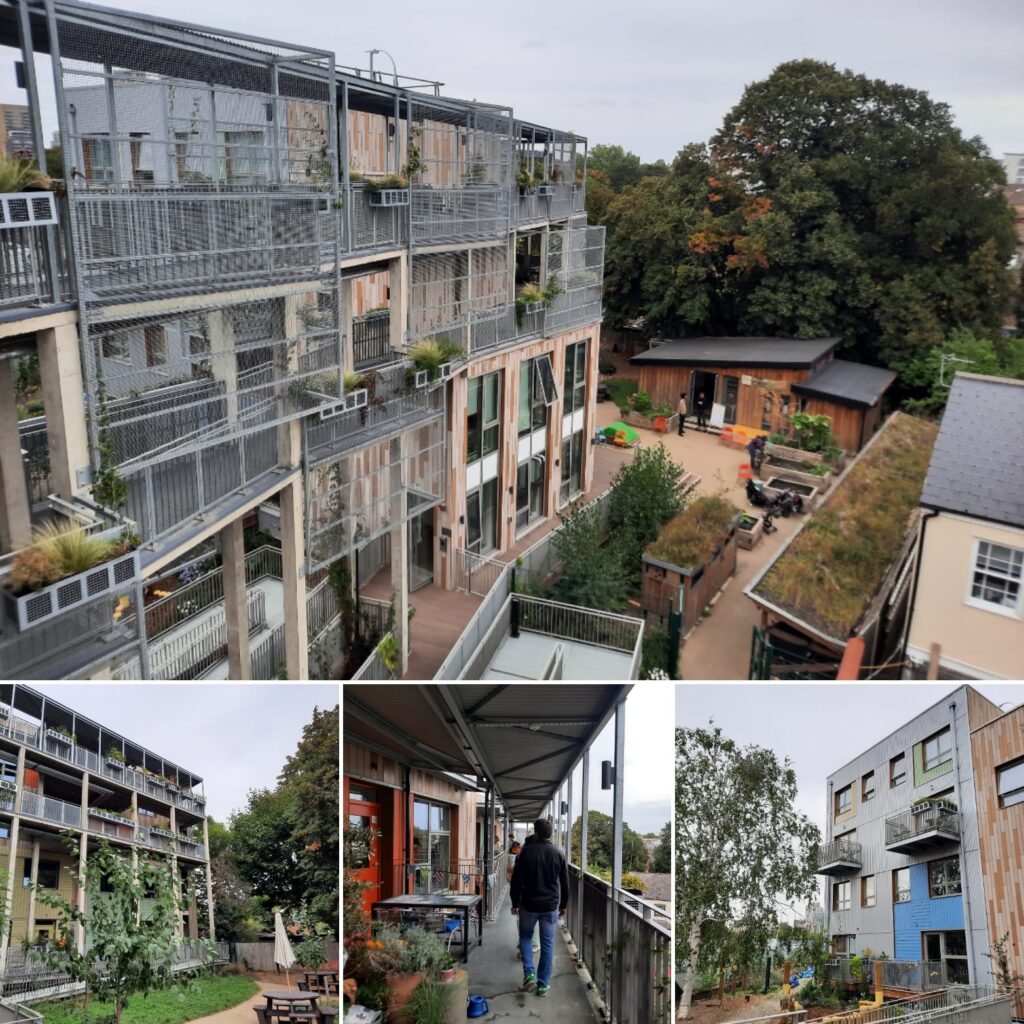
Continuing with our penchant for self-build projects (an interest of the Urban Geographer’s), on Sunday 14th we went for a tour of 12 Church Grove. We used to live near Ladywell, so it was interesting to see another side to it. And the project shared similarities with the Segal self-builds of the 1980s.
First of all, once more it’s Lewisham leading the way on interesting self-build schemes. This time with a relatively new organisation, the Rural Urban Synthesis Society (RUSS), leading the charge. This is the first RUSS project to reach completion, with residents having moved in a bit more than a year ago. RUSS advocate for bringing elements of rural living into the urban landscape, for example food growing and energy production. They also champion affordable homes in perpetuity, without restrictive clauses such as on pet ownership, as you often find in other affordable and shared ownership schemes.
Being a block of flats, it’s of course not possible for residents to be as hands-on in building their homes as their Segal predecessors. But they were involved in designs, and were able to select whether they wanted their units mostly finished, or handed over as shells ready to be fitted out. Residents also built communal facilities like the waste area, bike sheds, and manage the gardening. There’s a community space on site for affordable hire, and a playground overlooking the Ravensbourne (not lost here either) which is open to the public. The site, which was home to a foundry and then a school, had been vacant over a decade before RUSS took it on. Neighbours on the otherwise quiet side street didn’t enjoy the building phase, but are apparently now coming around.
The Tin Tabernacle / Cambridge Hall, Kilburn
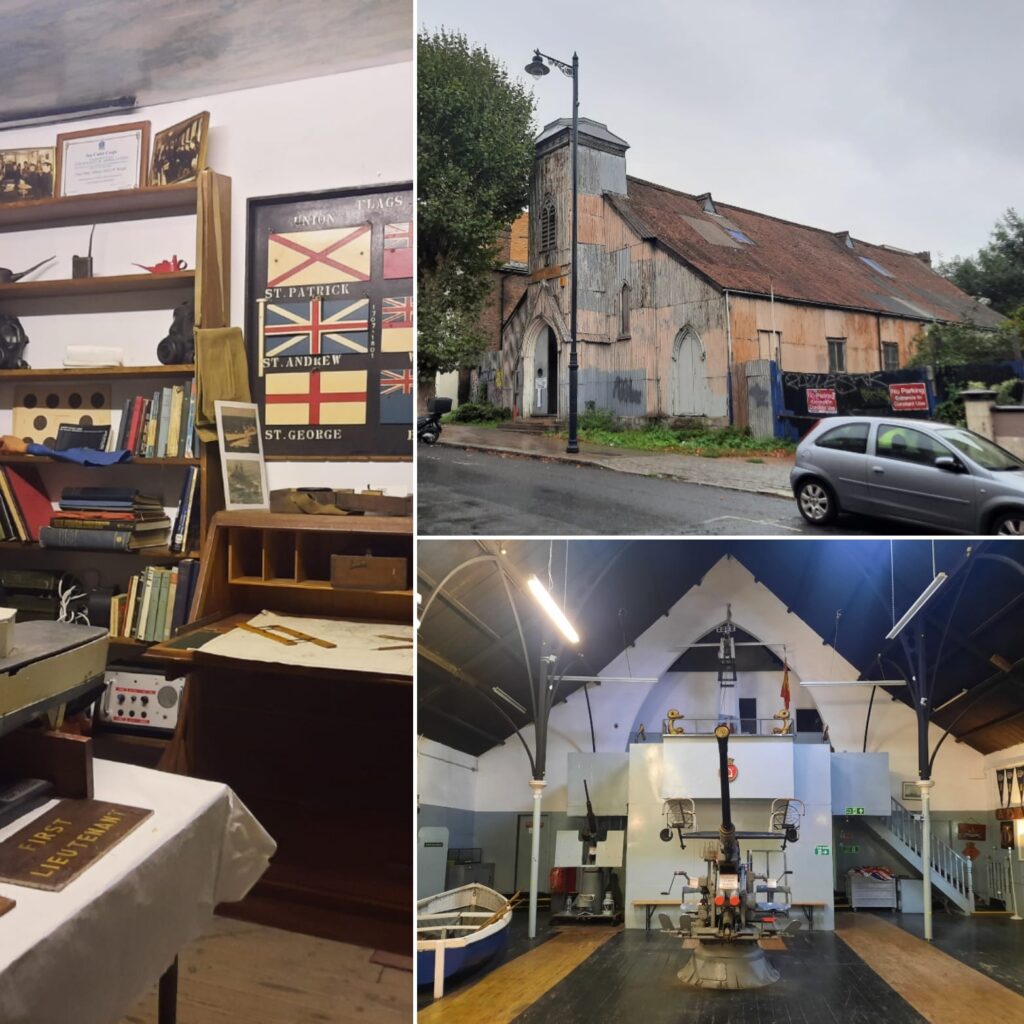
And now we venture out of South East London for a first time, to see one of London’s last remaining tin tabernacles. I saw a rebuilt version last year and said at the time I’d like to see a real one! As a reminder, so-called ‘tin tabernacles’ were cheap, supposedly temporary churches made of corrugated iron, erected in the Victorian period as London’s suburbs quickly expanded, and workers building housing or railroads needed somewhere to worship. The idea was that stone churches would replace them within five years.
This one, however, has been in Kilburn since 1863. Initially St James’s Church, it fell into disuse once in the 1890s before being taken over by another church group. It then closed at the outbreak of WWII, and did not resume its religious function post-war. Instead, in 1943, a lease was granted to the YMCA (they never took it up). Then in 1948, another lease was granted to the Sea Cadets, who renamed it Lord Lloyd Memorial Hall.
In the 1950s, something truly inspired and eccentric occurred. In order to better train Sea Cadets, the interior of the tin tabernacle was transformed to look like a ship’s interior, using elements from the decommissioned HMS Bicester. The hall is thus also known as the TS (Training Ship) Bicester. Visiting is a lot of fun. It’s got a ship’s doors, a rope room, navigational charts, and a gallery with a ship’s wheel and speaking tubes. Not to mention the WWII-era gun front and centre. As a temporary building in need of extensive care and maintenance the future of this unique space isn’t certain, but it was a wonderful place to see.

Crofton Roman Villa, Orpington
Time for a few mid week outings now. We start by heading back out to the South East London suburbs to see Crofton Roman Villa. It’s a stone’s throw from the train station at Orpington, and actually the town’s development is interconnected with the villa’s fate. Like Roman villas elsewhere in Britain (eg. Chedworth Roman Villa in the Cotswolds), nature reclaimed the space after its abandonment, and a thick layer of accumulated dirt eventually became farmland. Unlike Chedworth, however, Orpington is no longer an intact site.
Works like nearby roads and the creation of the railway sliced away parts of the villa. They also helped uncover the forgotten site. Archaeology was not a primary concern in the Victorian era. It was by the time a planned carpark once more threatened the villa in the 1980s, however. An urgent archaeological survey highlighted how much of the site was still intact, and the scaled-back carpark shared space in the end with an interpretation centre.
The interpretation centre is small but interesting. Panels explain the context of Roman Britain, and the development of this site in particular. You can see remains of foundations and underfloor heating, and understand how the latter worked. There’s small handling collection in a corner geared towards school groups. The return trip from Central London is almost certainly longer than the time you’ll spend visiting, but I do love an archaeological site so enjoyed my visit very much.
A Trio of City Churches
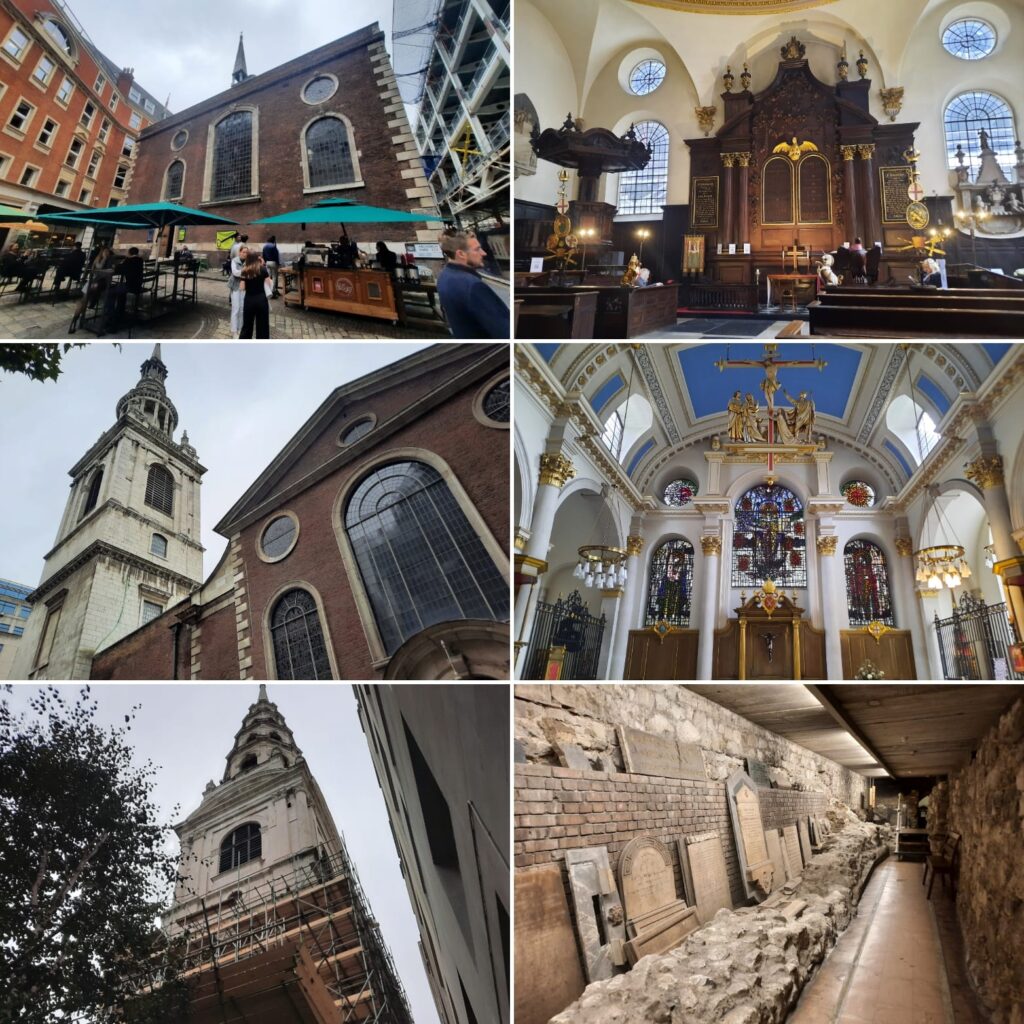
One of the options to get back from Orpington is a stopping train which terminates at Cannon Street Station. Why not go and check out some more drop-in sessions?, I thought. And so I ended up at three churches in the City of London, all with some connection to Christopher Wren. Until I put the photos together for this post, it didn’t even dawn on me how similar they look!
- St Mary Abchurch. In terms of an Open House offering, St Mary Abchurch wins. They had Open House signs outside, people to greet visitors, and handouts about the church interior and furniture. I thus learned I was looking at a carved altarpiece by Grinling Gibbons, and a painted dome dating to 1708. Well, mostly. The Great Fire of London destroyed an older church (at least 12th century), and this Wren replacement went up between 1681-86. St Mary Abchurch sustained damage during WWII (particularly to the dome) but wasn’t a total loss. The church also contains original box pews and a very old charity box.
- St Mary-le-Bow. This was the very opposite of the efforts of St Mary Abchurch. In fact, I would posit the church is always open to visitors, and this wasn’t really an Open House event. But it was interesting to look around, anyway. Its history is similar to St Mary Abchurch. It dates back to the 11th century, and fell victim to the Great Fire of London. A new Wren church opened in 1670. This time the church was a total loss during WWII (aside from the tower), and today’s rebuilt Wren design dates to 1964. St Mary-le-Bow is home to the famous Bow Bells: to be a Cockney you have to be born within earshot of them. Does that mean no Cockneys were born between 1941 and 1964?
- St Bride’s. During my first Open House in 2020 I visited the St Bride’s Foundation, but not the church. It again mirrors the fortunes of the others. Even older this time (7th century), destruction during Great Fire, more destruction during WWII, post-war reconstruction to Wren’s designs. No visible Open House participation, but a crypt and museum where visitors can learn about the church’s history. I think I’ll come back some time to look through the museum properly.
The Clockworks, West Norwood
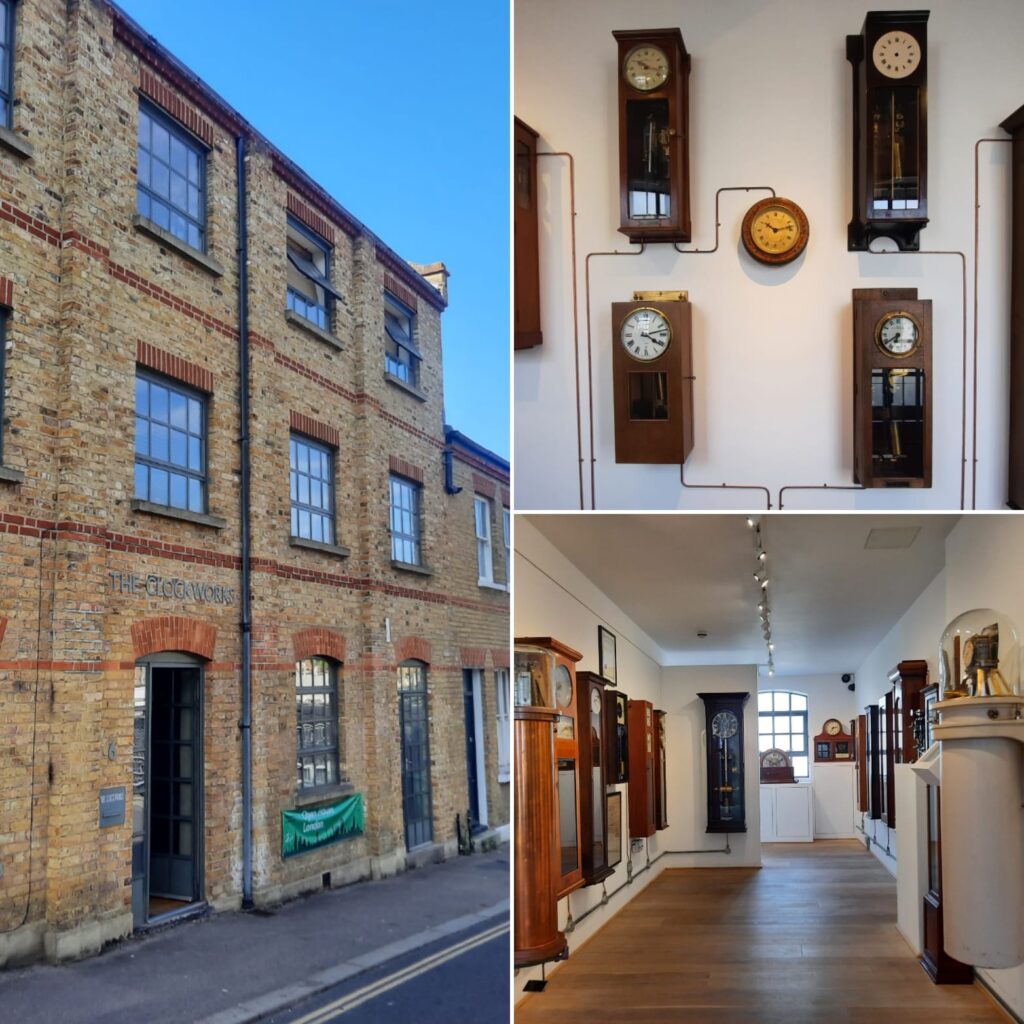
We have made it to Friday 19th now! A fabulously sunny day on which I saw two great spots on opposite sides of the city. I started with one of my pre-booked events, a tour of The Clockworks in West Norwood. Nettlefold Place is a quiet back street of Victorian light industrial spaces that I would likely have never stumbled across were it not for Open House. The building which houses The Clockworks was once a printworks. It was substantially renovated in 2012 by architect Michael Crowley to create a combined museum, reference library, and open workshop.
I was lucky to join a tour with James Nye. Nye assembled the collection over decades, before turning it over to a charity. A very sensible way to ensure one’s collection has a future beyond its initial collector. The collection focuses on electrical horology and networked timekeeping. I learned so much and found it so interesting I will do a separate post at some stage. But in a nutshell, what we’re talking about here are electric and precision clocks from approximately 1840-1970.
Sharing a common time was not part of the human experience until relatively recently. But it’s a prerequisite to do things like run trains that don’t constantly crash into each other. The museum part of the space shows different, frequently very clever, ways that clockmakers solved problems in timekeeping. There’s no signage, so one of the trio of Nye, curator Kirsten Tambling or Conservator-in-Residence Alex Jeffrey is needed to explain things. The open workshop is a great design flourish, putting skills and tradition front and centre. And the library creates a nice entrance space, guiding the visitor in. All in all, a great conversion and a fascinating, niche museum.
Culture House, Shepherd’s Bush
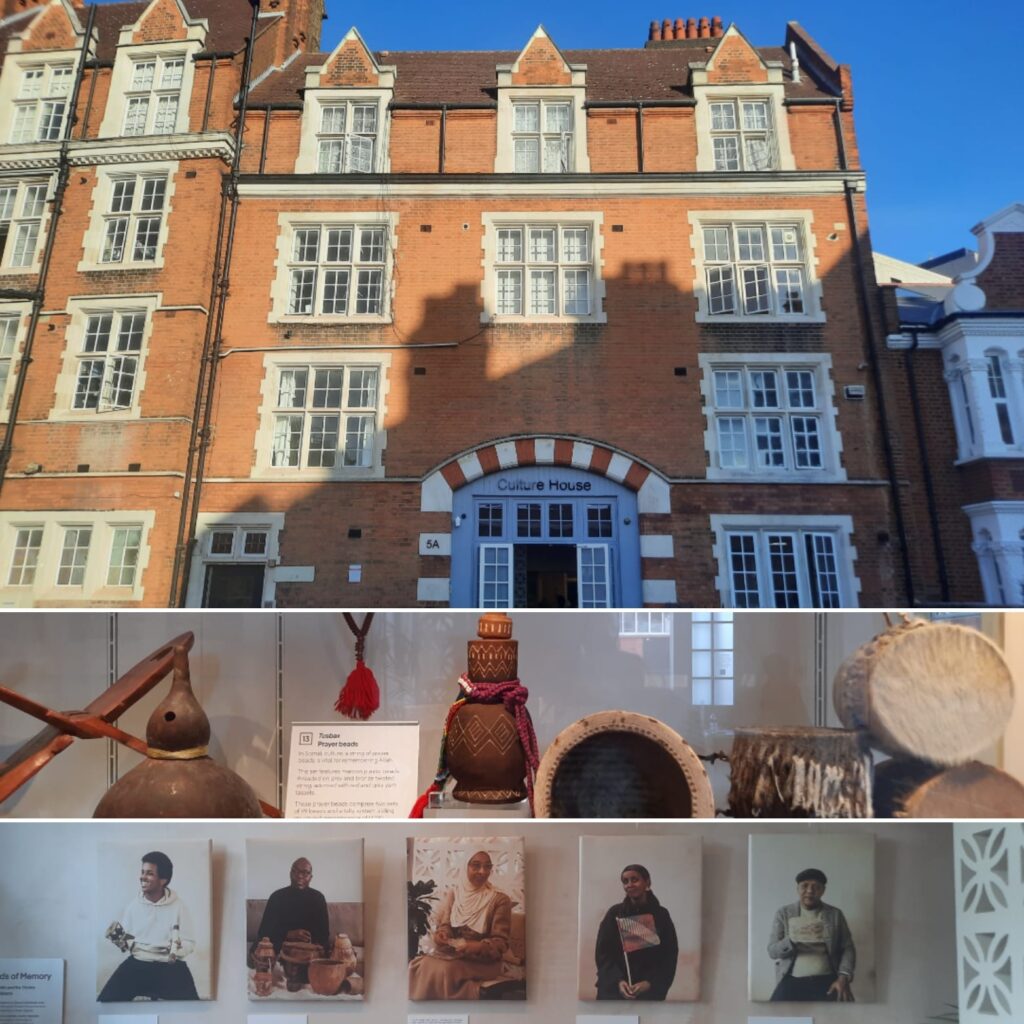
My other pick for Friday was an even newer museum space. Culture House is in Shepherd’s Bush, basically next door to the Bush Theatre. It is also the UK’s first permanent exhibition space for Somali artefacts curated by the Somali community. It’s fairly modest in scale. There is a display case of objects donated by community members, curated into groupings of personal use, daily life, and spiritual purpose. Additional objects make up a handling collection which was available in an adjacent room. The entrance lobby and two further rooms are home to temporary exhibitions. Currently these are three photography exhibitions, including one sharing the stories behind the collection.
Culture House grew out of the founding of the non-profit Anti Tribalism Movement in 2010. Their community work, and particularly the impact on the community of COVID-19, led to a nascent collection of objects and stories. Culture House is a space to display this collection, bring the Somali community together, and share their stories more widely. As well as the public spaces I saw, it consists of a physical archive, resource centre, and learning space. Like Church Grove, Culture House’s mission has also led them to offer an affordable community and events space. They were setting up for a poetry open mic night when I was there.
This may be another example of an Open House listing that is open to the public outside the festival, but it’s also a chance to see a brand new public space. Freehaus Design led the project, engaging with the community to help shape the design choices. What results is a versatile space that retains some of the building’s Victorian history, while also bringing in East African design elements. Culture House opened in May 2025.
Whitgift Almshouses, Croydon
It’s now the second weekend of Open House London 2025, so we’re on the home straight. On Saturday 20th I visited only one place, and it was another pre-booked one. Also another in the suburbs of South East London!
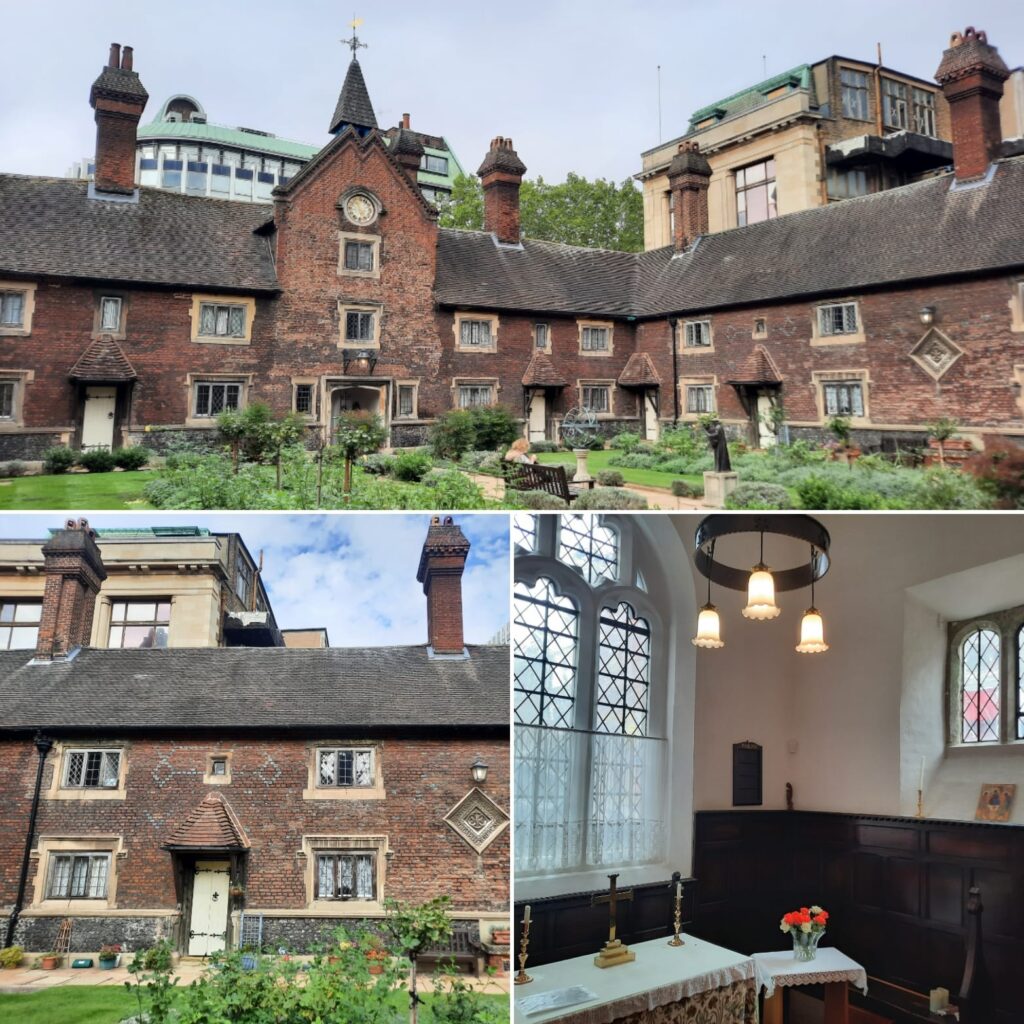
Interestingly, this was also a site I had walked right past before without noticing. In 2023 I did a behind-the-scenes tour of the Museum of Croydon, but didn’t notice the Whitgift Almshouses as I passed by on North End. It’s understandable, though: the fairly plain brick wall doesn’t give much of a hint of the peaceful oasis inside.
The Whitgift Almshouses are part of the Whitgift Foundation, endowed by Elizabeth I’s favourite Archbishop of Canterbury John Whitgift in the late 16th century. Rooms were built for 30-40 residents: over sixty, able to look after themselves, church-going, but in need of financial support. Not only did they have a little space of their own, they received a stipend, clean water, heating in winter, a uniform, and took meals communally. A much better fate than befell many at the time. The residents were mostly from the Archbishop’s household to begin with.
The almshouses still function today broadly along the original lines. There are now 16 flats, including bathrooms and sitting rooms for each resident. As part of the tour we saw the common room, chapel, and assembly room, all with charming Tudor features. I find it fascinating to see these historic spots with a lineage back to Tudor (or older) charters, once semi-rural but now smack bang in the middle of urban London. With thanks to the residents for allowing us to step inside and see their space!
7 Meadow Lane & 13 Nubia Way, Grove Park
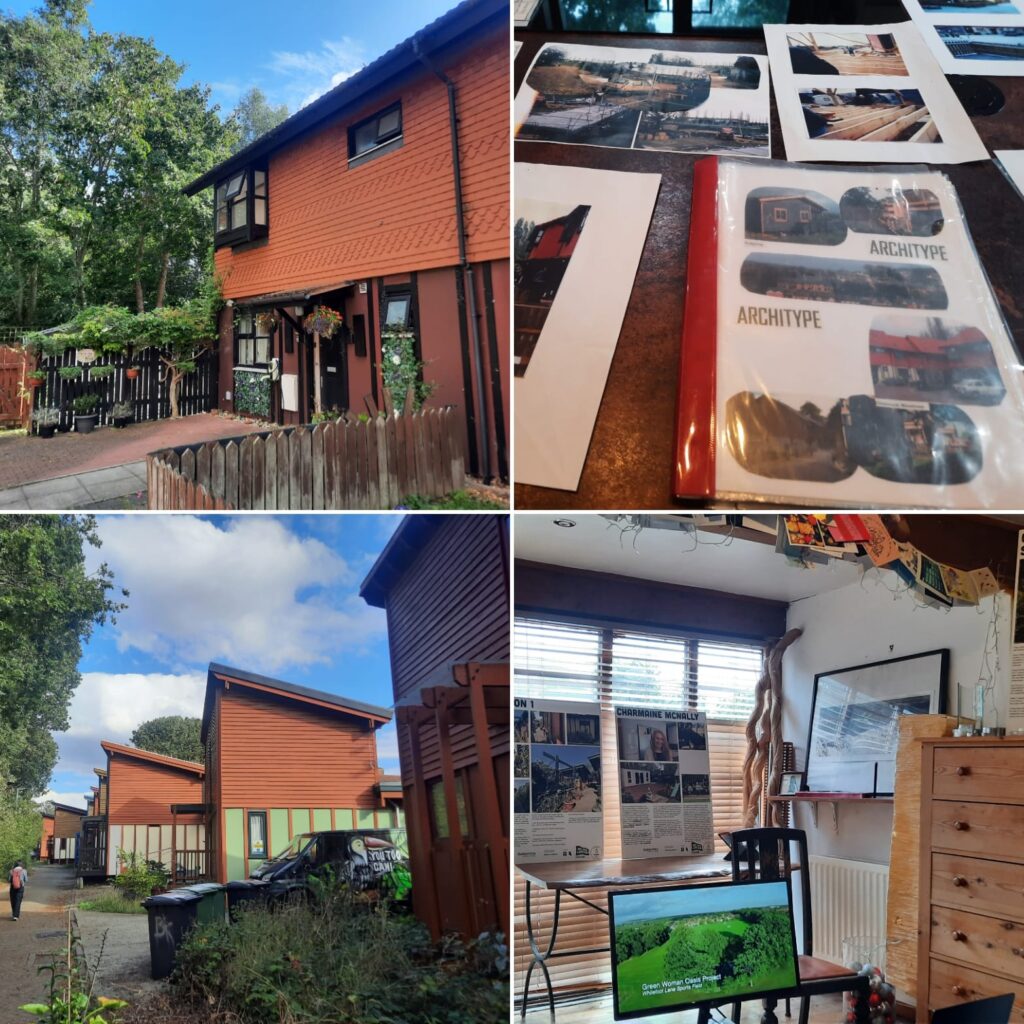
To finish our Open House meanderings this year, the Urban Geographer and I headed back to South East London once more on Sunday 21st. We were here to see two more private residential listings, both part of Lewisham’s self-build scheme. First up was 7 Meadow Lane, a short walk from Grove Park Station near the River Quaggy. We met with Charmaine McNally, who became involved in this build-to-rent scheme as a way to move her young family out of a tower block and into a more suitable home. The skills she learned on site (future residents had to put in a certain number of hours per week to qualify for rent reductions) increased her confidence. They also led to McNally running a women-led maintenance company for a number of years.
Meadow Lane was the third of the self-build schemes run by Fusions Jameen, London’s first black housing co-op. Fusions Jameen’s Tim Oshodi was self-build consultant on the project. We got to meet the man himself at the next stop, at his home on Nubia Way. We watched a video explaining this earlier project, before Oshodi answered questions. Nubia Way was again a build-to-rent scheme, using Walter Segal’s principles to make construction accessible to non-experts.
Something which came across in conversation both with McNally and Oshodi was firstly how much they believe in self-build projects, and secondly how much things have changed since they built their homes in the 1990s. While there are still self-build projects going on in Lewisham and elsewhere (like Church Grove above), it doesn’t seem to be as supported by the council as it once was. Perhaps partly because housing waiting lists are ever longer, and blocks of flats fit more people than simple houses?
But it also seems that, a generation on from these schemes, the memory of the principles enshrined in them is fading. The residents of Nubia Way have faced attempts to remove the benefits and protections earned by working to build these homes and keep costs down. Community bonds are perhaps not as strong as they once were. The light of reality shines on Lewisham’s little self build utopia.
That feels like a more pessimistic note to end on than I intend. What I love about Open House is seeing the ebbs and flows in London over the decades and centuries. Somewhere like the Whitgift Almshouses feels largely unchanged since the 16th century. Here in Lewisham we have multiple examples of communities coming together to build comfortable, sustainable living spaces. In Shepherd’s Bush, the Somali community are sharing their stories. Architecture is ultimately an expression of how we live, work and exist together.
Trending
If you see this after your page is loaded completely, leafletJS files are missing.