
48 Hours in Bishkek – A Guide for Culture Lovers
A couple of days in Bishkek is just about long enough to start to get a feel for Kyrgyzstan’s capital. Why not extend it just a little and add in a daytrip?
48 Hours in Bishkek
A recent trip to Kyrgyzstan was my first time visiting Central Asia. I was there primarily for a hiking trip, so had already planned out most of my time. But my visit started and ended in Bishkek, with about 2.5 days all up to explore. I am an experienced traveller, but I honestly didn’t know what to expect in this new part of the world. And I wanted to see and do as much as I could, while I was there. So I took what I thought was a sensible approach, and booked a tour for each of the days I had to myself at the end of my trip. One excursion outside the city, and one city tour including a few main sights.
I realised as soon as I landed at Bishkek airport that this was a slightly unnecessary precaution. I could tell it was going to be fairly easy to get around the city centre, figure things out, and plan my own day of Bishkek highlights, so I cancelled my city tour. And it was. Easy, I mean. Bishkek is a fairly compact city with interesting museums, parks and squares. You can almost do it all on foot, although Osh Bazaar is a little out of the way and might be worth a taxi or public transport. There are enough English speakers to get by, although as usual learning a few words of Kyrgyz (or sometimes Russian) is welcome.
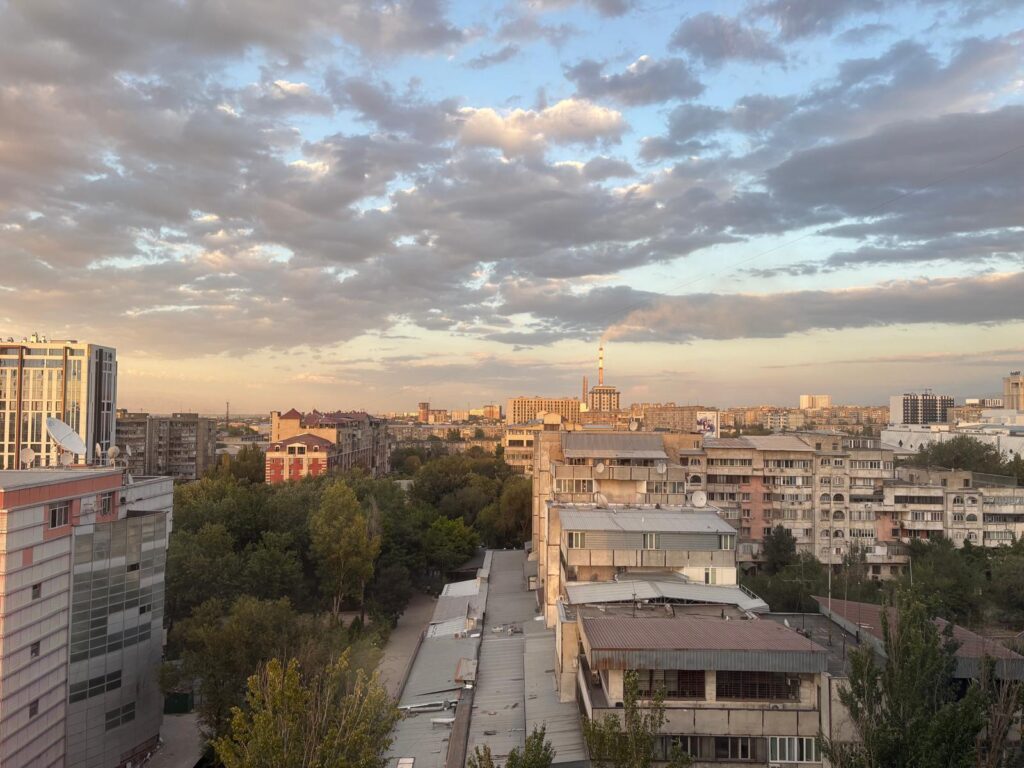
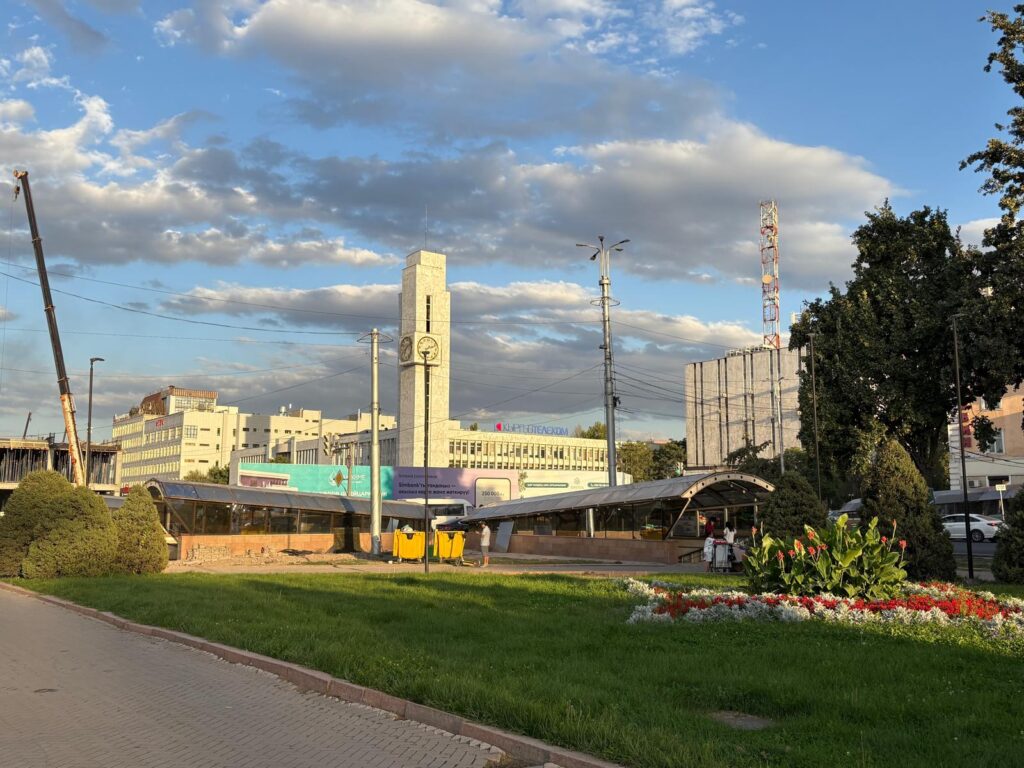
A lot of the reading I did before arriving in Kyrgyzstan suggested there was not that much to see in Bishkek, and I might be bored after a day or so. I disagree. I found it a fascinating city. Right now the legacy of the 20th century and its time as the capital of the Kirghiz Soviet Socialist Republic is plainly visible, but at the same time it’s rapidly changing, and I don’t know how much longer this will be the case. It’s a very green city, too, with lots of parks and tree-lined avenues. It straddles an interesting crossroads between Asia and Europe, a result no doubt of being largely a planned city of the Russian Empire (and then USSR).
I had a great time exploring, both with my tour group and on my own. Below, after a quick crash course in Bishkek history, are some ideas for how you might put together your own 48 hours in Bishkek. If I missed anything critical, please let me know in the comments!
A Brief History of Bishkek
Let’s start with names. Bishkek was formerly Pishpek. OK, they’re close at least, probably makes sense. There’s some sort of etymological myth about how the name Bishkek comes from a paddle for churning milk, we don’t need to pay it too much attention. A more interesting fact about Bishkek’s name, perhaps, is that, between 1926 and 1991 (with a brief reversion), Bishkek became Frunze, after Soviet revolutionary Mikhail Frunze. In fact, it was only while I was in Bishkek, in August 2025, that the airport code changed from FRU to BSZ.
So: Pishpek > Frunze > Bishkek. Pishpek, presuming that was its name at the outset, goes back in records only to the 1800s (although settlement in the region is much older: see the daytrip section below). The Khanate of Kokand constructed the fort of Pishpek to control local caravan routes. In 1860 Russian forces destroyed the fortress, establishing a Russian settlement on the site a few years later. The Russian Revolution took a little while to arrive here, but it did eventually. The Kara-Kirghiz Autonomous Oblast was established in 1925. Pishpek, soon renamed Frunze, was its capital.
Frunze’s time as part of the USSR mostly mirrored the larger political and economic trends at play. There was massive investment in infrastructure and housing, sometimes by enthusiastic volunteers brought in from other Socialist countries such as Czechoslovakia. Later, there were purges (including of those Czechoslovakian workers). Eventually the Soviet Union collapsed, bringing independence but also near economic ruin.
Today Bishkek is the capital of the Kyrgyz Republic (or Kyrgyzstan). It has a population of around 1.2 million, out of a national total of just over 7 million. While people of Russian/European origin were in the majority until the 1990s, the population is now 75% Kyrgyz. Bishkek has some of the features of a planned Russian/Soviet city, like a huge central square and tree-lined avenues, but also has the snow-capped Ala-Too Mountains in the distance. Bishkek has benefited from the relatively successful introduction of democracy (popular uprisings have quelled any attempts at cementing dictatorships here), both in terms of the development of business, and in investment in modernisation and infrastructure.
OK, as far as brief overviews go, I think we’ve covered a fair bit of ground. Let’s start exploring, beginning with Osh Bazaar!
Osh Bazaar
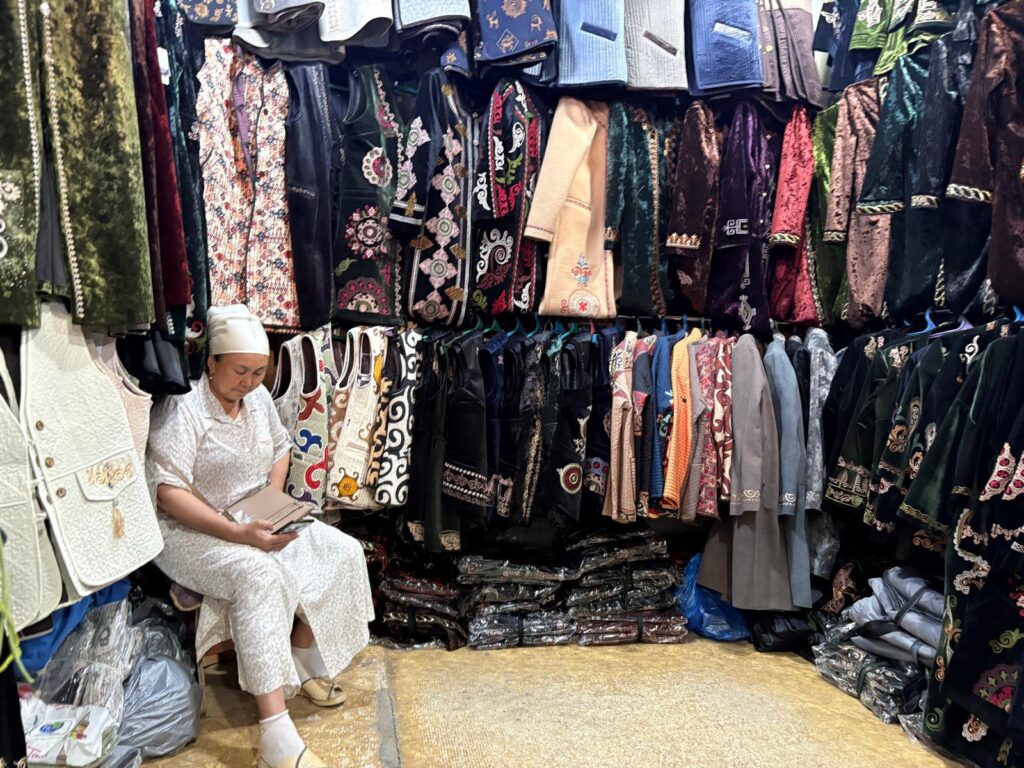
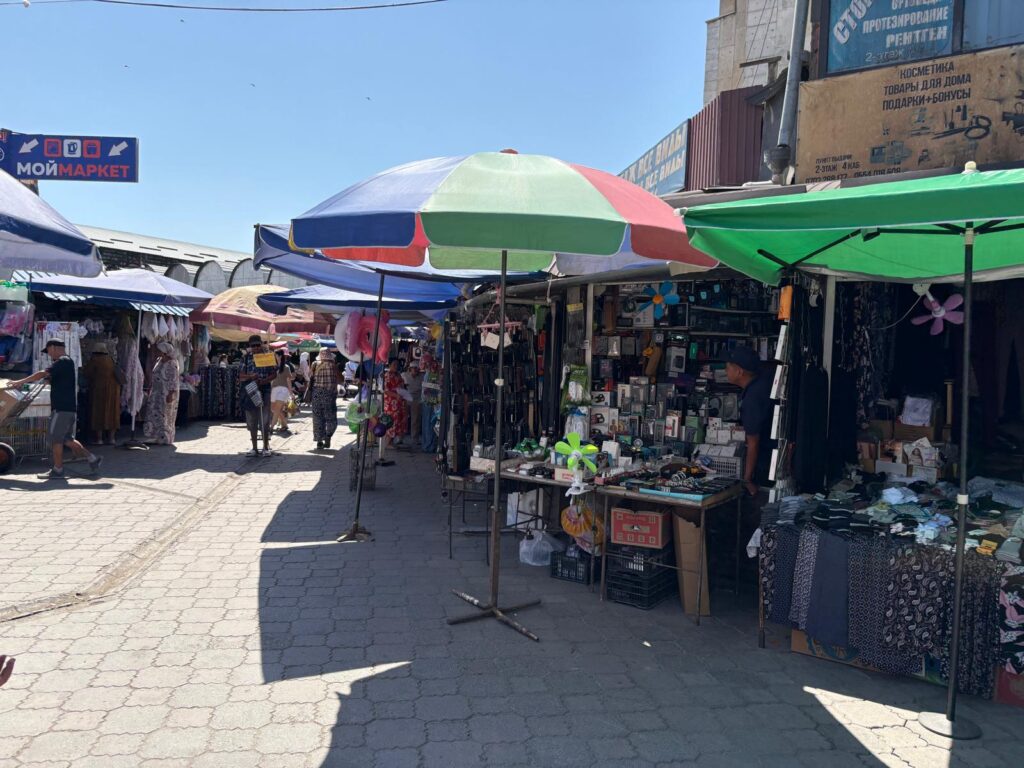
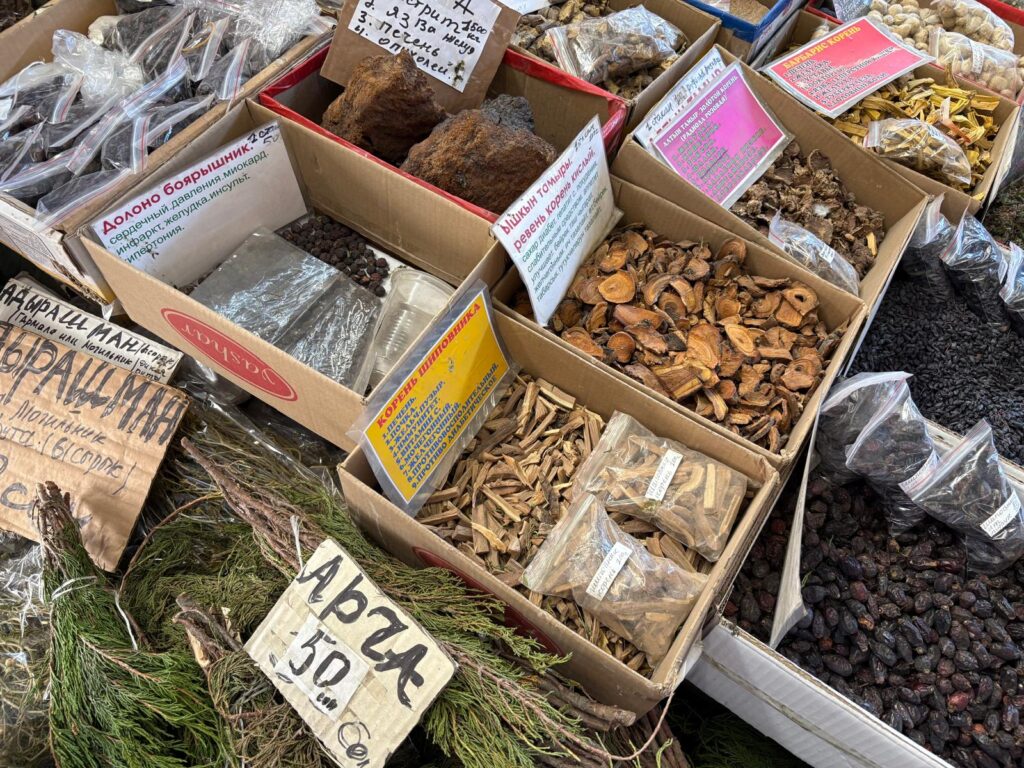
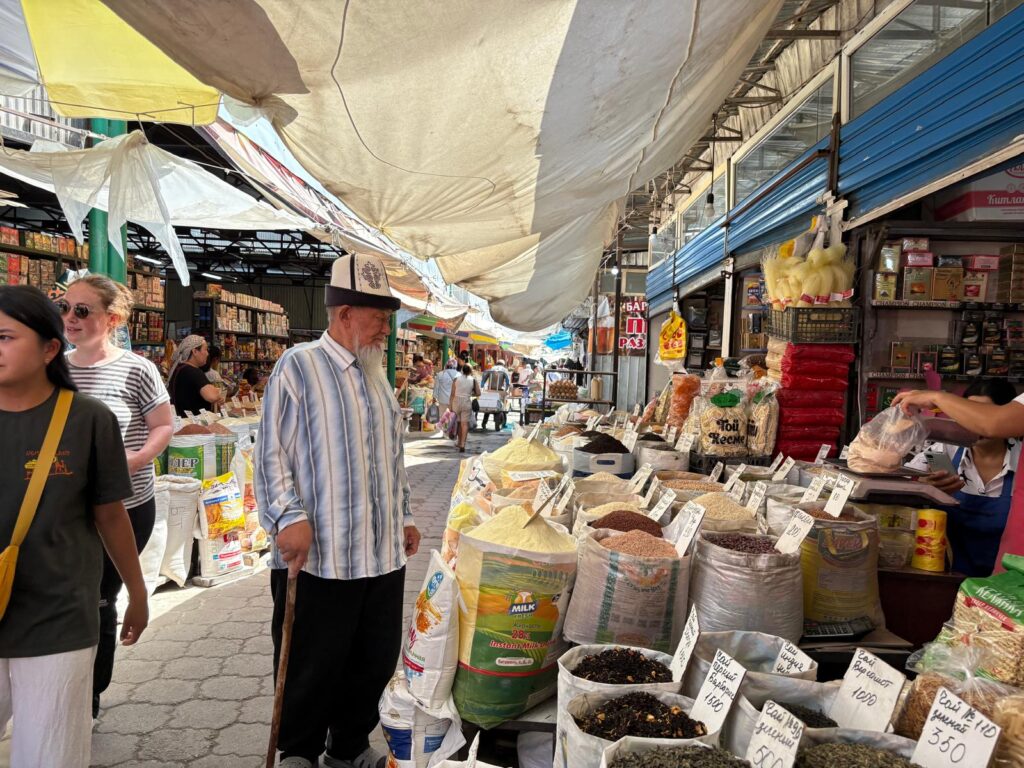
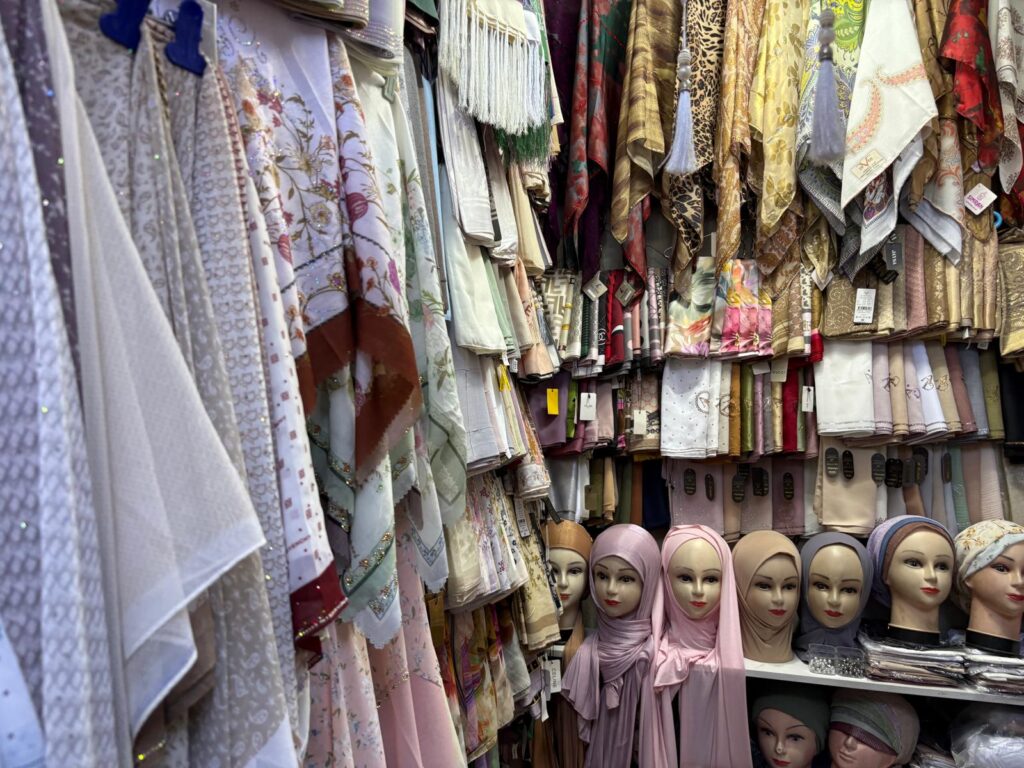
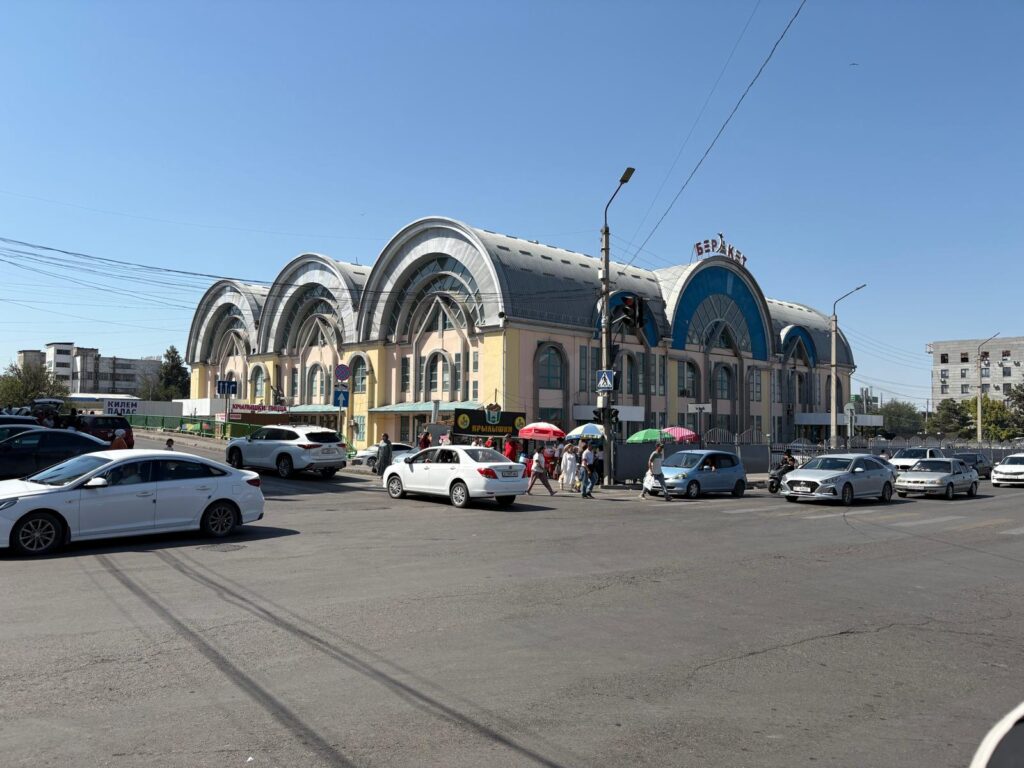
Whatever else your itinerary in Bishkek includes, Osh Bazaar is likely to be on the list. It’s a large market in the West of the city, and is a tourist attraction for a couple of reasons. Firstly, it’s fascinating to explore and see what’s for sale. While you’re there you can stock up on a few souvenirs and typical items of Kyrgyz national dress. And you can also try some national dishes (there’s a section at the end of this post on food and drink).
Like Bishkek itself, it’s hard to pin down a date for the founding of Osh Bazaar. Some blog posts will tell you it’s been a Silk Road meeting point for centuries. Wikipedia says it dates to 1983, and opened at the same time as various markets in other Kyrgyz cities. The truth is probably somewhere in the middle: I doubt there was a notable market here before there was a settlement, but the people of Pishpek/Frunze/Bishkek have always needed to buy food and other goods from somewhere.
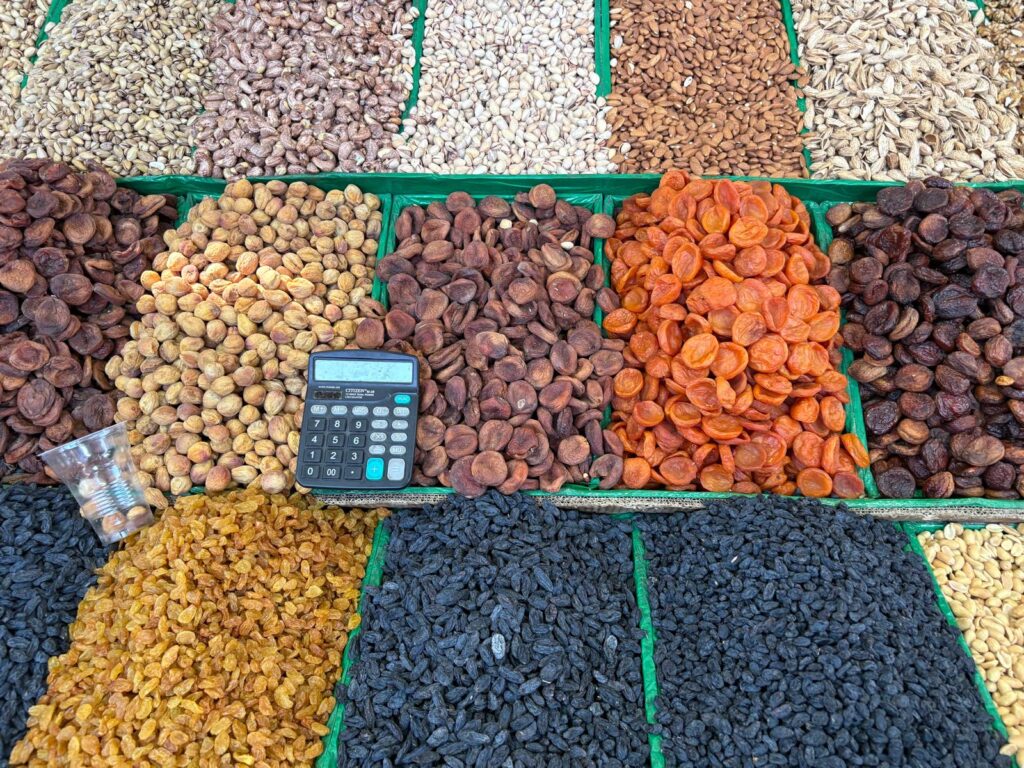
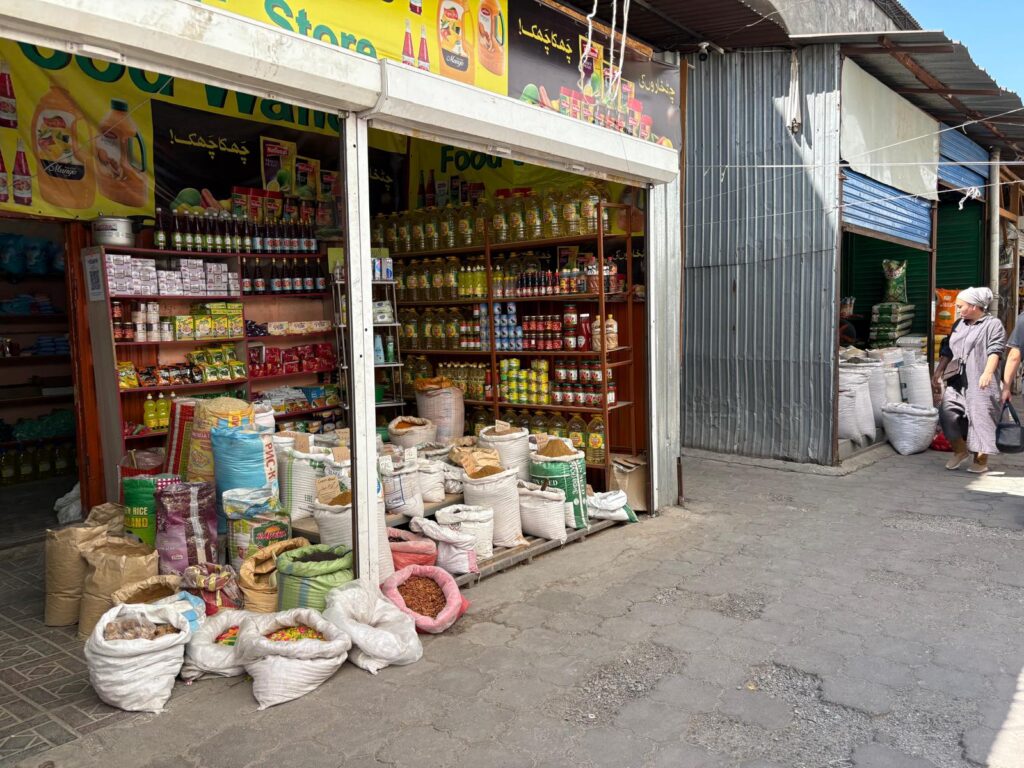
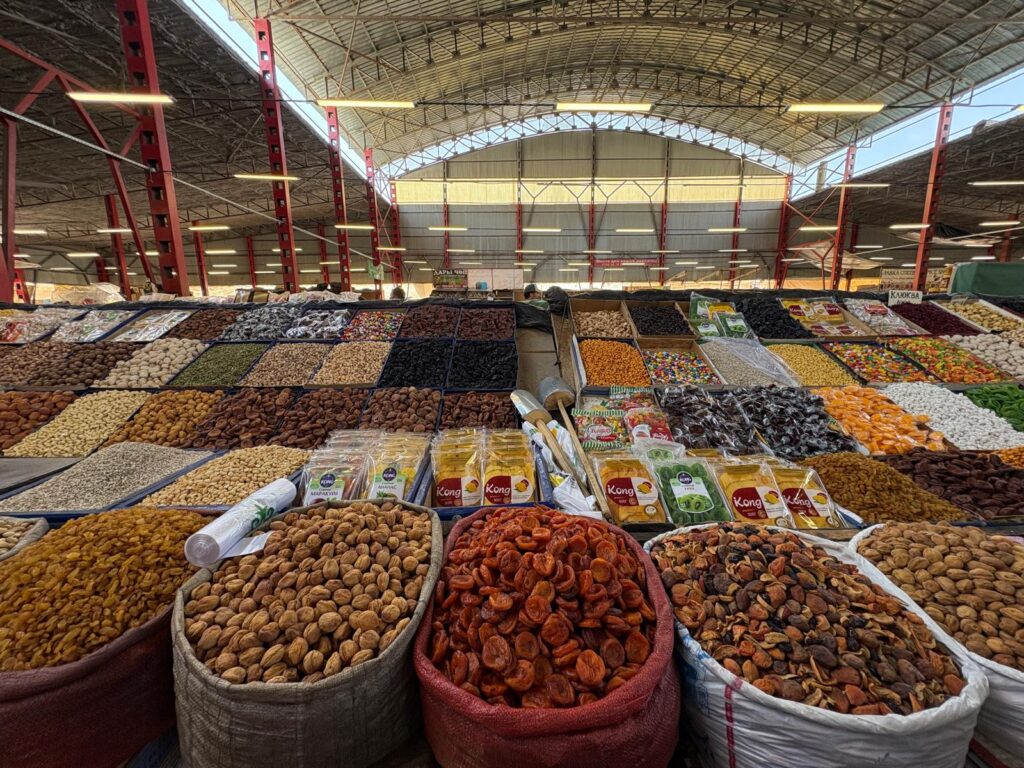
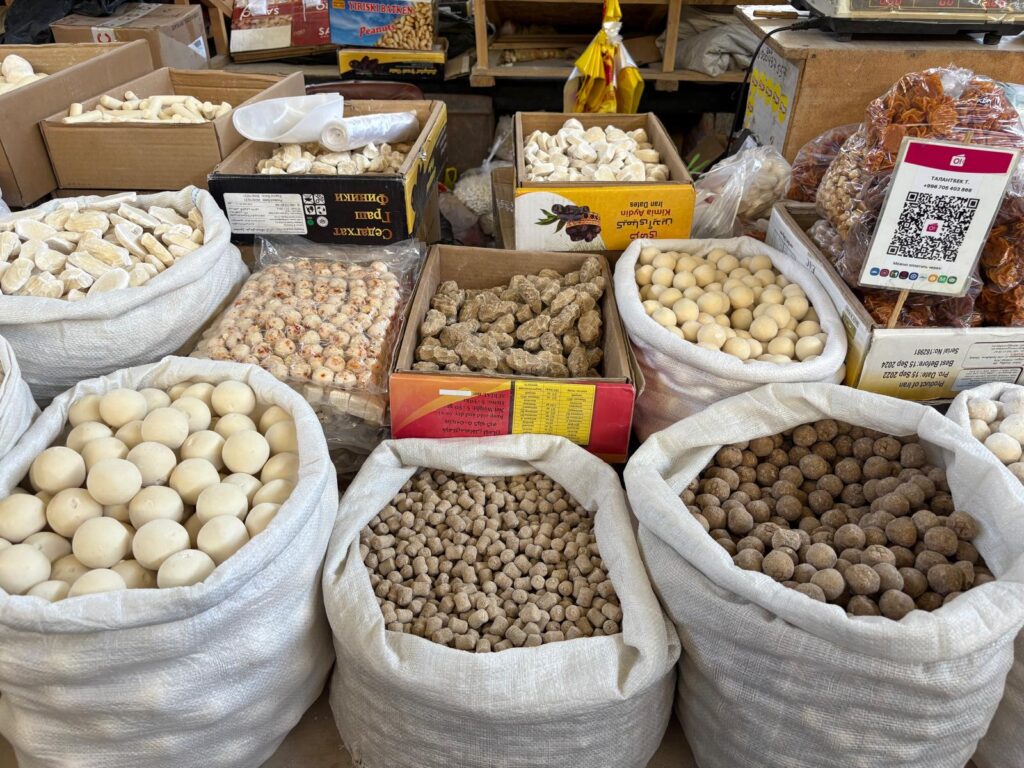
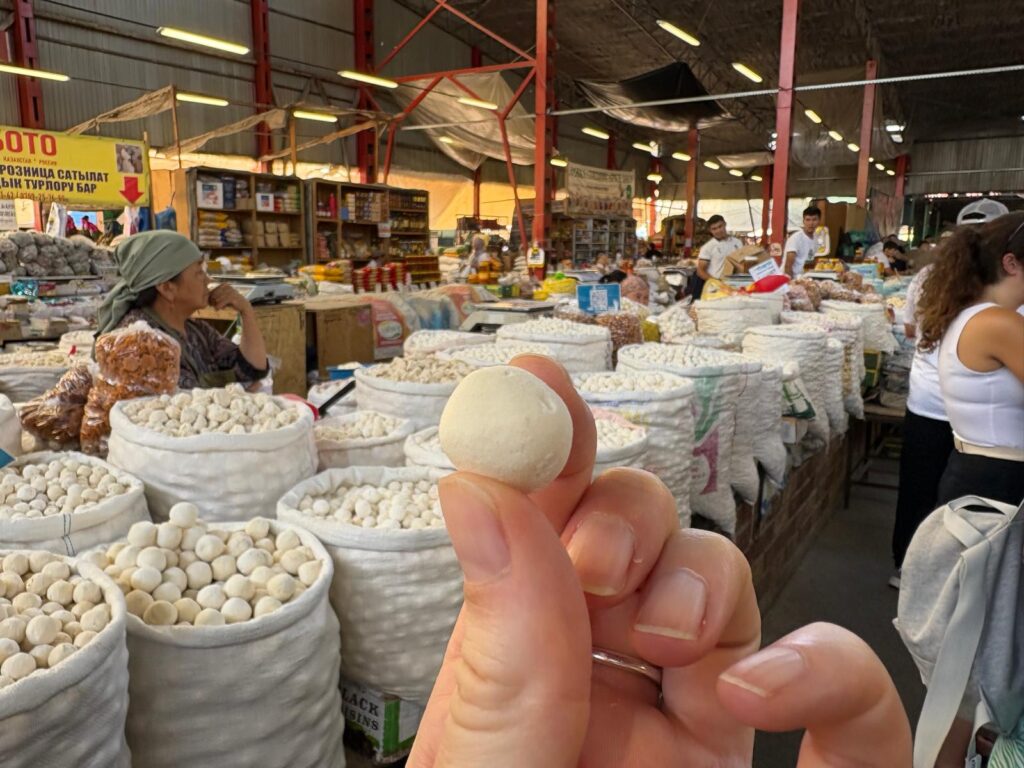
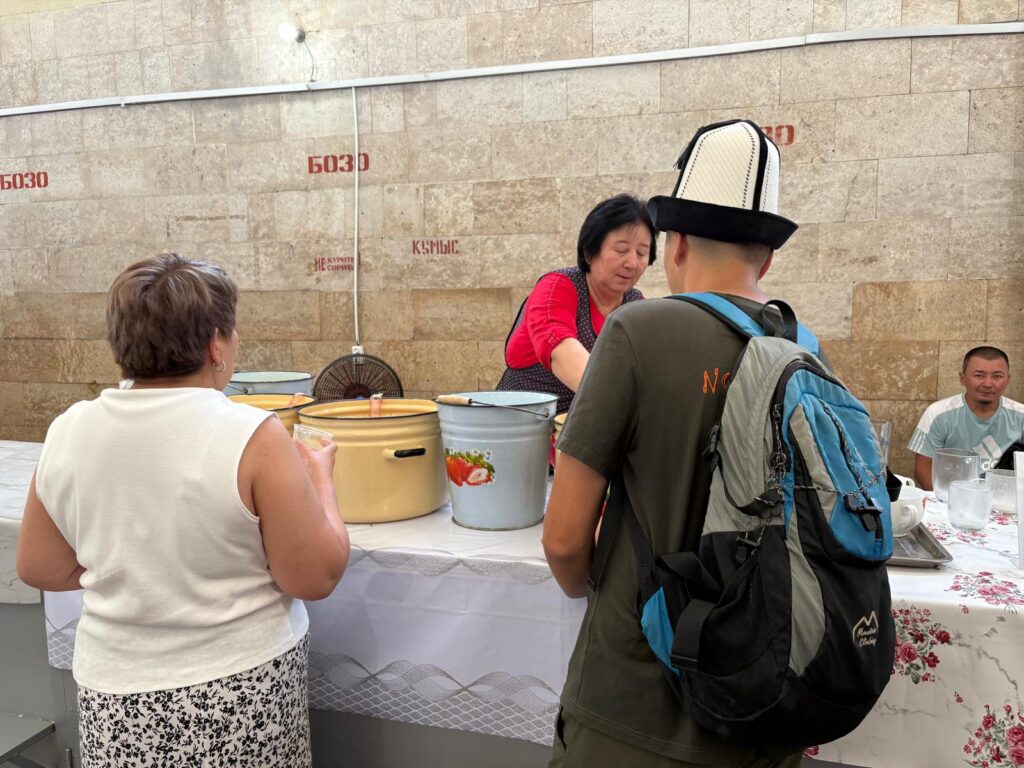
I think the best way to approach Osh Bazaar is just to pick a starting point, wander, and get lost. The area around the main entrance has electronics and other goods of medium interest. But it’s not long before you come across cavernous hangars filled with dried fruits and nuts, dried yoghurt balls, and other local treats. Vendors may let you sample before you buy. If you’re hiking, this is a great place to stock up on healthy snacks. Further on, there are separate spaces for meat, dairy, household goods, clothing, school supplies: basically anything you can think of! The dairy section is where you can try kumis (fermented horse milk). It is most definitely an acquired taste, so it’s not a bad idea to get a group together and share a mug rather than have one to yourself.
Like markets I’ve visited elsewhere (this one comes to mind), Osh Bazaar is a great place to start to get a feel for Bishkek. The rhythms of daily life, how people dress, the sounds of the Kyrgyz language. Whether or not you bring a little piece of Osh Bazaar home, the memories will surely stay with you.
Museums
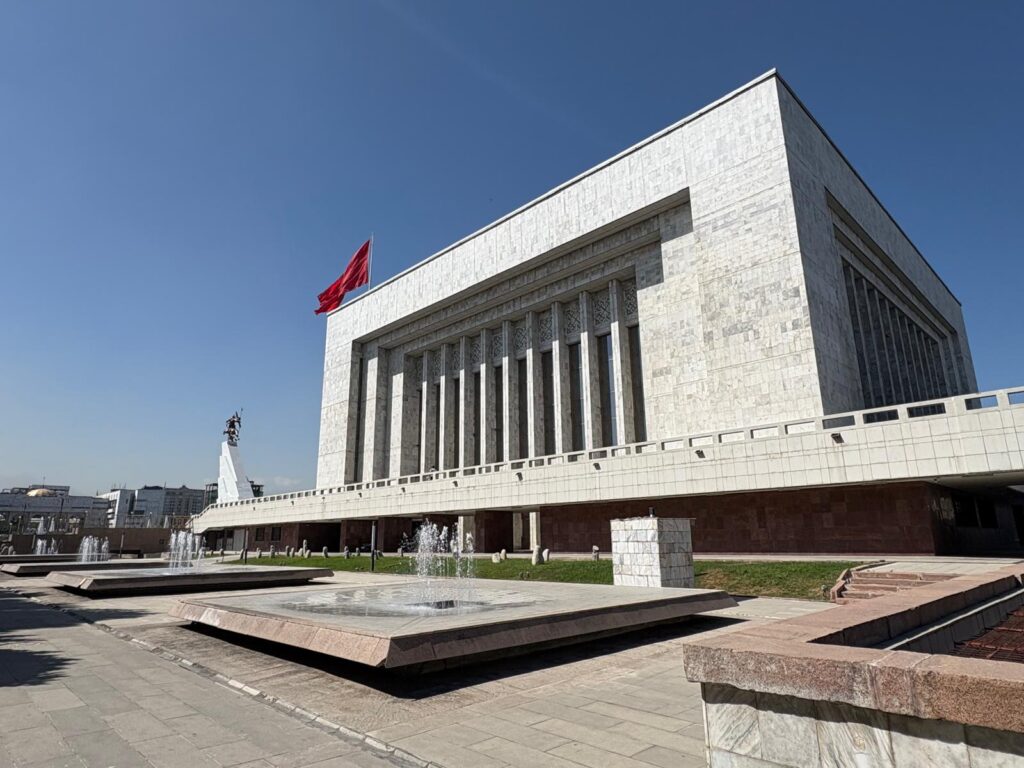
Like any good capital city, there are a number of museums to check out in Bishkek. What you want to see will depend on your interests. And there is a clear dividing line between museums that retain a memory of the USSR, and those which are now modern and looking to the future. I had a great time visiting three of the former and one of the latter. Like a lot of European cities, most museums in Bishkek are closed on Mondays, although there are one or two which are open. All, or at least all on this list, are within walking distance of Ala-Too Square.
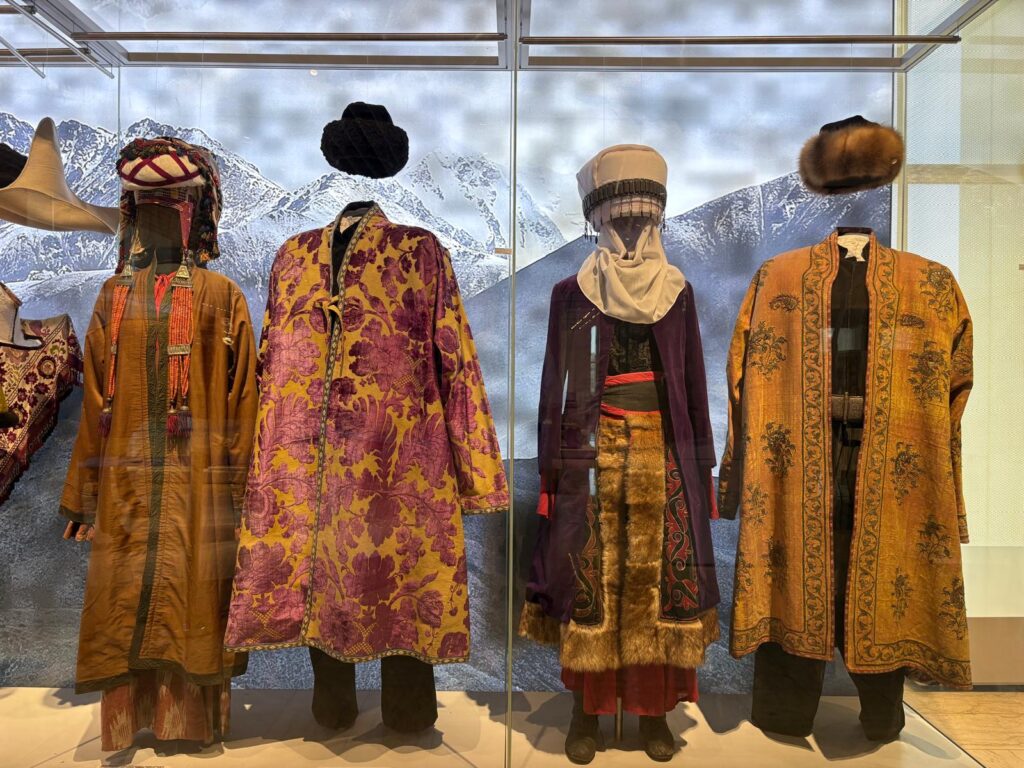
- National History Museum of the Kyrgyz Republic. If you visit one museum in Bishkek, it should be this one. Extensively renovated in recent years, it now has a contemporary interior, and tells the story of Kyrgyzstan from earliest settlement to the present day. The textiles and other traditional crafts are particularly impressive. Mandatory bag check and no large cameras, but phones are OK.
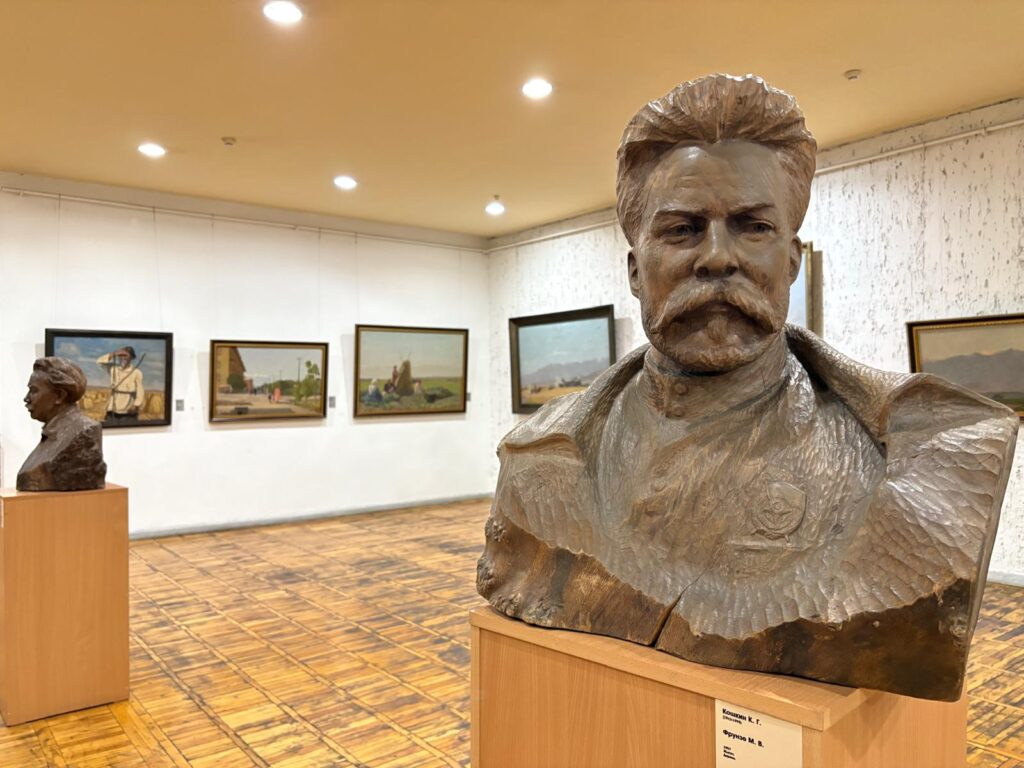
- Kyrgyz National Museum of Fine Arts Gapara Aitieva. The national art museum was basically next to my hotel (Hotel Navat, in case you’re interested: recommended), which was perfect. This is the first of the time capsule options: mid century design and plenty of Soviet Realist art. I really enjoyed my visit.
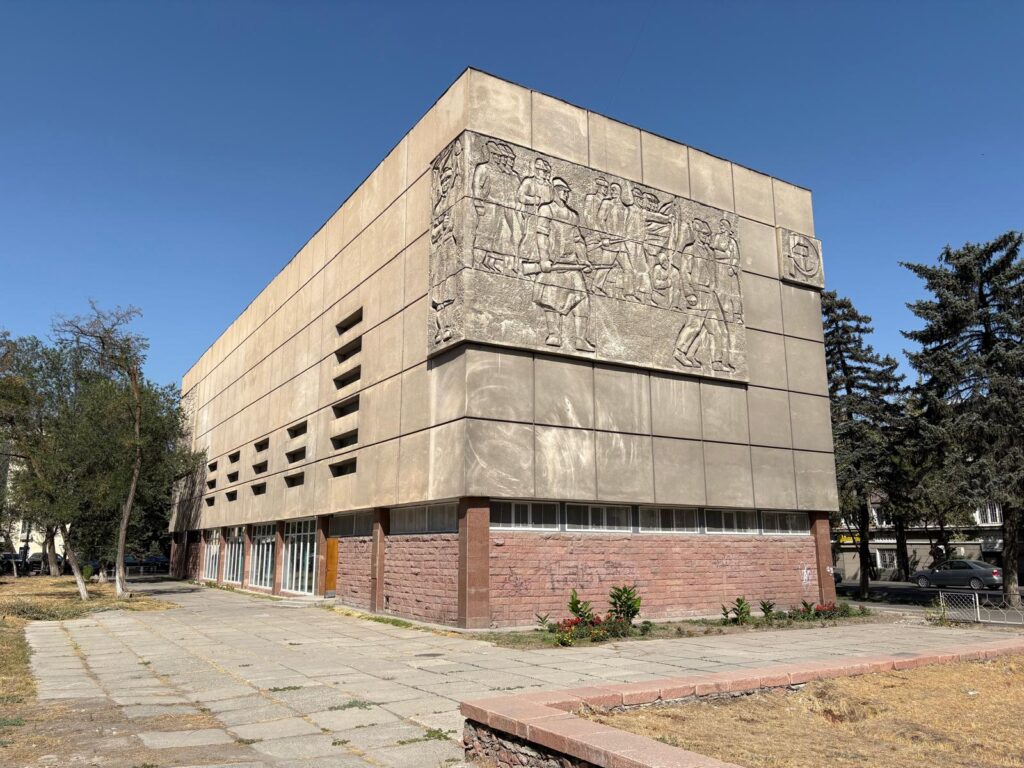
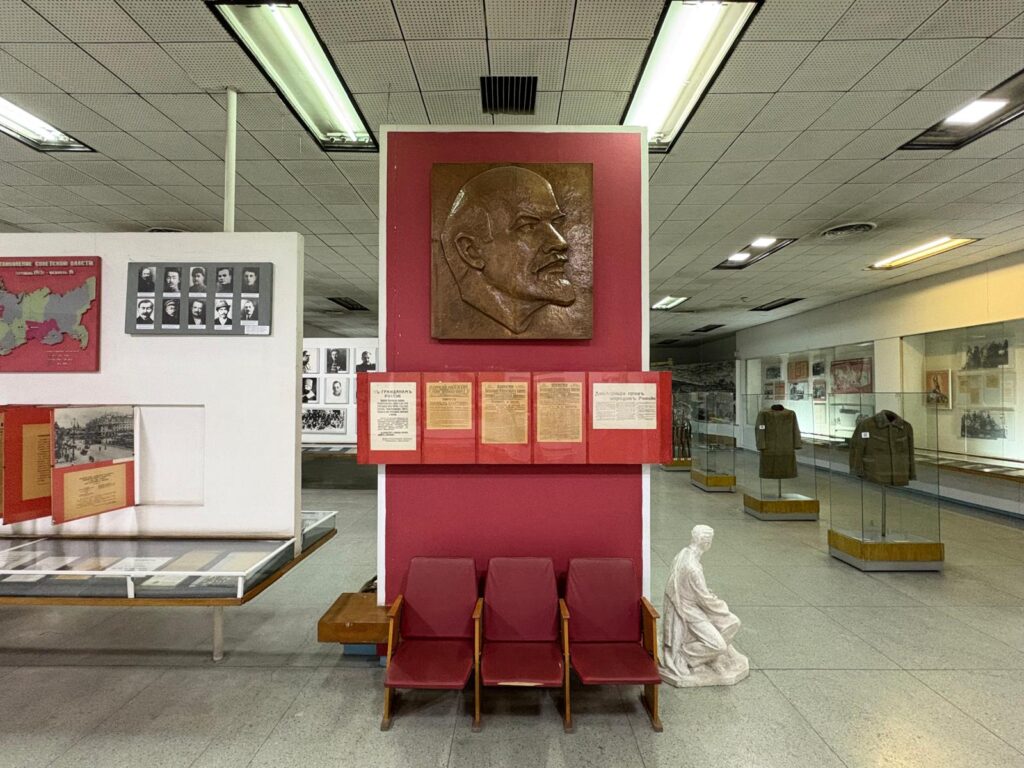
- M. V. Frunze House Museum. I had a great time here, this is a good pick to get a sense of what the city of Frunze was all about. The museum tells the story of Mikhail Frunze and his heroics, and on the ground floor is, supposedly, the house he was born in. Nobody seems to believe it’s the literal house, it’s more of a focal point for hero worship. Again it’s in a great mid-century building, has displays that surely haven’t changed much since the USSR days, friendly staff despite a language barrier: a good time was had by the Salterton Arts Review.
- Toktogul Literary Museum. Not one I visited, partly because my guidebook said the information would be in Kyrgyz only. Covers the development of Kyrgyz literary life, which they take seriously, from the Epic of Manas to Chinghiz Aitmatov.
- Aaly Tokombaev Memorial Museum. Continuing the literary theme, this is a house museum dedicated to a poet and composer who helped to standardise written Kyrgyz, and translated many works into that language. Also contains an exhibition on the 1916 exodus of Kyrgyz people to China following Russian repression. Open on Mondays.
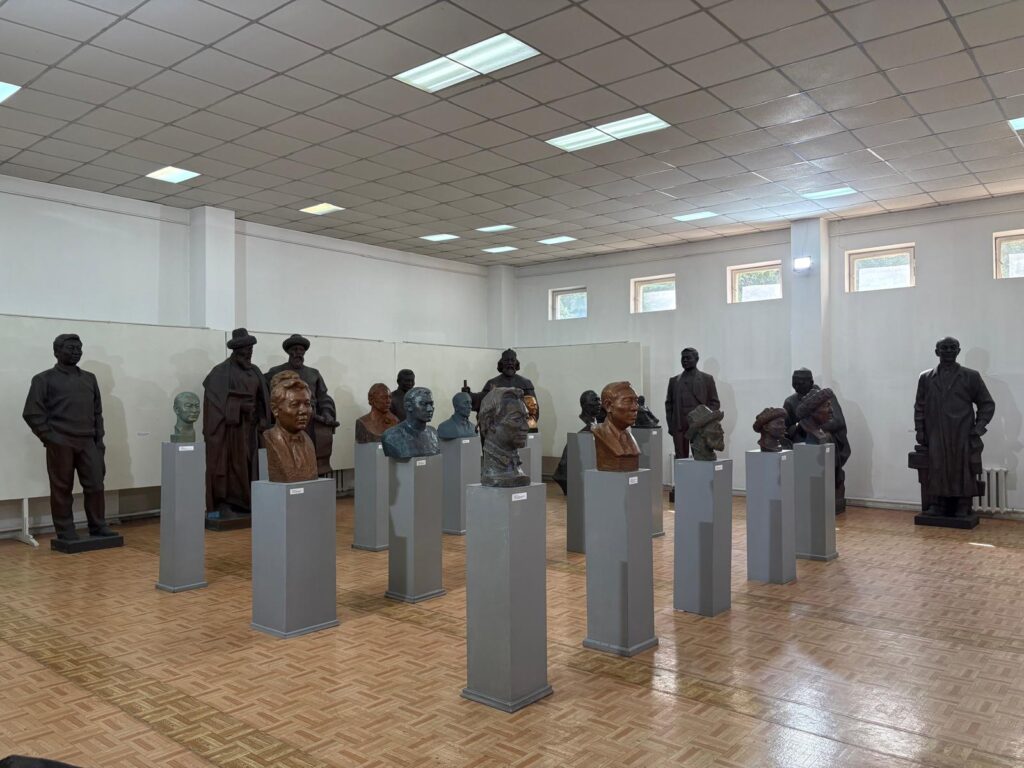
- Museum of the National Academy of Arts. T. Sadykova. Also open on Mondays, which was one of my reasons for visiting. Another reason was how much I enjoyed learning about a national sculptor when I was in Iceland. Tinibek Sadykov has long been an important sculptor in Kyrgyzstan, contributing to many monuments you will see around the city. This museum houses examples of his work, as well as being the home of the National Academy of the Arts. Now in his 90s, Sadykov still maintains an office here. A very unique experience.
- Open Air Sculpture Museum. See below in the Parks section.
Parks
As I’ve said above, Bishkek has a lot of green spaces. If the weather permits, the city’s parks are a great place to see how locals enjoy their city, encounter some art, and even have a go on some fairground rides.
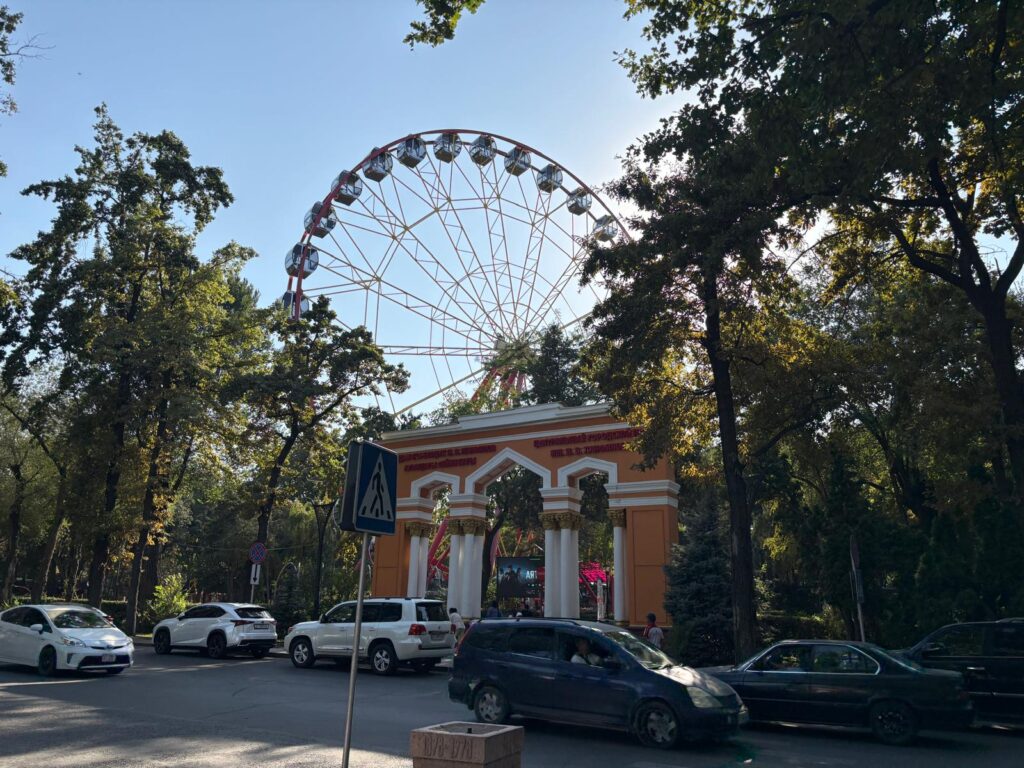
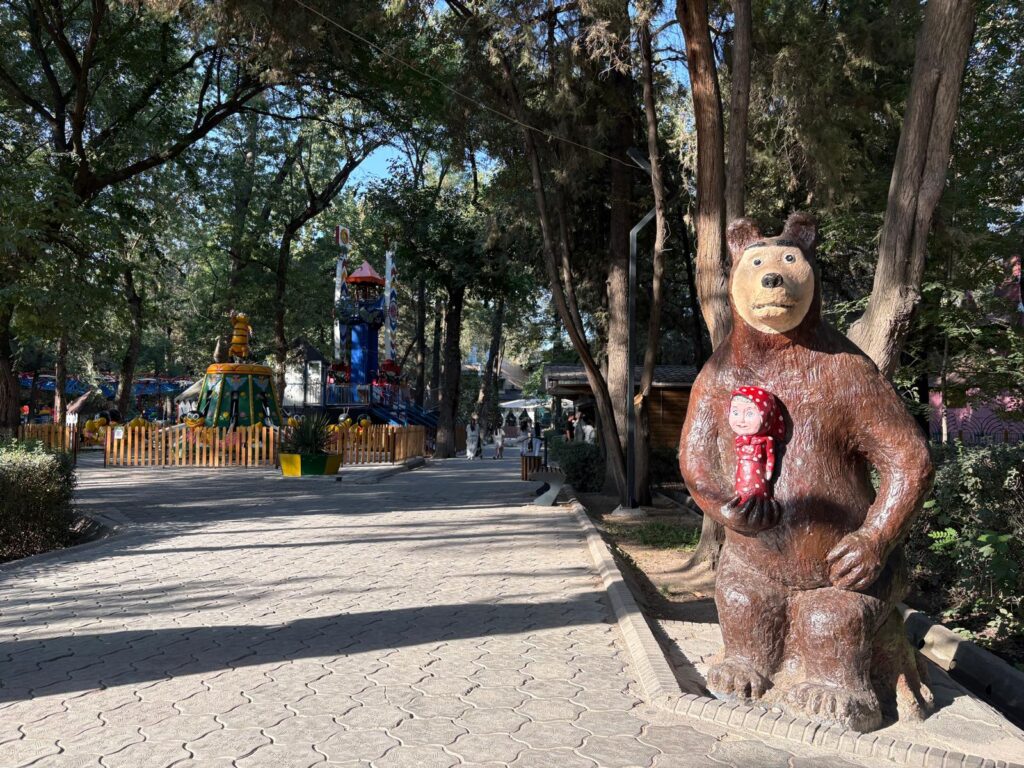
- Panfilov Park. This was one of the last places I visited during my time in Bishkek, but is the first on my list of park suggestions. Panfilov Park, with a star-shaped layout, is full of fairground attractions, food and drink stalls, and families enjoying these facilities. It has a nice local vibe, and the views from the Ferris wheel are excellent. I enjoyed a good wander around in the early evening.
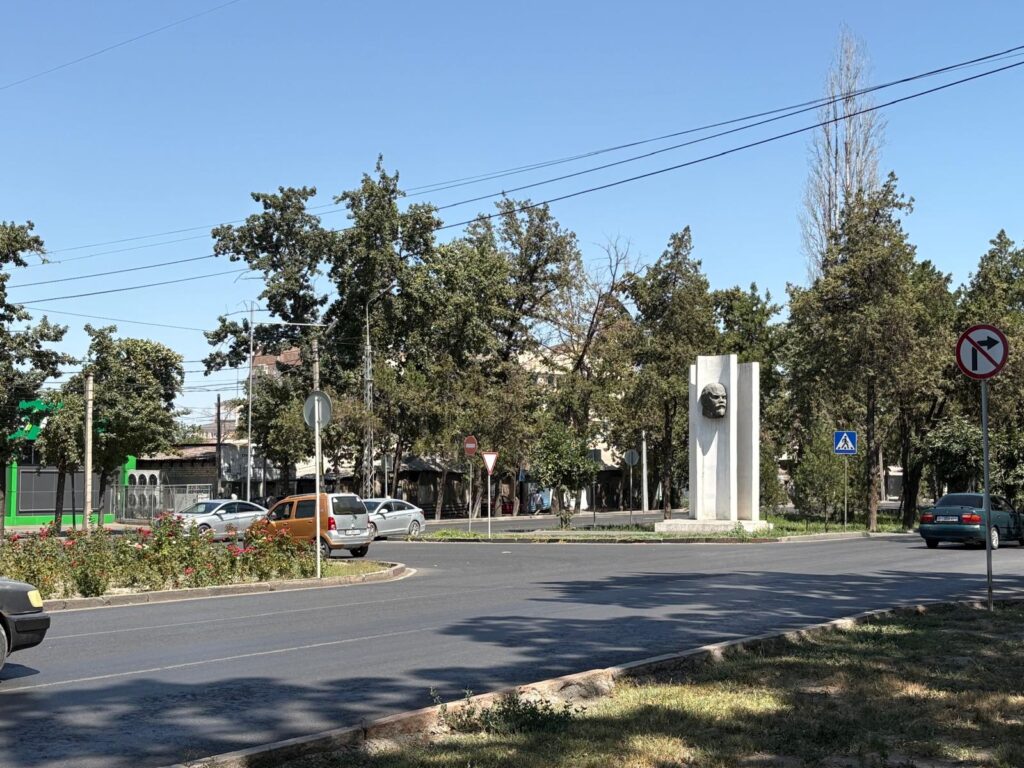
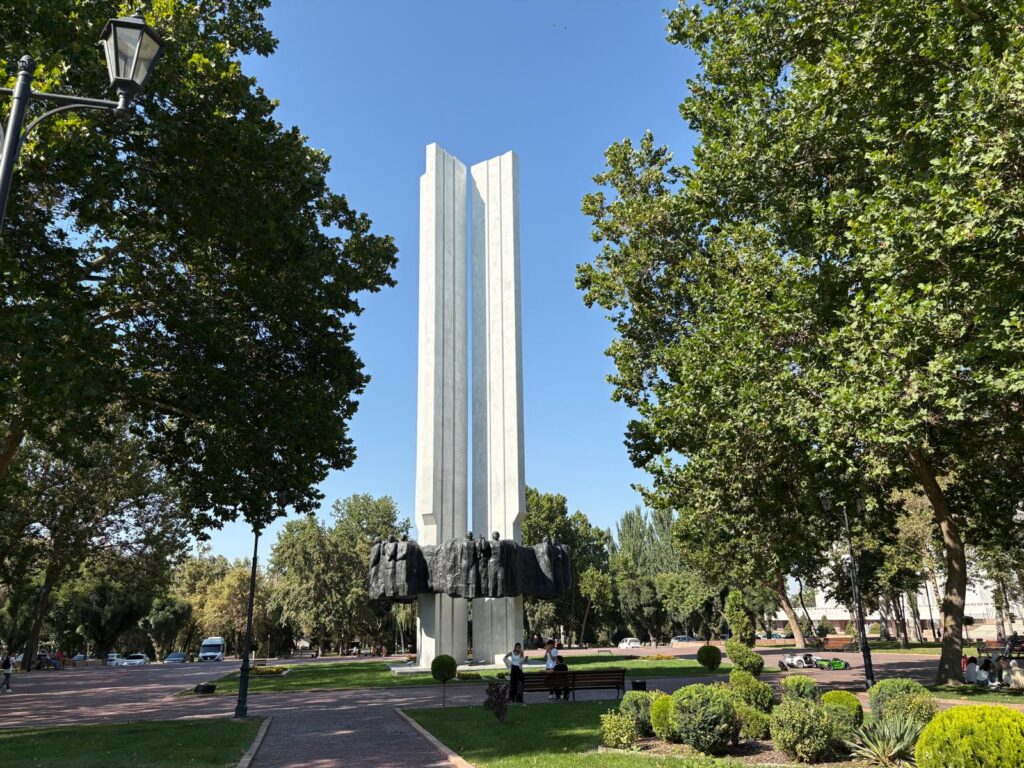
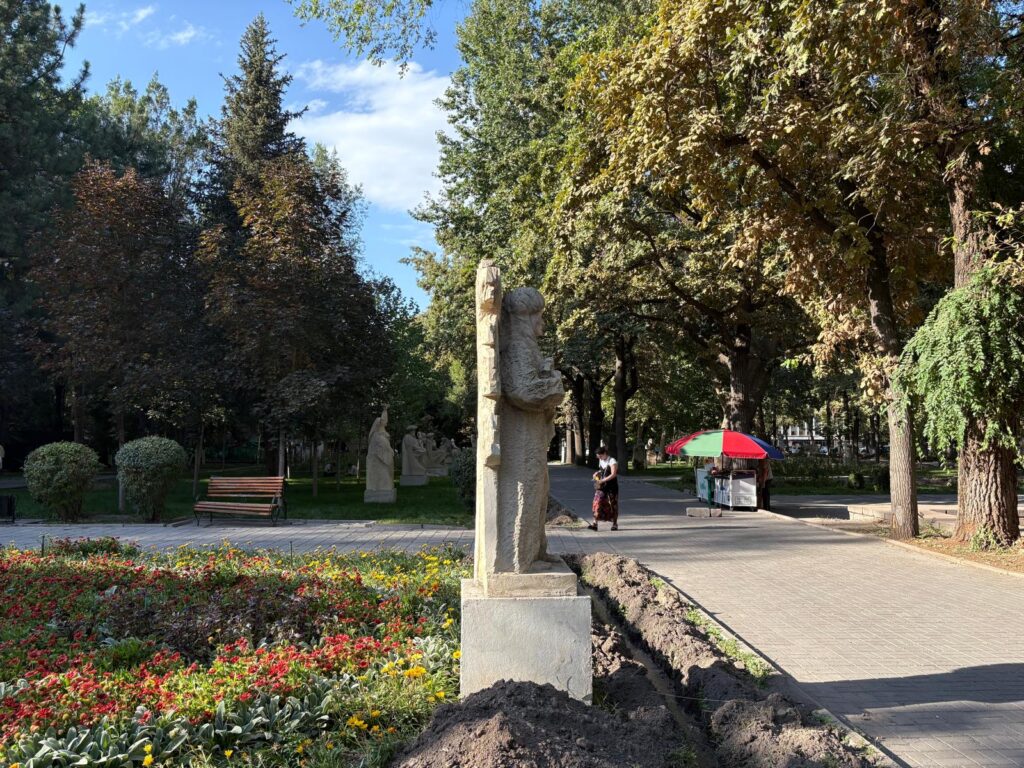
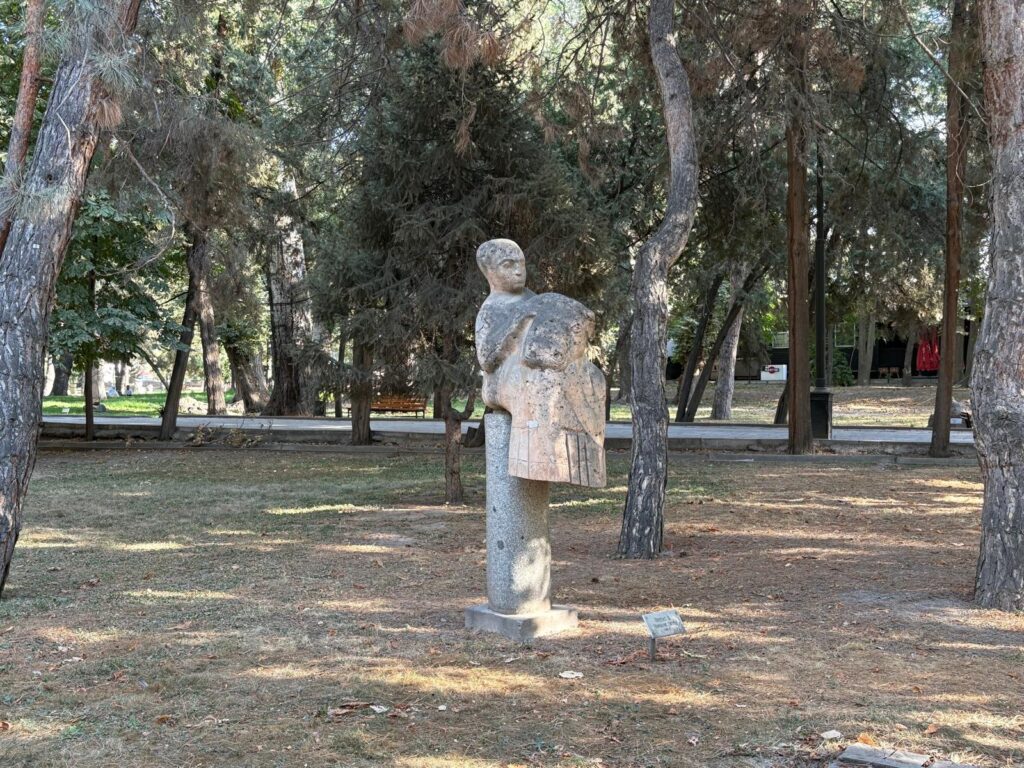
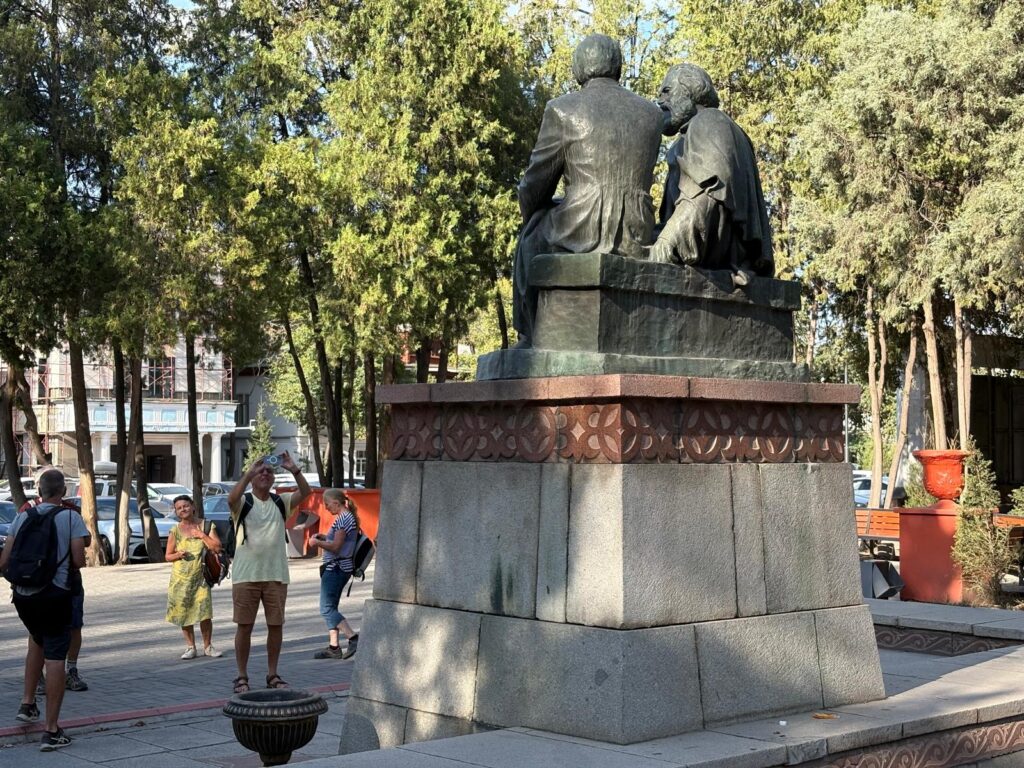
- Dubovy Park. A nice, centrally located park which is popular with locals. I even saw a TV drama being filmed here. There are shaded paths and bright flowers, as well as the Open Air Sculpture Museum. This is just part of the park and freely open to the public, with a number of sculptures commemorating the 60th anniversary of the Kyrgyz ASSR on the theme of “peace and labour”. It was nice even while undergoing renovations when I visited. Look out as well for the statue of Marx and Engels in conversation: Kyrgyzstan is apparently unusual in Central Asia for retaining some Soviet-era sculptures (there are a few of Lenin around the city, too) as an acknowledged part of its history.
- Fuchika Park. Closer to Osh Bazaar than the city centre, those Czechoslovakian socialist volunteers we talked about earlier built this park in 1936. It’s named for the Czechoslovakian leader at that time.
- Ata Turk Park (or Atatürk Park). As a Turkic people, Kyrgyzstan retains ties to Türkiye. This park is of course named for the founder of the modern country. It’s even further again from the central city, but apparently has collectables markets, another Ferris wheel, and a few memorial sculptures.
- Botanical Gardens. To the West of the railway station, and managed by the Academy of Sciences.
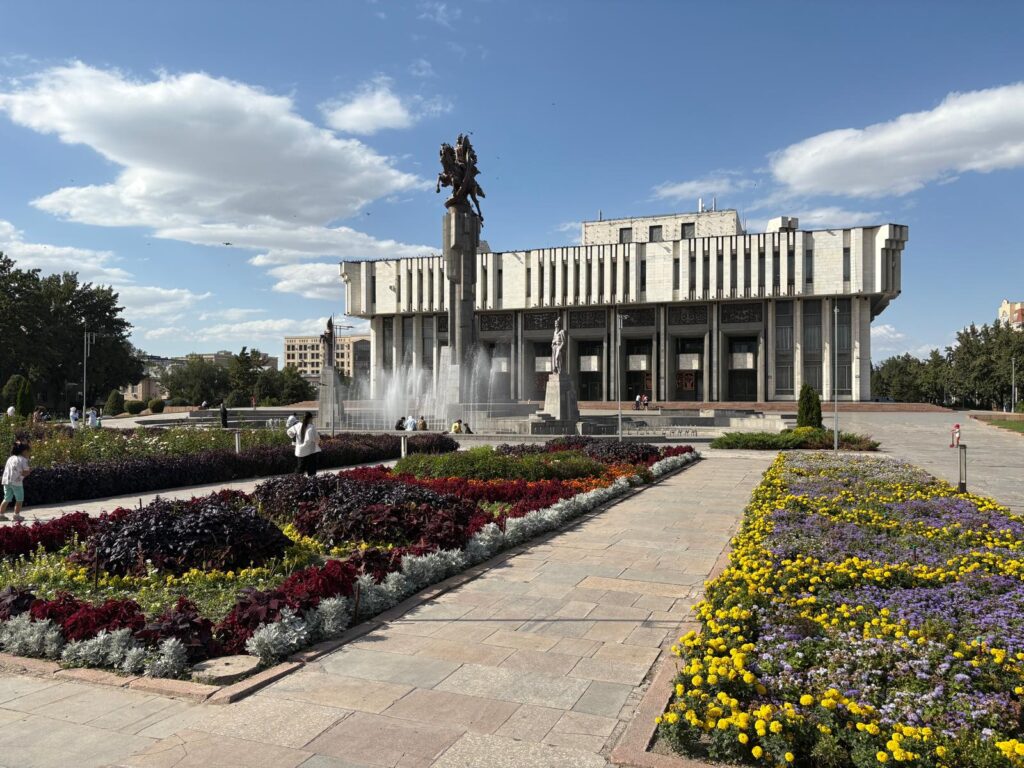
- Smaller Green Spaces. Bishkek has a number of nice squares where you can sit and watch the world go by. I particularly liked the one at the Toktogul Satylganov Philharmonic Hall.
Places of Worship
The majority of Kyrgyzstan’s population is Muslim, following a pattern of belief which is fairly relaxed, and fused with some pre-Islamic shamanistic practices. Sunni is the predominant sect. There are differences between different populations within Kyrgyzstan, however, and this is reflected in the practices and places of worship in Bishkek. While the Uzbek population is larger in the South of the country, for instance, there is an Uzbek contingent within the capital who tend to dress more in accordance with conservative Muslim practices. While the Russian segment of the population is much smaller than it once was, their own beliefs are still reflected in Orthodox churches and cathedrals.
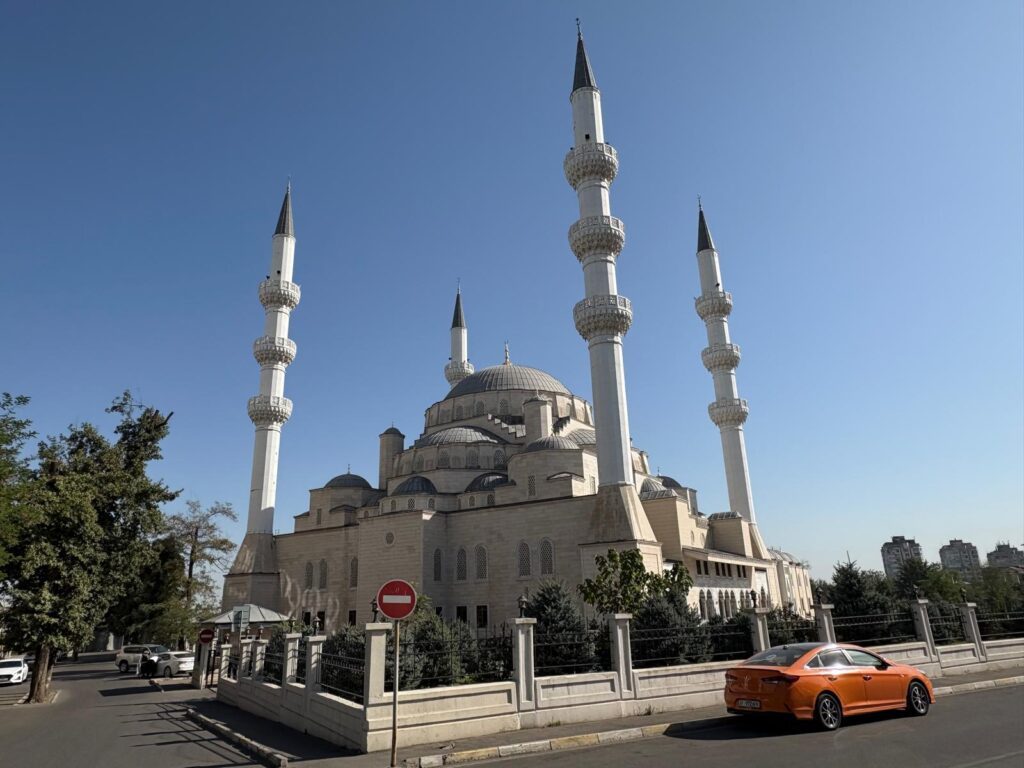
Many places of worship, both Muslim and Christian, are OK with tourists visiting. Men should take off hats, women may be able to borrow one of a selection of headscarves, and women may also need to cover up in a borrowed robe at some mosques. Photos are generally not allowed inside. Someone I met described a visit to the new Central Mosque which made me think they are less keen on non-worshipping visitors, so I contented myself with walking past and admiring it from the outside. It is possible to visit, though, so don’t let me stop you.
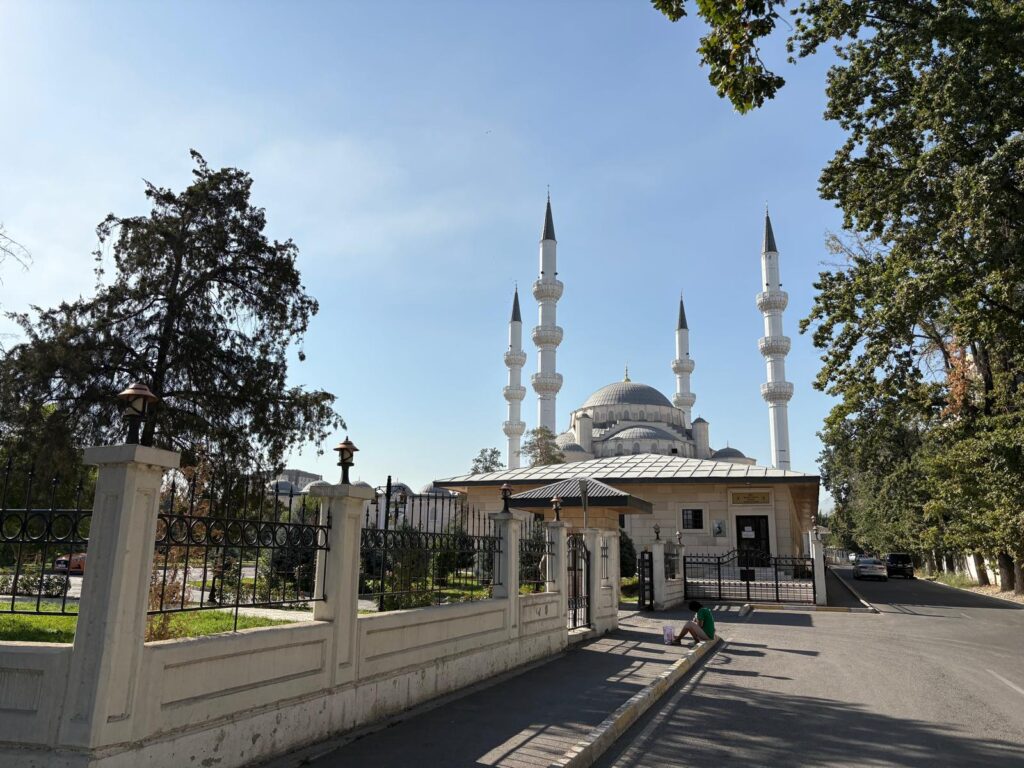
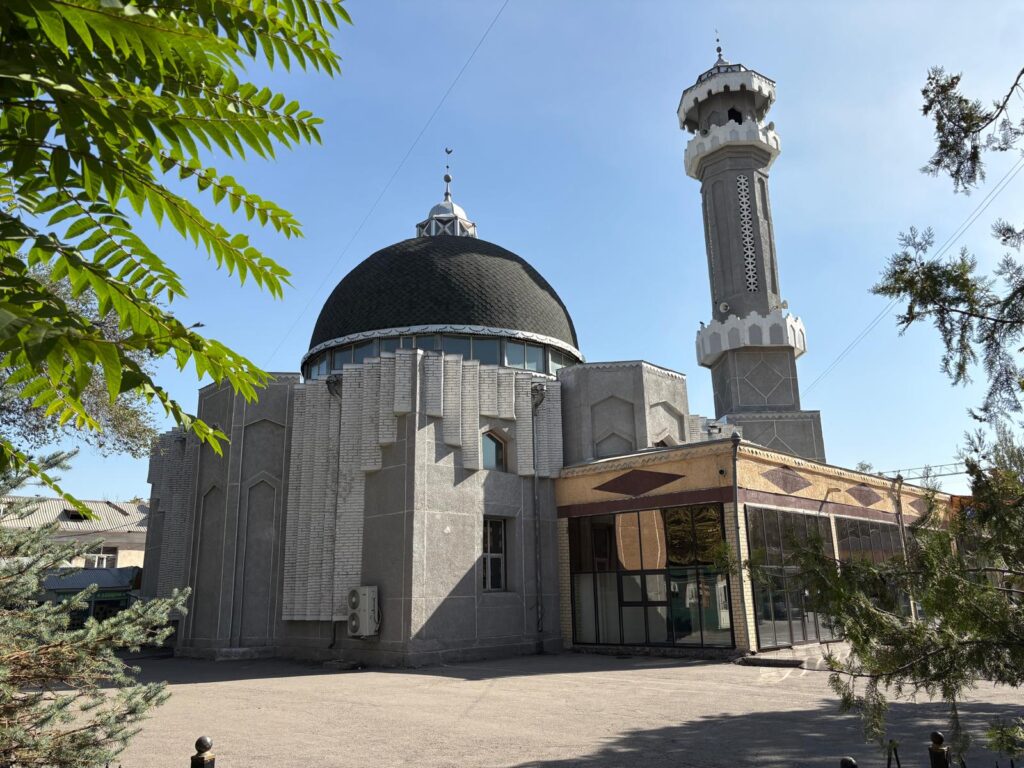
- New Central Mosque (first two images above). If this reminds you of the Hagia Sophia or other Turkish mosques, well spotted. It was funded by the Turkish Diyanet (state institution to manage religious duties) and inaugurated in 2018. It’s named after medieval Islamic scholar Al-Sarakhsi. There’s capacity for 9,000 people in the enclosed space, and 30,000 people overall. The architectural style is Ottoman revival.
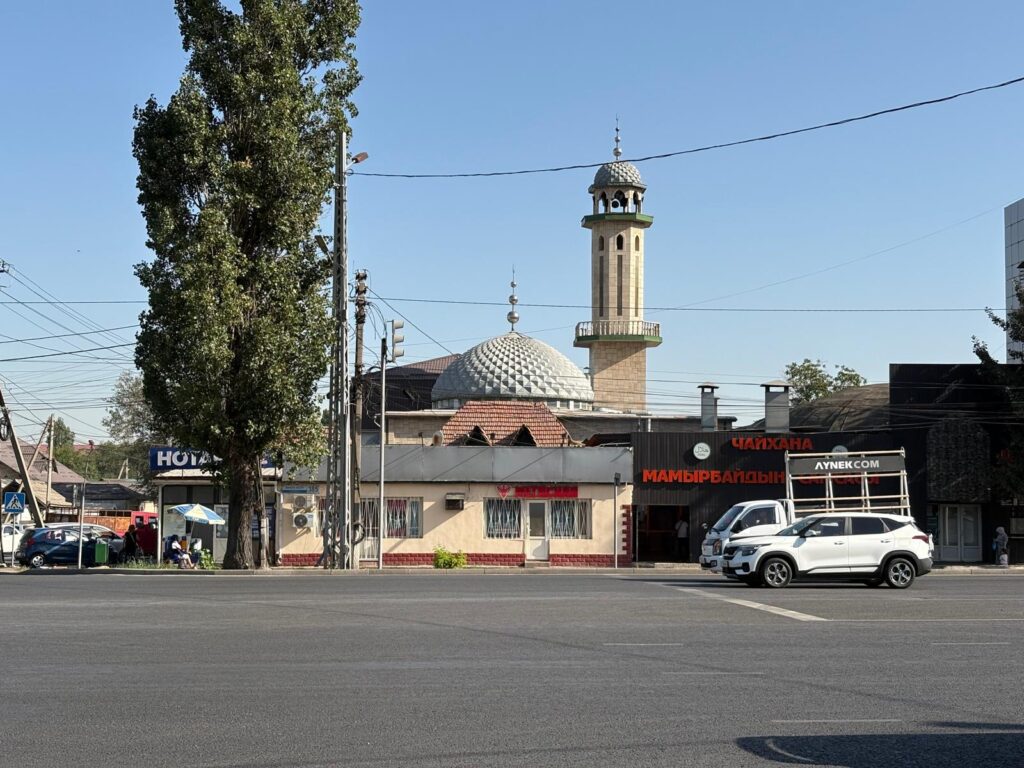
- Old Central Mosque (third image above). Actually on the same street as the new Central Mosque, which makes for an interesting walk. Architecturally I preferred this one as being rather quirky. Parts of this mosque date back to 1886, but it was renovated in the 20th century. I’m not sure whether its use as a mosque was continuous during the Soviet period: Islam was repressed in Kyrgyzstan along with Christianity, especially in the 1930s. Maybe that’s the reason extensive renovation was needed? The capacity is much smaller: 1,600 indoors, and 5-6,000 in total.
- Many other mosques throughout the city (eg. fourth image above). Both in Bishkek and if you have the opportunity to travel within Kyrgyzstan, you will see a lot of small, seemingly modern mosques. I liked their fairly informal style and neighbourhood feel.
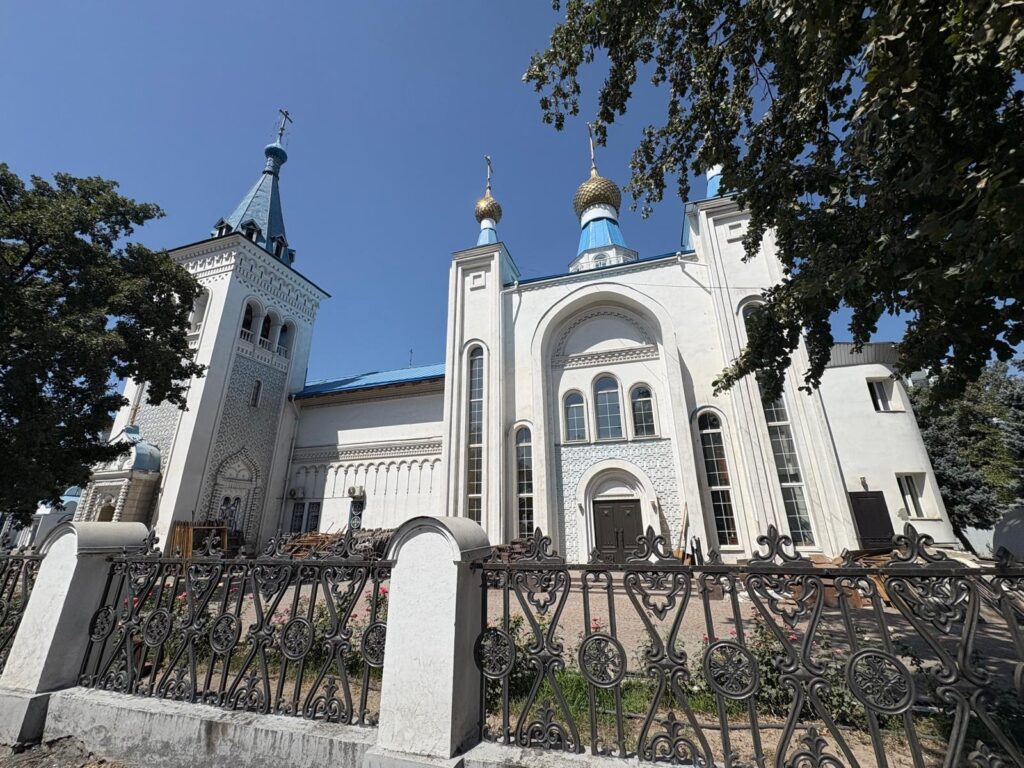
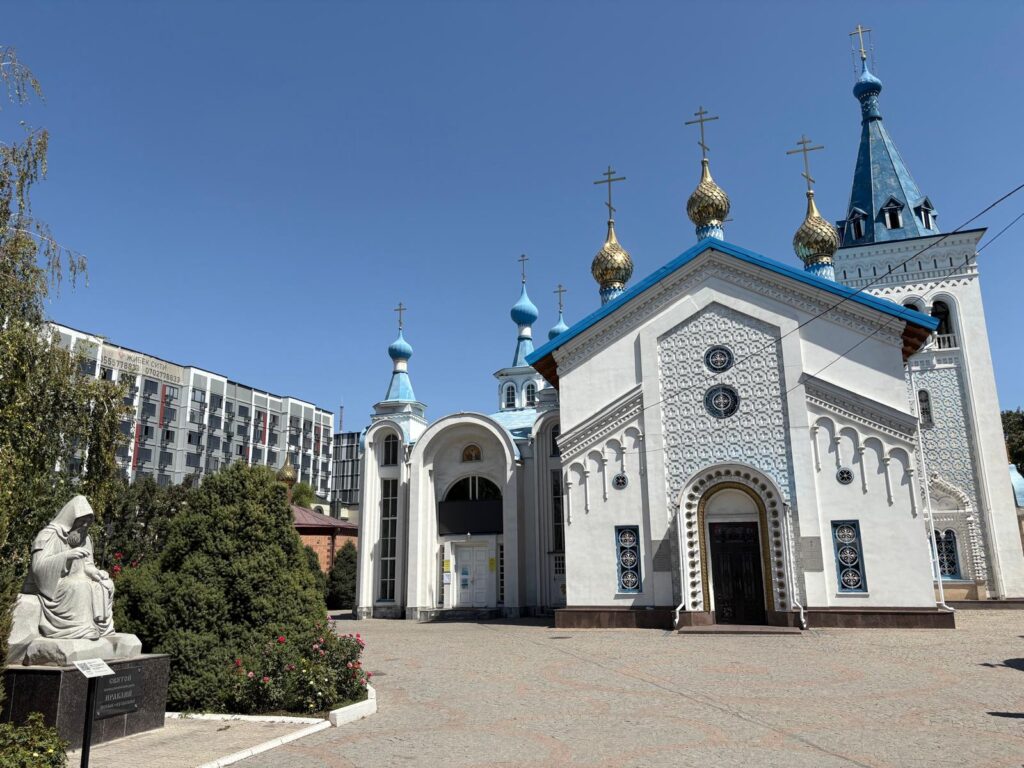
- Russian Orthodox Cathedral (fifth and sixth images above). The cathedral is to the North of the central city, on main avenue Jibek Jolu. It dates to 1947: without finding much online to back me up I’m going to guess that religious repression lightened up in the post-Stalin period, but this one somehow got a head start. The cathedral’s blue domes are cheerful, and the interior peaceful.
Other Points of Interest
As well as the museums and parks I’ve described, plus Osh Bazaar, there are a number of other points of interest you may want to check out during your time in Bishkek.
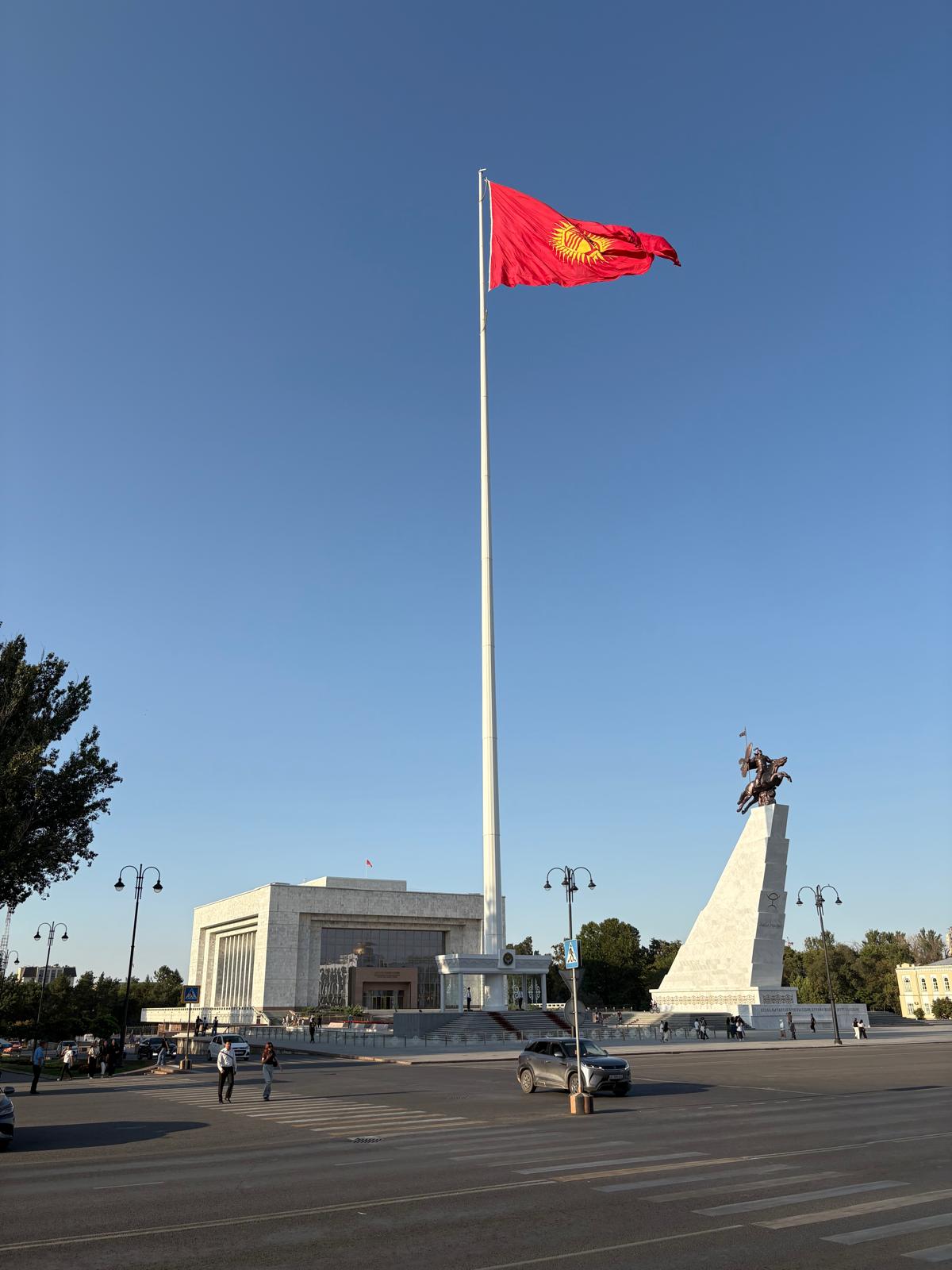
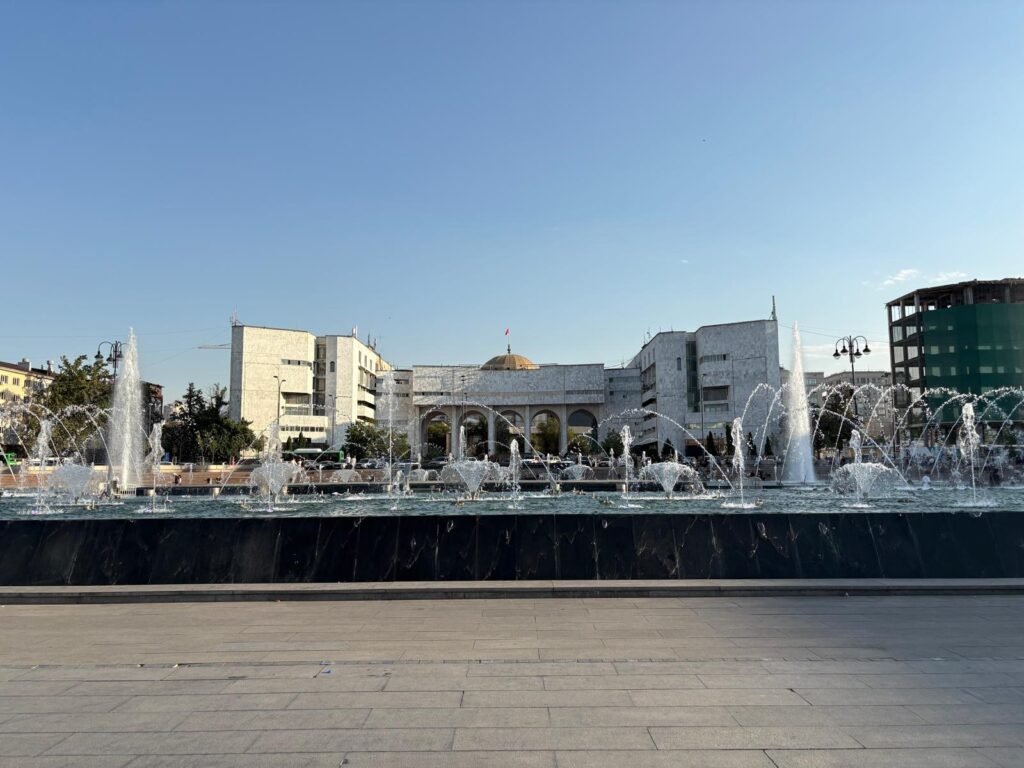
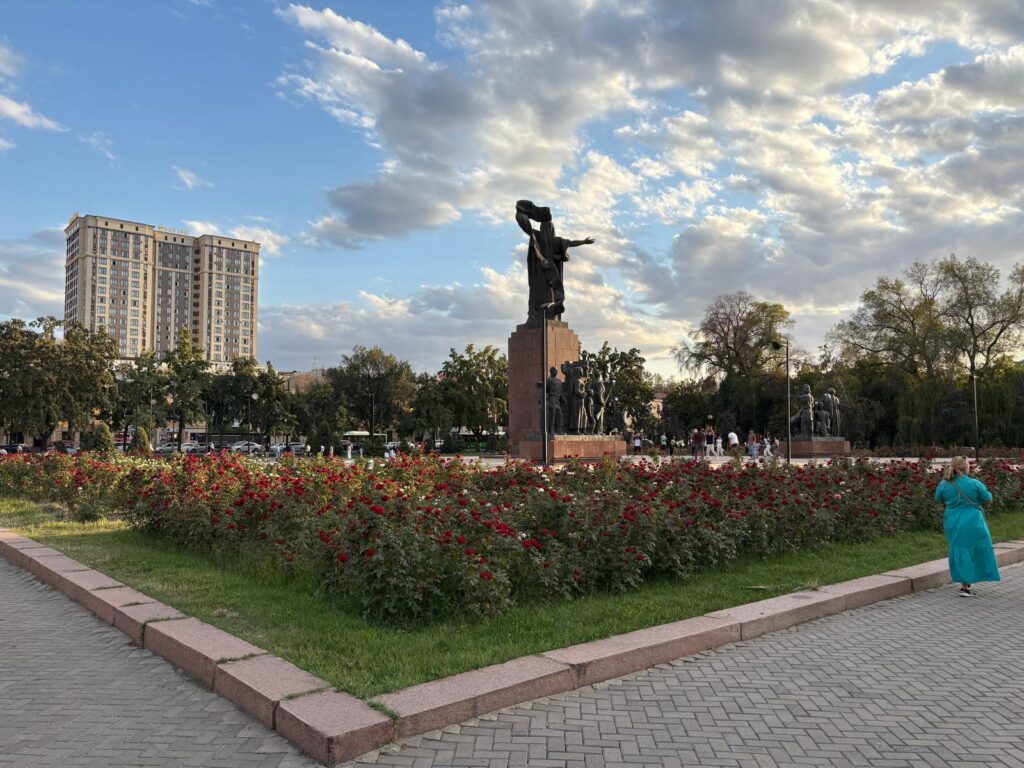
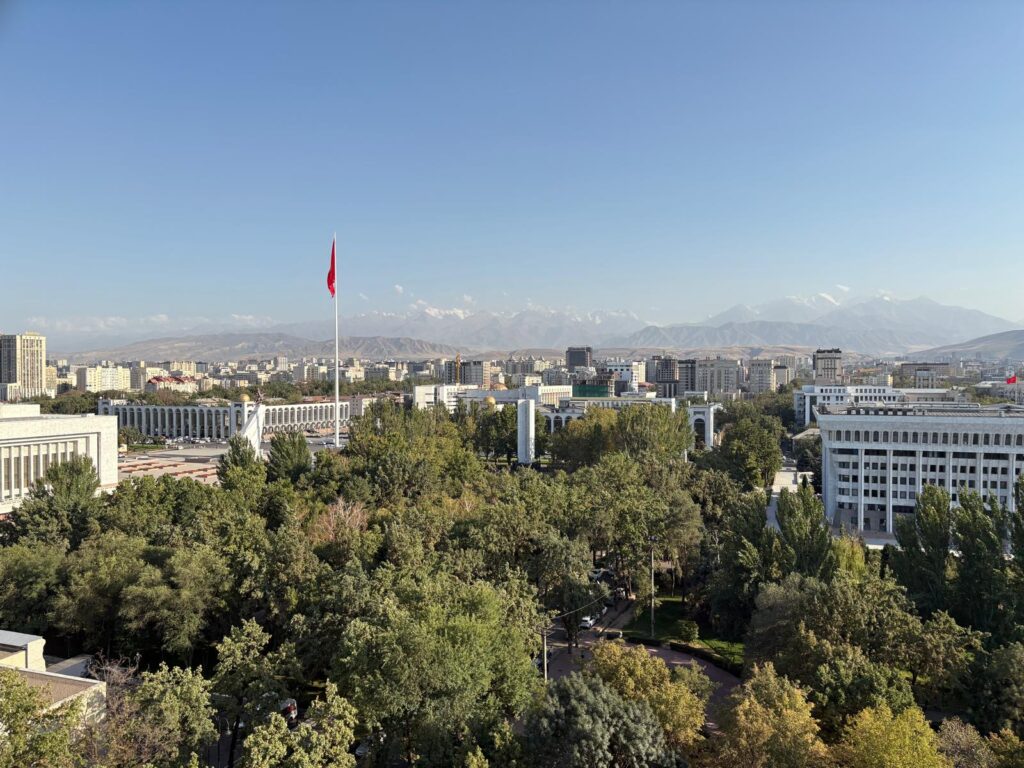
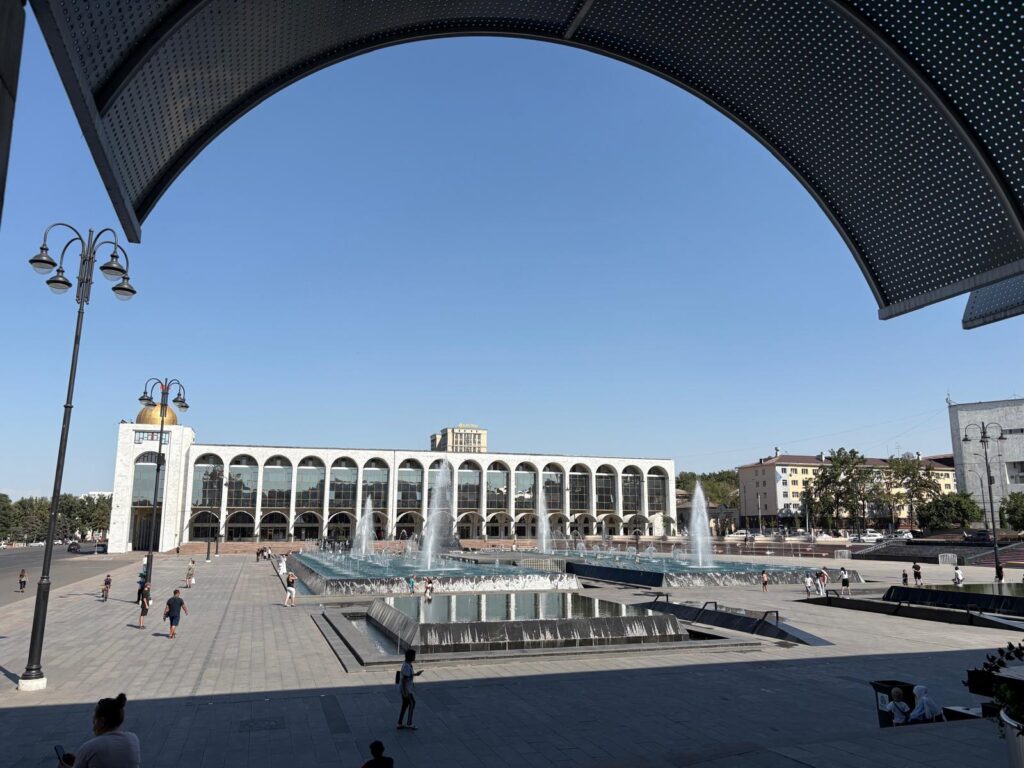
First of all, we haven’t yet talked about Ala-Too Square. This is the central square in Bishkek and is immense. I strongly suspect it was emptier during the Soviet period and used for parades. Today it contains fountains on one side, and an immense flagpole and soaring statue of Manas on the other. Manas is a folk hero central to Kyrgyz culture: people known as manaschi memorise and recite the Epic of Manas, one of the great literary treasures of the Turkic world. Like Homeric bards reciting The Iliad, but much longer and therefore more impressive. Anyway, back to Ala-Too Square. You can see a changing of the guards here on the hour, or get snacks or souvenirs from the shops lining the square.
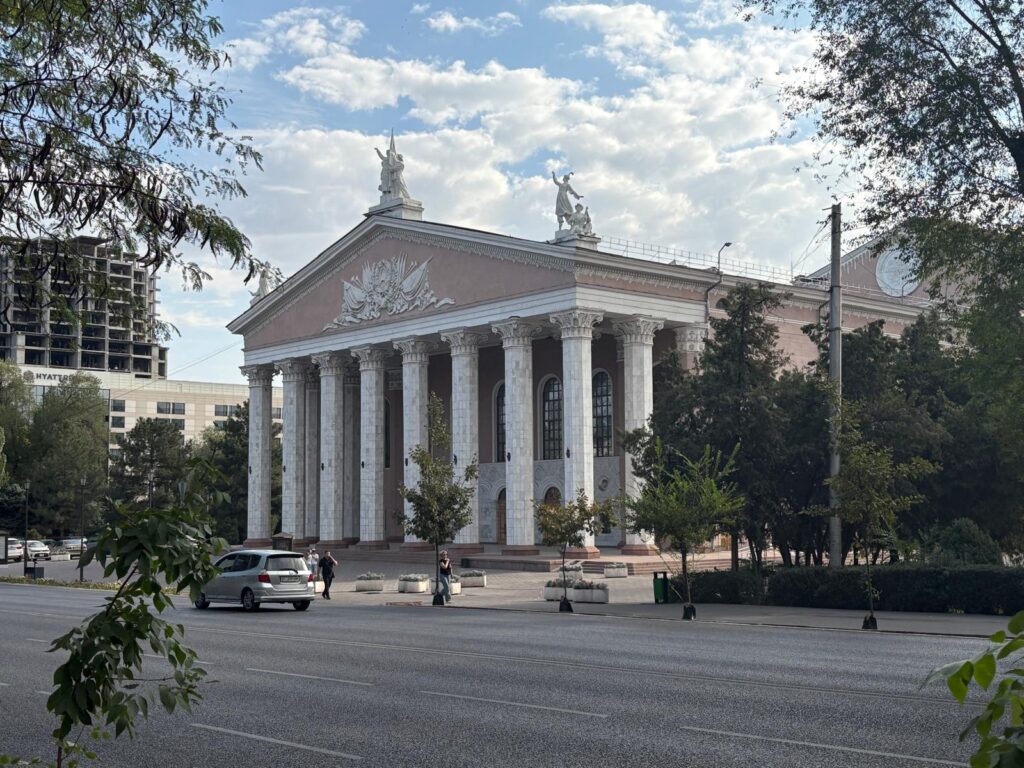
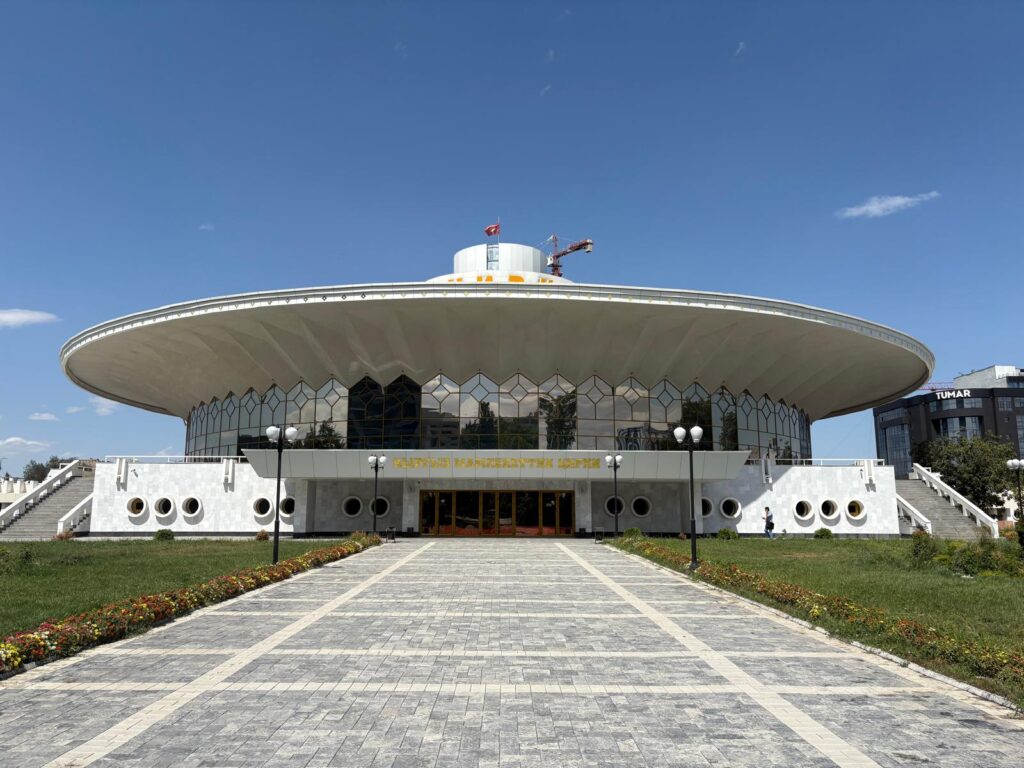
There are also options for evening entertainment in Bishkek. The Kyrgyz Opera and Ballet Theatre was opposite my hotel, but sadly didn’t have performances on while I was there. Apparently when they do, they follow a Russian tradition and start at 5pm. I approve! I did go closer to the opera house to check out the hammer and sickle designs still on the façade. There’s also the Kyrgyz State Circus, its 1976 building looking very much like a UFO. Or you could try the Kyrgyz National Philharmonic. Overall the Russian influence is still very much apparent in evening entertainment offerings.
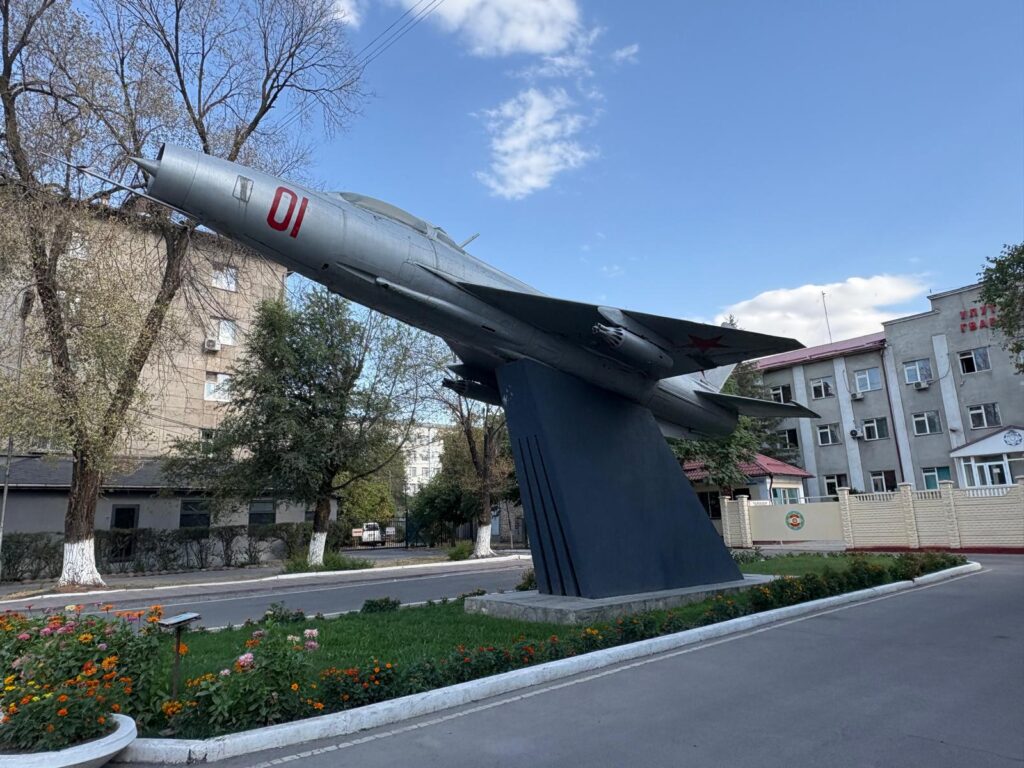
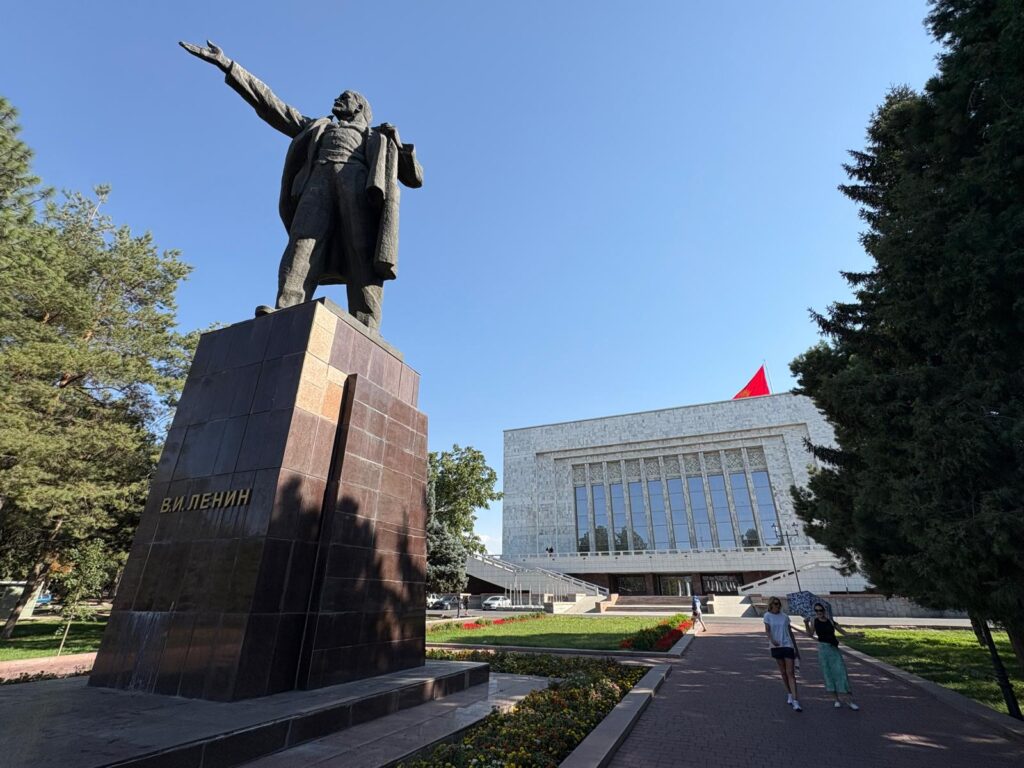
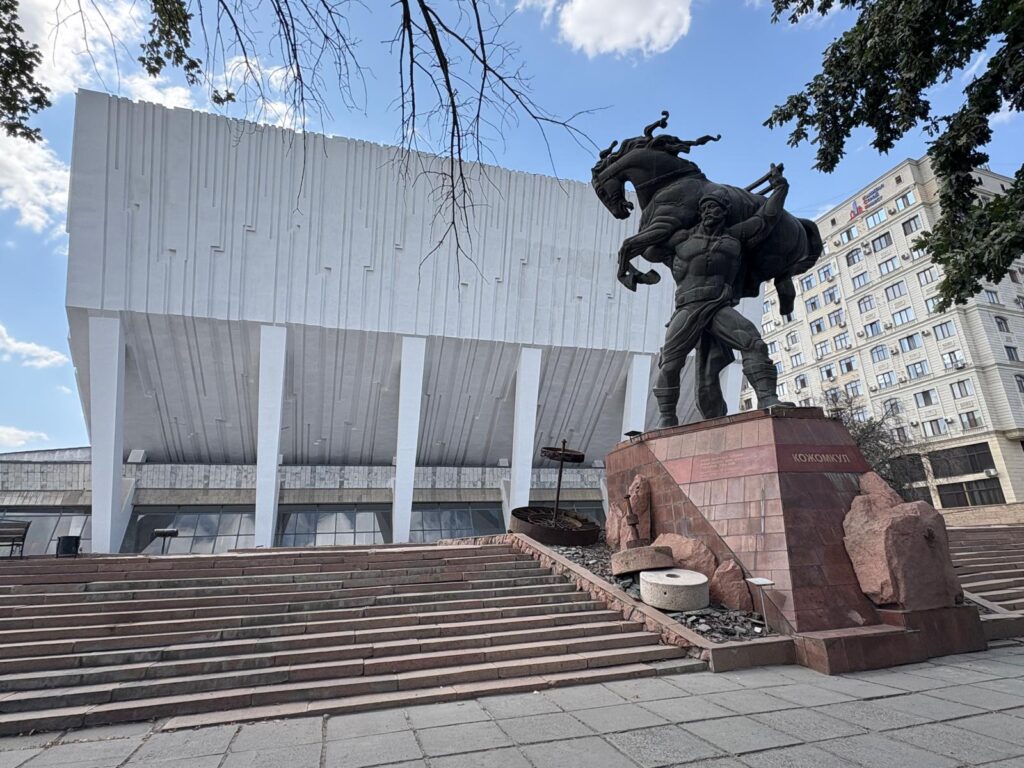
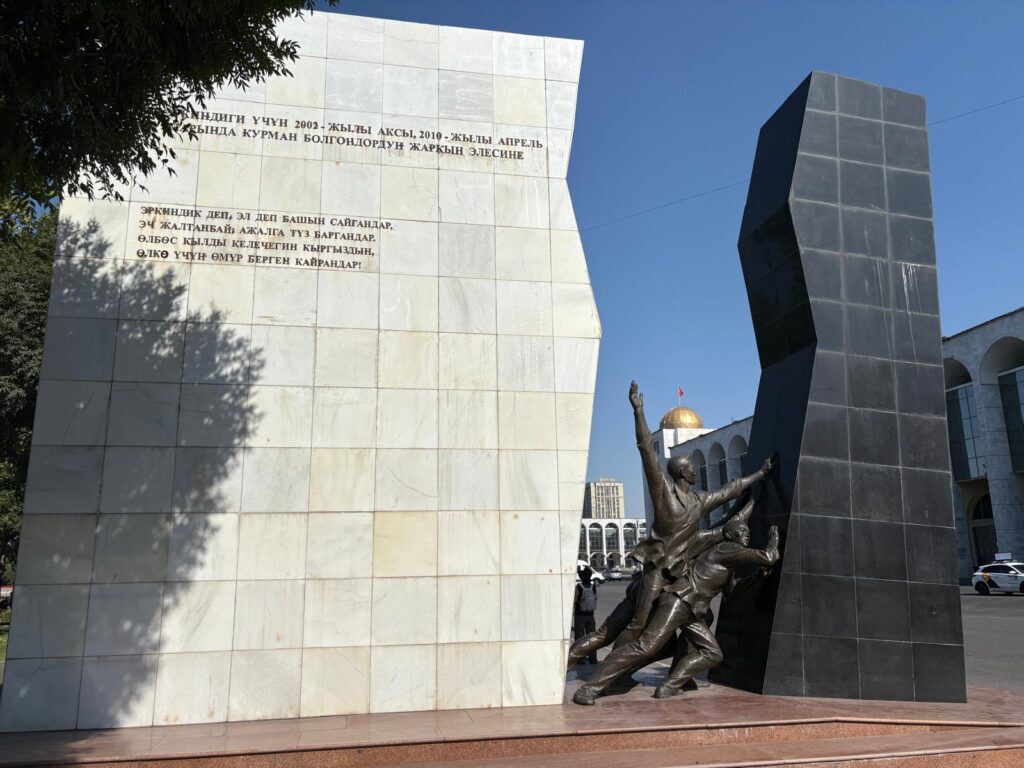
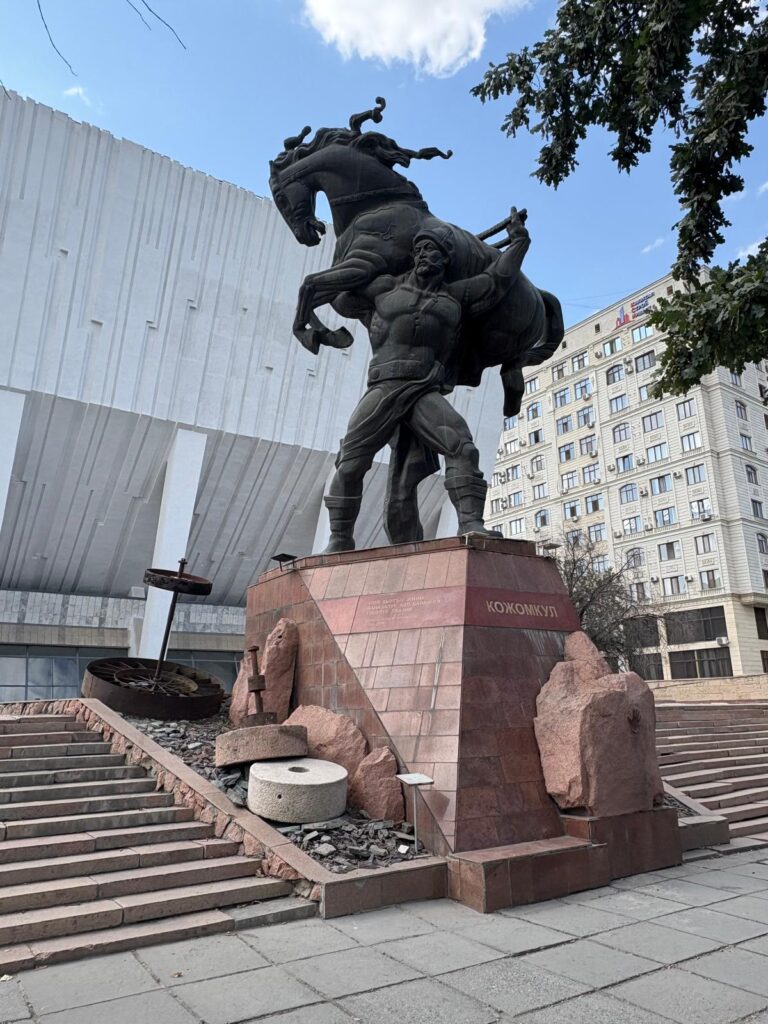
Then there are the city’s monuments and sculptures. I’ve mentioned a few already, like Marx and Engels in Dubovy Park. Don’t miss the statue of Lenin (in ‘pointing to the future’ mode) behind the National History Museum. He used to be in Ala-Too Square but has been downgraded. More modern monuments commemorate those who have fought to protect democracy in Kyrgyzstan. Then a fun one is the statue of Kojomkol near the stadium (on the same street as the Tinibek Sadykov Museum). Kojomkol was a semi-legendary giant and strong man: I’ve seen many a statue of a man on a horse, but never a horse on a man before. There’s also a spot where you can compare the size of your hand to his. Finally, pass by the headquarters of the National Guard on Kievskaya to see an old MiG fighter jet.
Architecture
There is a great overlap in the Venn diagram of culture lovers and architecture lovers, and so architecture may well be another thing you want to explore in Bishkek. Others have created dedicated guides to this, like the ones here or here. But if you want a quick overview, keep reading.
- Pre-Russian Pishpek. There’s basically no trace of this today. The city’s Wikipedia entry says you can find the remains of the fort north of Jibek Jolu Street, near the new main mosque. But I only saw this mentioned after I was back in London, so can’t verify it. The fort does feature on the city’s coat of arms, though.
- Russian Empire. I found little trace of this in the city centre. The layout and tree-lined avenues, for sure, but few buildings that seemed to date from this area. If you have the opportunity to get out of the city, though, keep an eye out for Russian domestic architecture. Even in Bishkek’s suburbs, you’ll see wooden houses that speak to the city’s past. And a lot more of them in Karakol and smaller towns and villages. Look for the gingerbread-like wooden decoration.
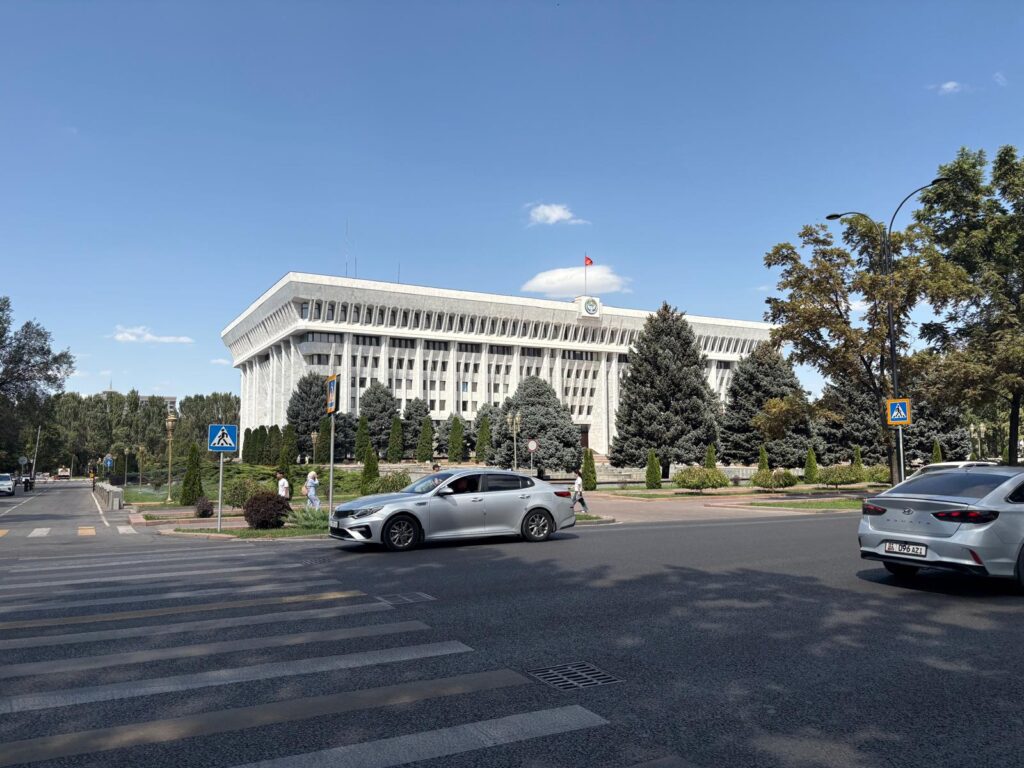
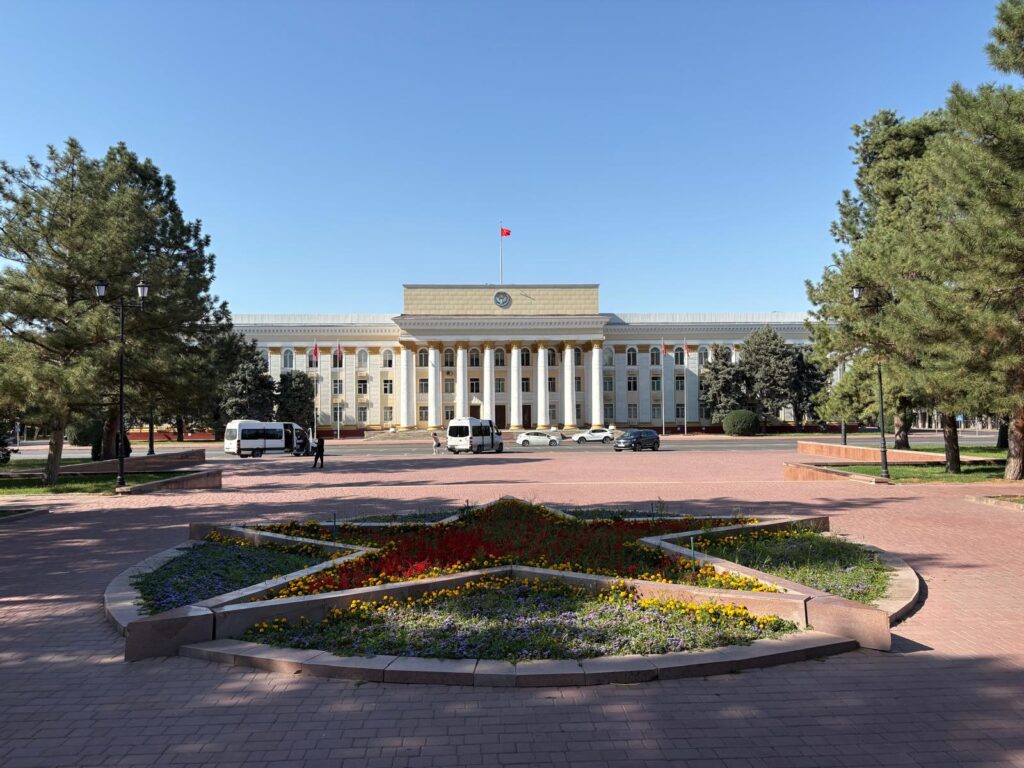
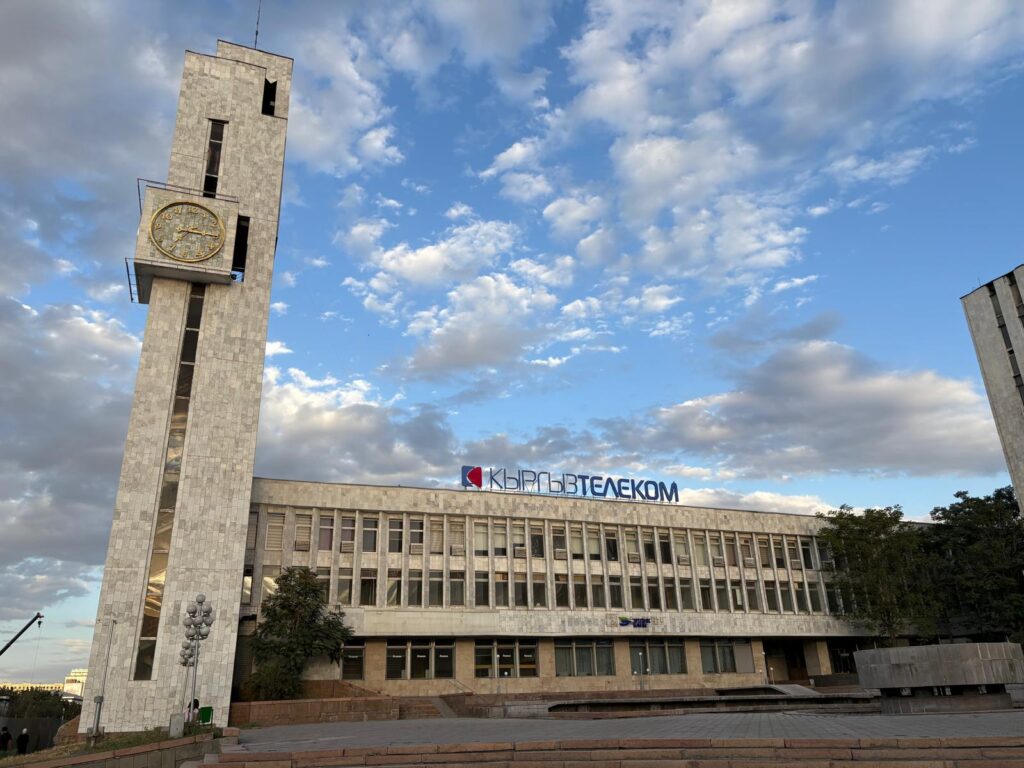
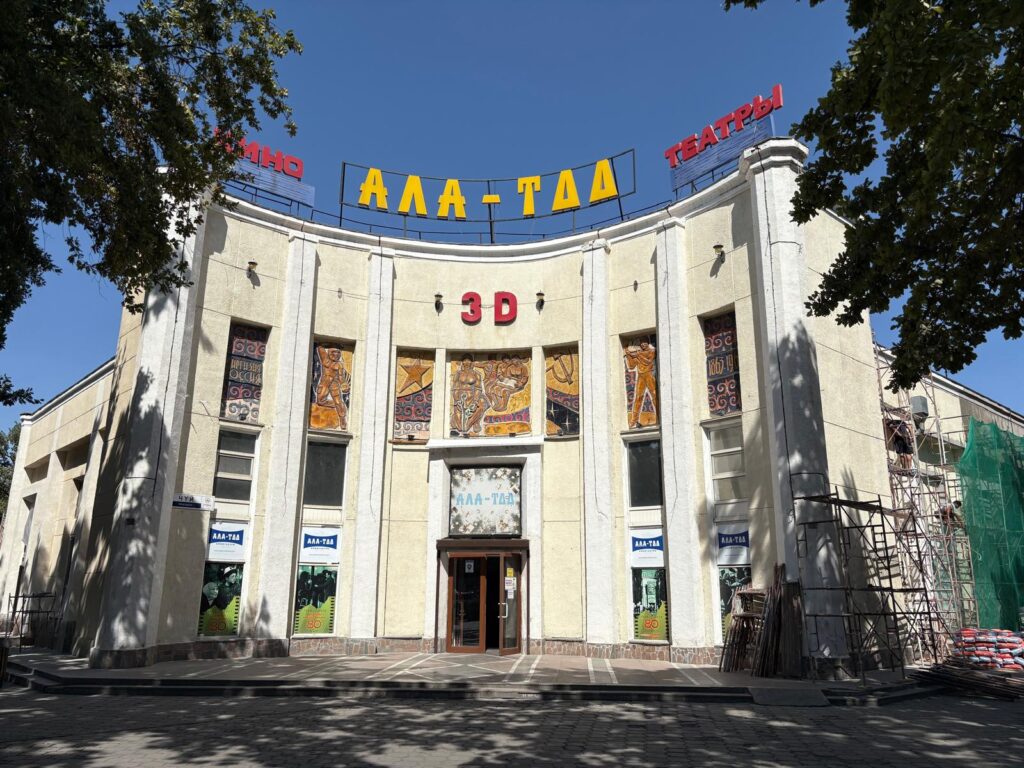
- Soviet Frunze. You could easily spend a day just tracking down examples of Soviet architecture in Bishkek. And interestingly, the style isn’t uniform. You’ve got neoclassical buildings from the Soviet period, like the Kyrgyz Opera and Ballet Theatre (1955). The White House, or presidential office building, is likewise very restrained (and this time is late Soviet). Elsewhere, a lot of cultural institutions are excellent examples of mid-century Brutalist design: the Toktogul Satylganov Philharmonic Hall, Kyrgyz National Museum of Fine Arts Gapara Aitieva, and M. V. Frunze House Museum, for instance. The Kyrgyz State Circus is a must, but the area should apparently be avoided at night.
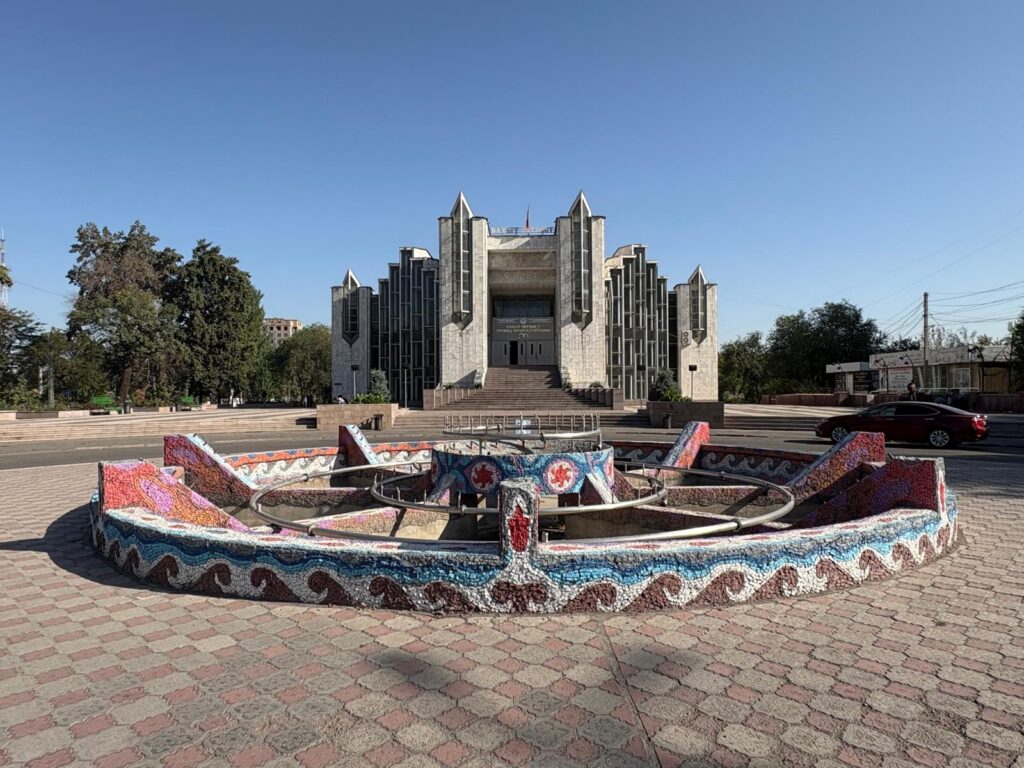
- Look out for smaller, quirky buildings too, like the Wedding Hall on Dzhumabeka, or the soda shop in Dubovy Park. And even when the architecture isn’t super interesting, Soviet flourishes like hammer and sickle designs can be seen on a few buildings, like the Ala-Too Cinema.
- Independent Bishkek. The architecture post-USSR has gone in a couple of directions. Firstly, a number of buildings are built in a more generic, international style. A little bit of a shame, but sure. Some of the mid-century buildings are being reclad, giving them a new lease of life. And I noticed one planned apartment block where the hoardings showed a building clearly inspired by those very recognisable Stalinist towers. Interesting the way Bishkek seems to look both forward and back. Lastly, there are the structures that clearly proclaim Kyrgyz culture: the monument in Victory Square, which evokes a yurt, is a great example.
Street Art
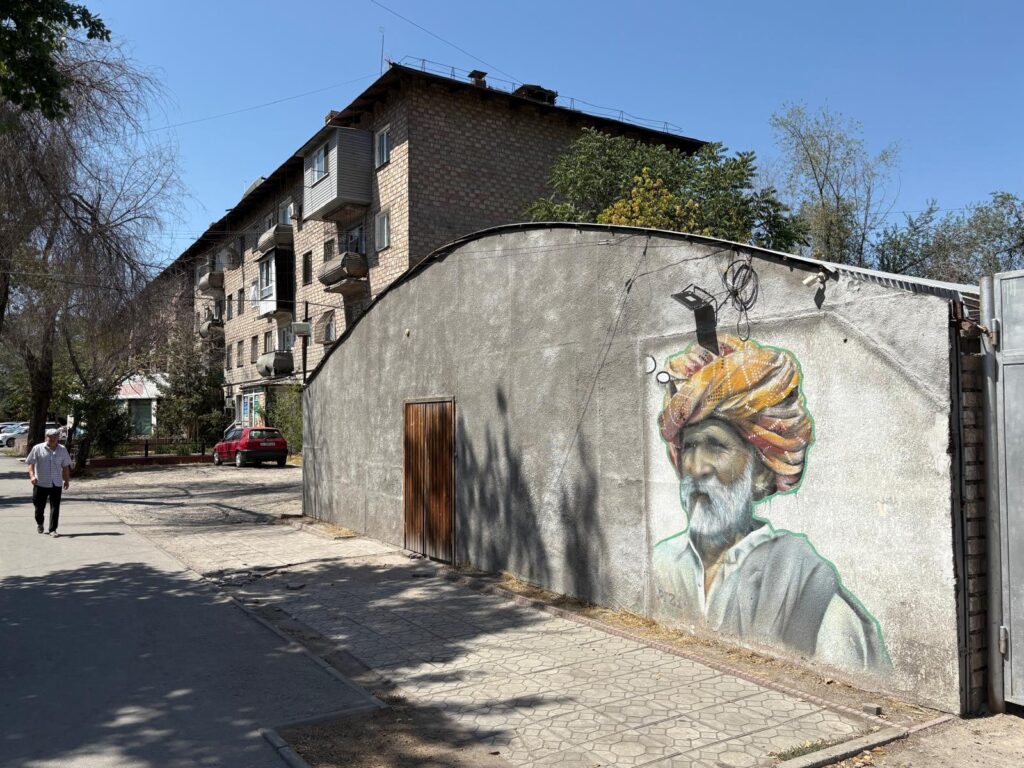
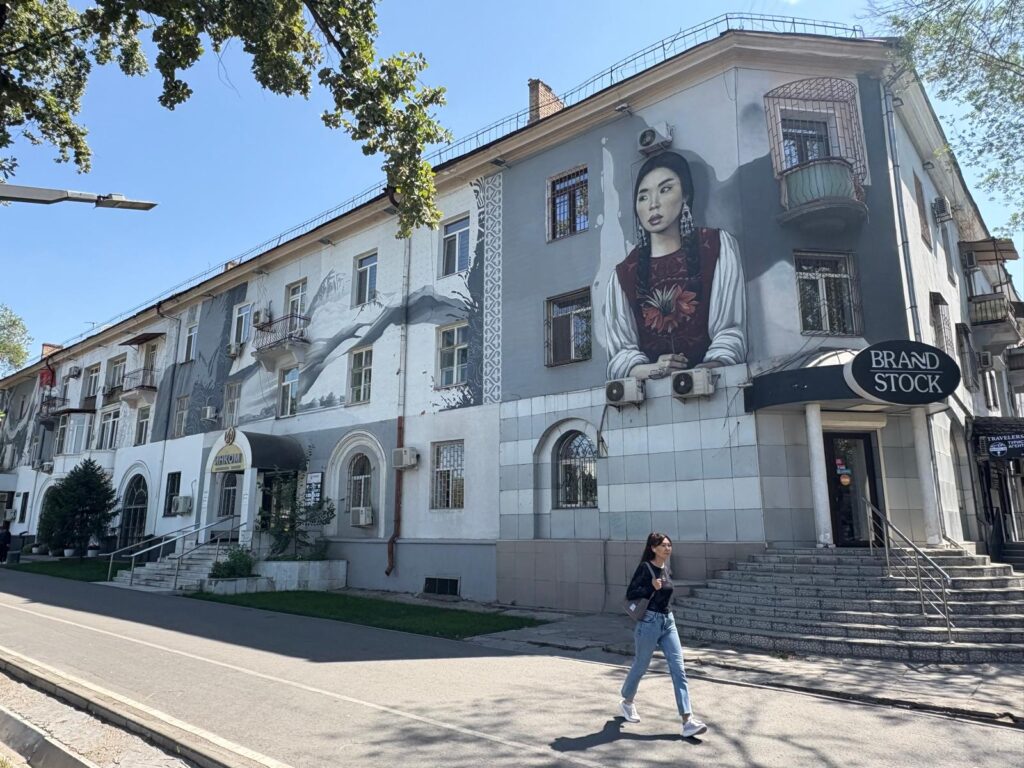
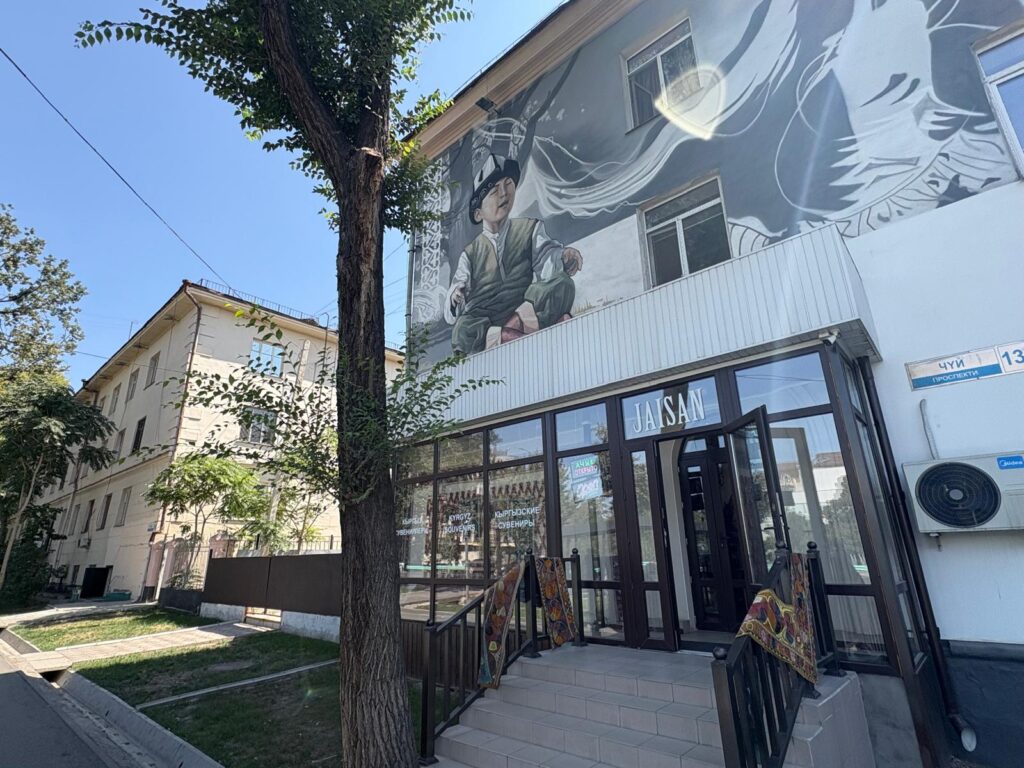
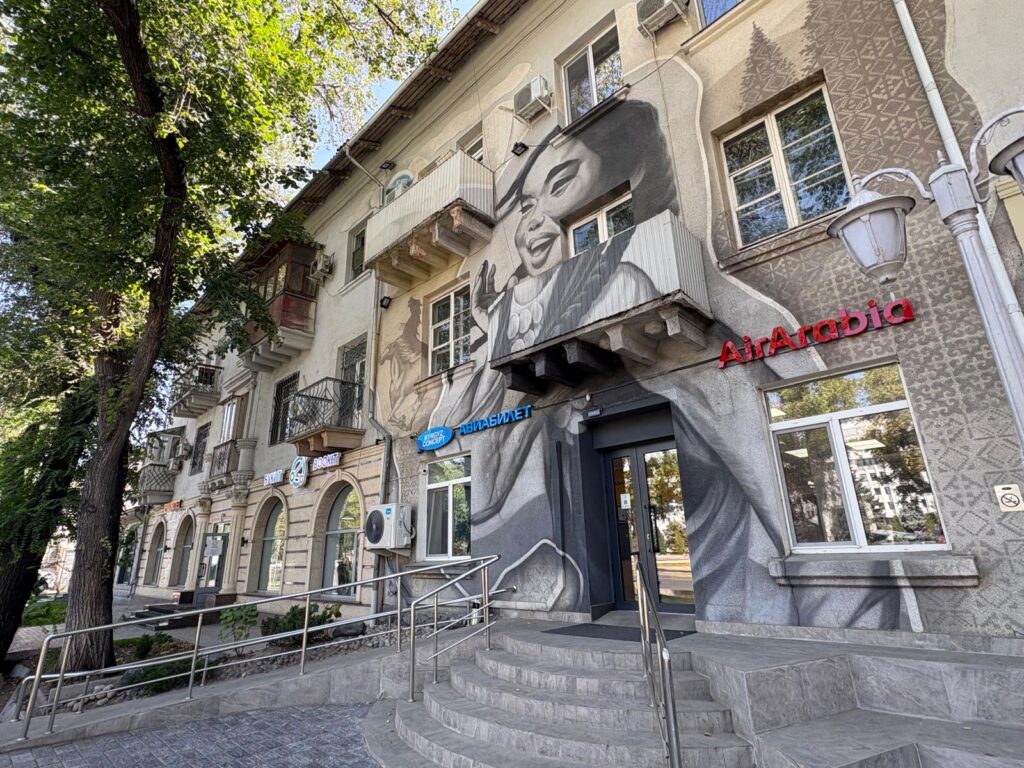
Street art is a fast-moving thing, although I saw more commissioned murals than informal street art in Bishkek. But for that reason, I won’t suggest particular spots, but rather encourage you to look up as you walk around.
Bishkek’s murals tend to bring a Kyrgyz character to otherwise fairly bland buildings. Many feature local people in traditional dress, national heroes (eg. sporting figures), famous films, or illustrate myths or legends. They are thus a way to convey social messages as well as beautifying the city streets. I didn’t see this one, but apparently Bishkek also has Central Asia’s largest mural at over 700m sq., on the side of the Asia Mall. The city’s street art shows a clear divergence from USSR and authoritarian culture: the artworks are much more inspirational than instructive.
You can find tours of Bishkek’s street art, and more specifically of its mosaics.
Daytrips from Bishkek
As I mentioned at the beginning of this post, I found more than enough to fill 48 hours in Bishkek. But not everyone does, apparently. Or perhaps you’ve extended your stay and have just a little bit longer. In either case, you might want to think about a daytrip from Bishkek.
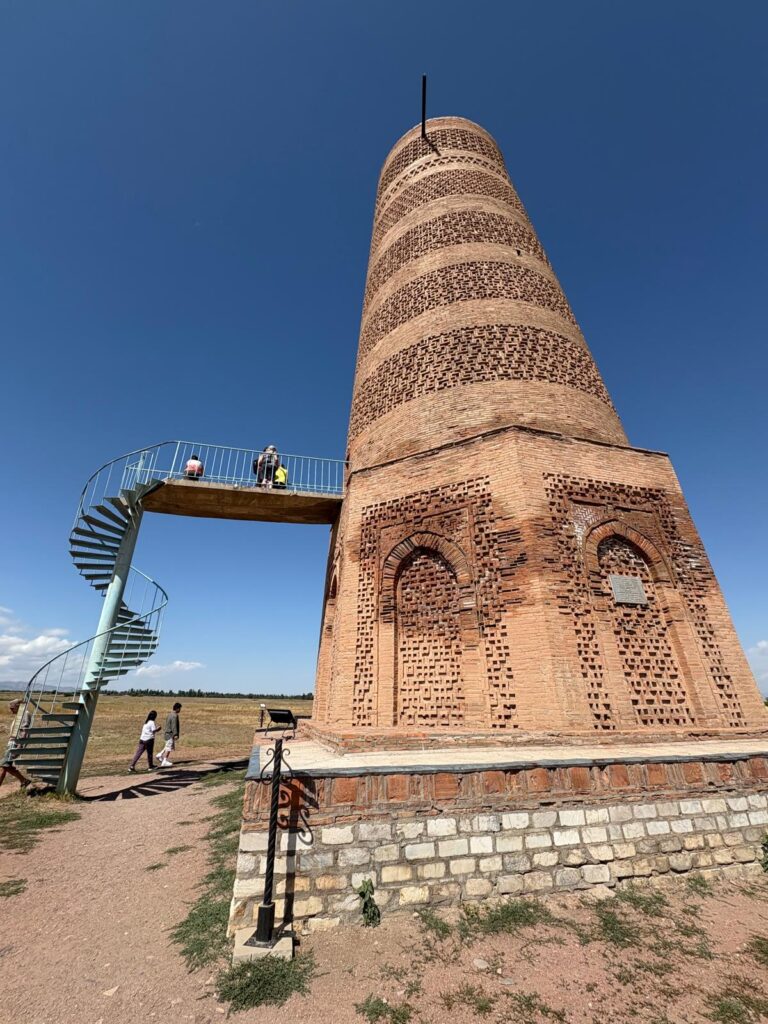
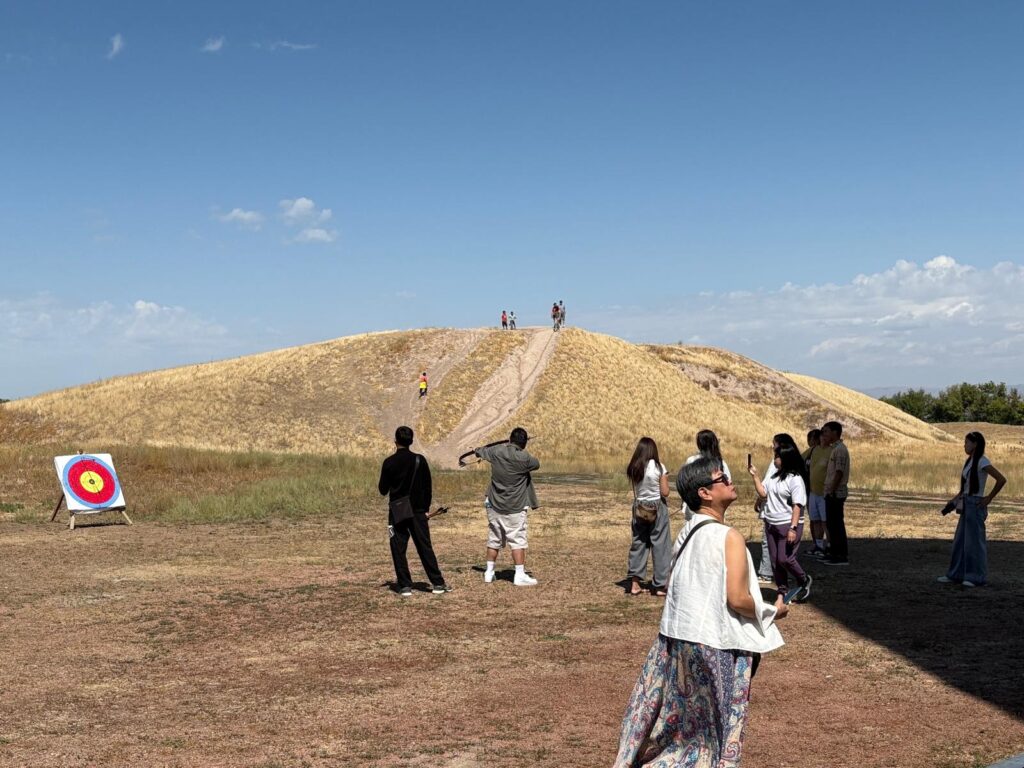
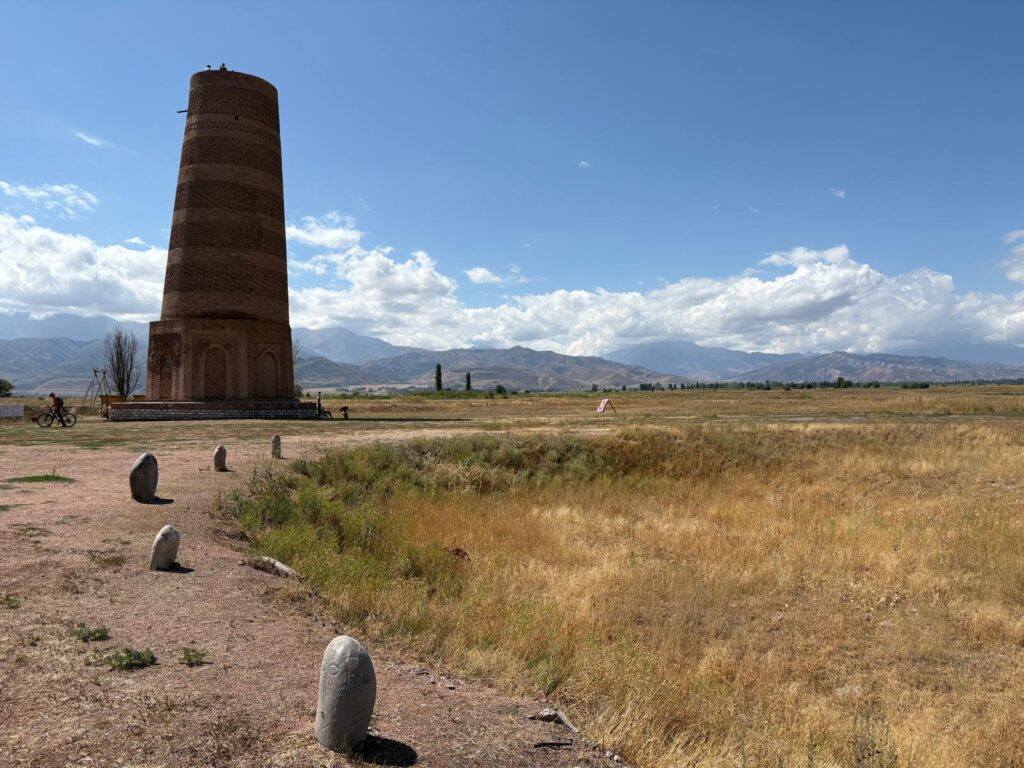
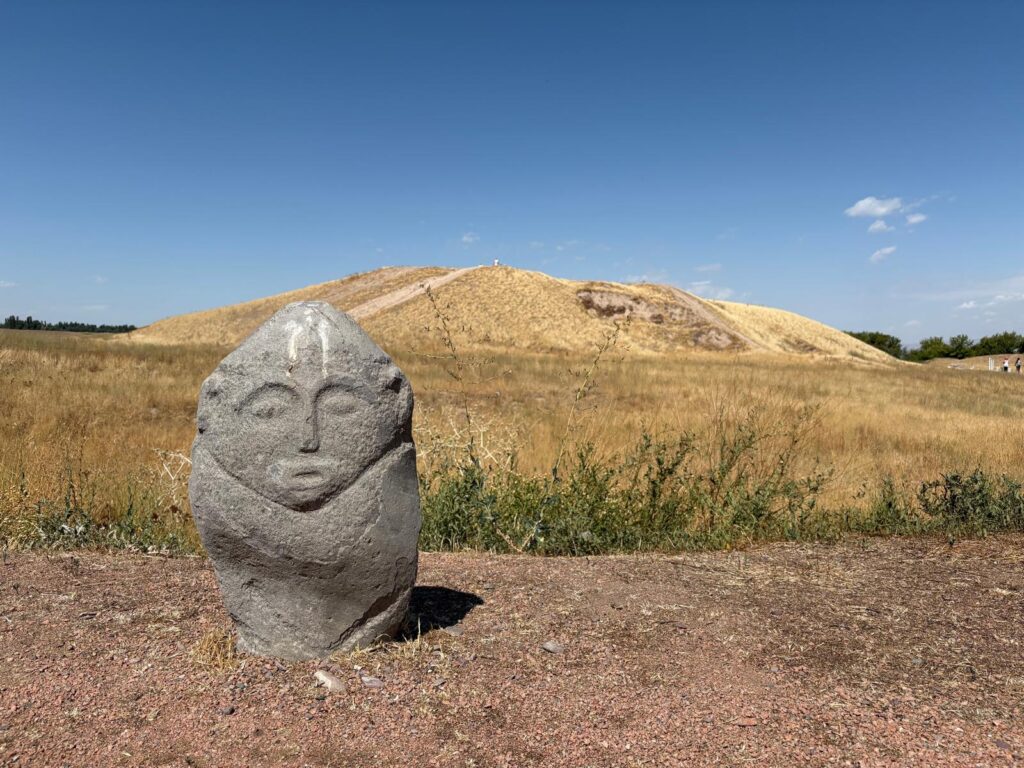
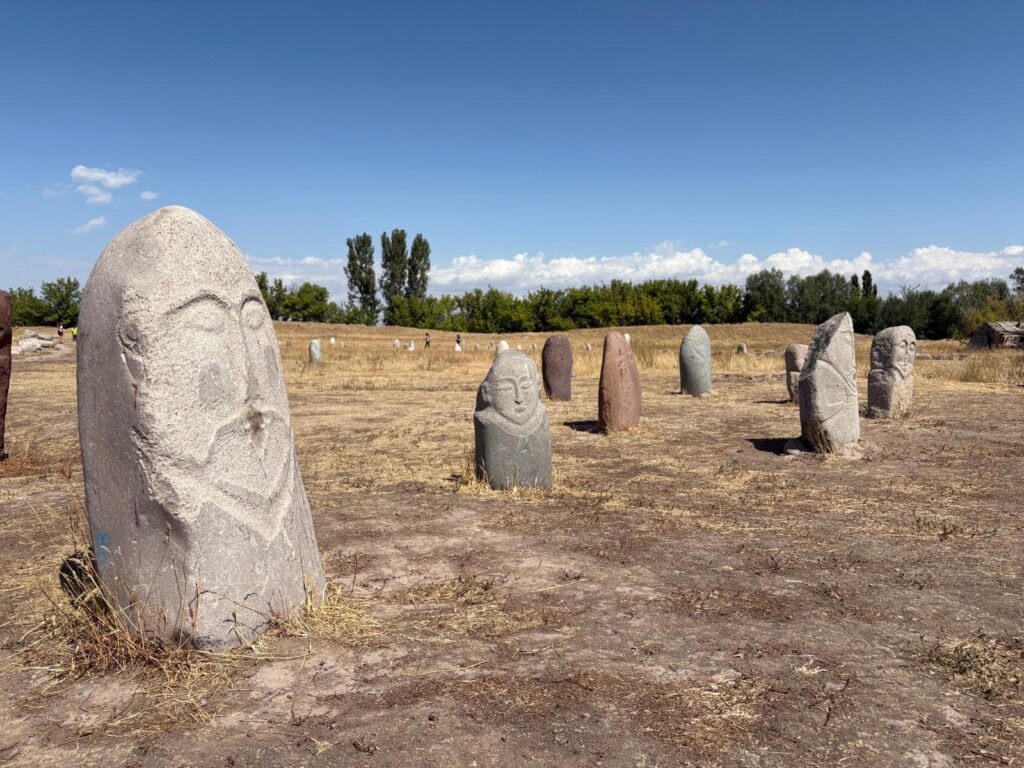
As you can see from the photos above, I did a daytrip. Or a half-day trip: I came back in the afternoon and had time for a museum visit. I went to the Burana Tower. This was a good choice for a few reasons. Firstly it features on a lot of images of Kyrgyzstan, so it’s nice to see it in the flesh. It also gets you out of the city. The drive along main roads isn’t particularly scenic, but there’s a much nicer southern route through foothills which is very pleasant. And where Bishkek has very little visible history prior to the Russian Empire period, the Burana Tower is older. Sort of.
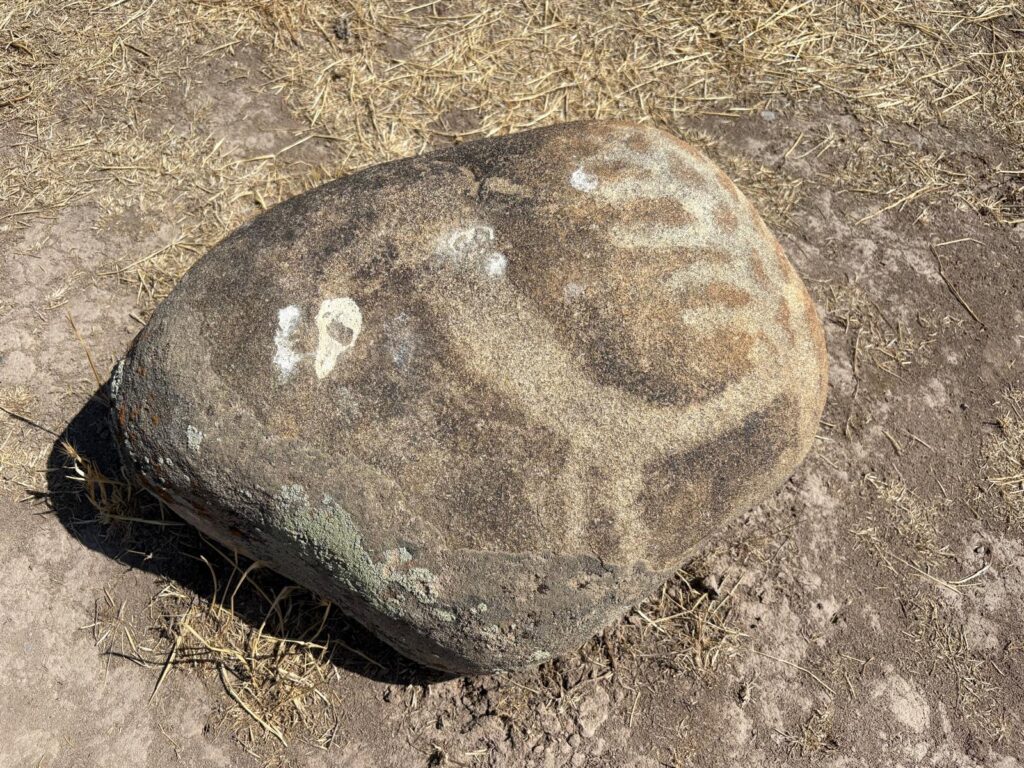
The site is certainly older. This is the last trace of the 9th century Karakhanid city of Balasagun, on a minor Silk Road route. The tower is an 11th century minaret, with extensive 20th century renovations. The staircase could be original though: it’s one of the most dangerous I’ve seen open to the public! Around Burana Tower you can see Balbals (anthropomorphic gravestones) and petroglyphs from around the country. There’s also a small museum. No food or drink on site, and most groups come as part of a multi-day tour so there are few options to get here privately. My own tour was partly a scam (long story) but I’m still glad I made the trip.
Interestingly, like the Bamiyan Buddhas (alas…), a local legend developed to explain the tower as the memory of it as a minaret receded. In this case the tower is said to have been built by a wealthy man, after a fortune teller at a celebration for his daughter’s birth foretold her death at sixteen from a spider bite. The tower was his way of trying to keep her safe, but, inevitably, a poisonous spider hitched a ride on a basket of fruit on her sixteenth birthday… Remind anyone of Snow White?
Other daytrip options from Bishkek include:
- Konorchek Canyon (hiking, includes a couple of areas you need to climb with ropes)
- Ala Archa National Park
- Hot springs at Issyk-Ata Gorge
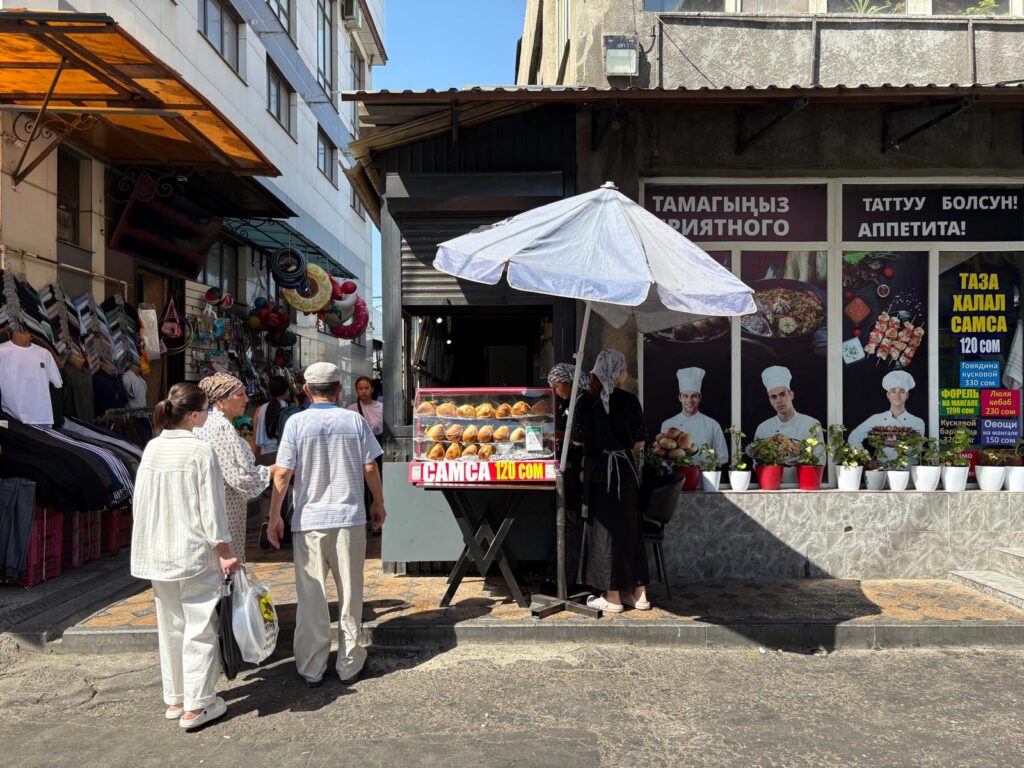
Food and Drink
Let’s wrap up now with a final section on food and drink. The options, and the names of various foods, speak to the cultural exchange in Kyrgyzstan’s past. The Central Asian dish plov, for instance, has the same etymological root as pilau or pilaf, and shares rice as its main ingredient. Meanwhile a hand-held snack of lamb wrapped in dough is called a samsa, like samosa. They are variations on a theme, but share a common origin.
But enough history and linguistics, here are some foods that I tried and think you should too!
- Kumis. I mentioned this above: it’s fermented horse milk. A bit fizzy, and a bit alcoholic. A definite acquired taste but worth having a little sip at least.
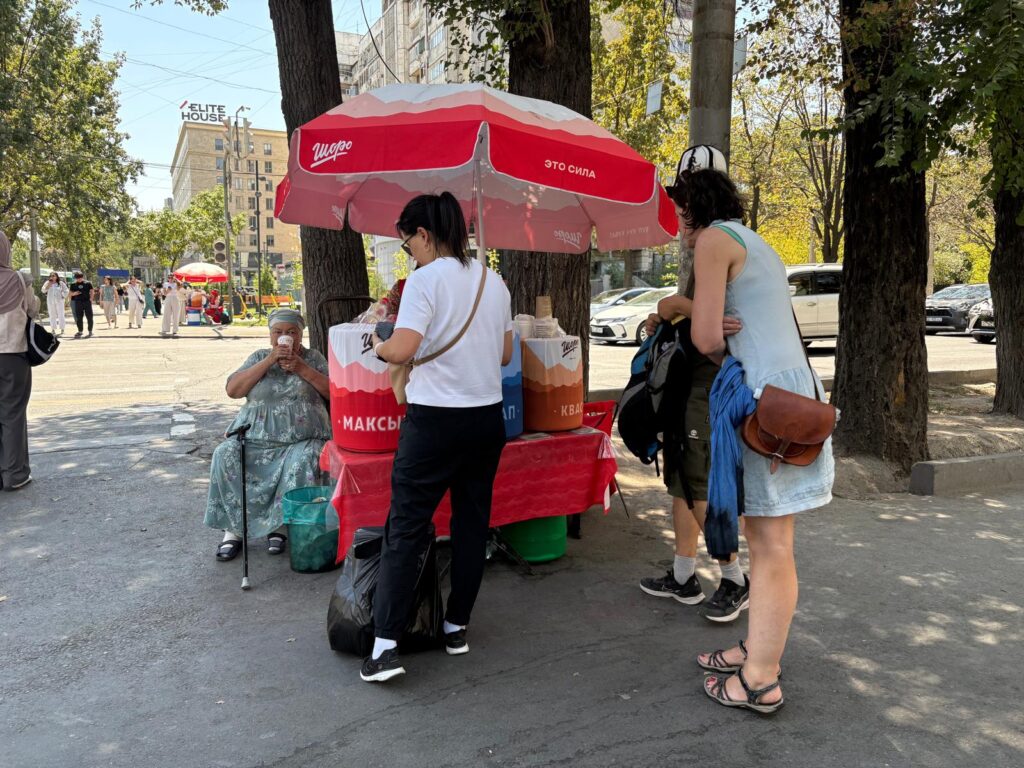
- Also check out the ubiquitous roadside stalls selling three drinks: maksym (slightly fizzy, non-alcoholic, made from fermented grains), chalap (fermented drink made from sour milk, water, and salt) and kvas (traditional Russian drink made from fermented rye bread).
- Kurut. Fermented, dried yoghurt balls (there’s a theme emerging). They’re not quite what I expected: a little chalky, a little cheesy. The ones blended with dried apricots are quite nice.
- Beshbarmak. Translates as ‘five fingers’. Chopped meat on top of noodles in squares or thin strips, with broth. Very tasty. This is one dish which may contain horse meat sausage: look for thin slices, dark meat, and a band of fat.
- Plov. Rice with meat and carrots. Delicious, filling, and variations are found in Uzbekistan and Tajikistan as well.
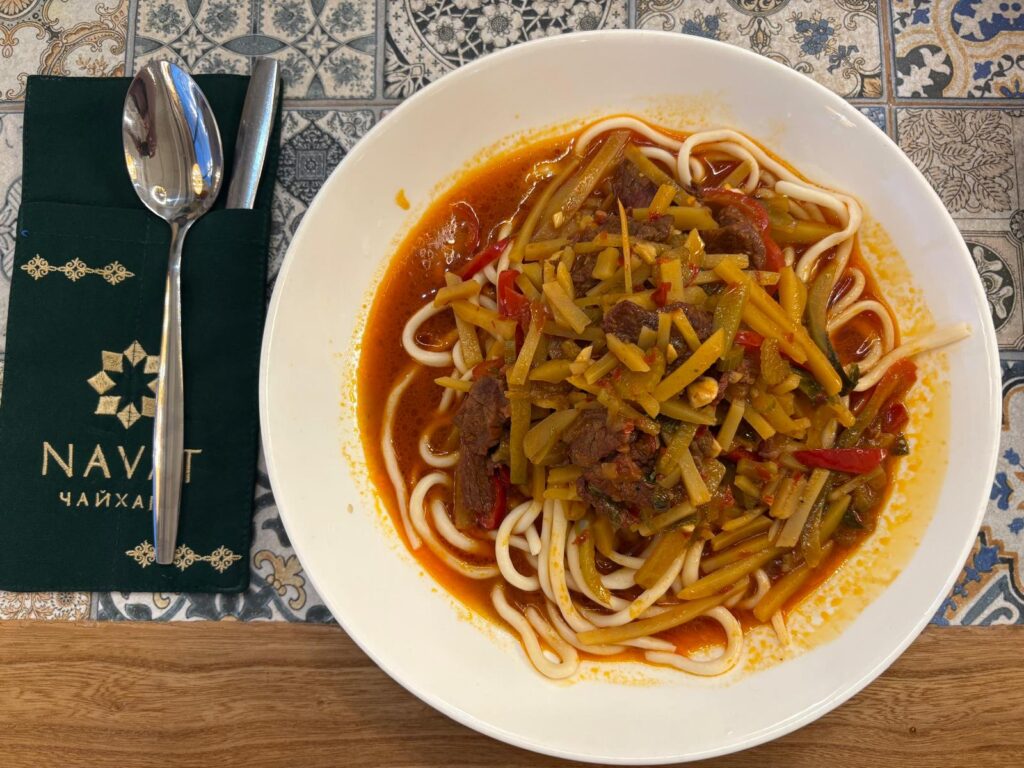
- Lagman. Another (hand-made) noodle and meat dish. Very flavourful, went down very well with my tour group.
- Samsa. As above, similar to a samosa, but with doughier pastry. The filling is likely lamb and onions, maybe with potato.
- Manti. Dumplings. Often with meat and vegetables.
A couple of final pointers. As you can tell from this list, it’s a little tricky for vegetarians or vegans in Kyrgyzstan. During our tour, our guides coped with making meals without meat. But a couple of times in restaurants or guesthouses the vegetarians in our group received meals with meat picked out – not quite the same.
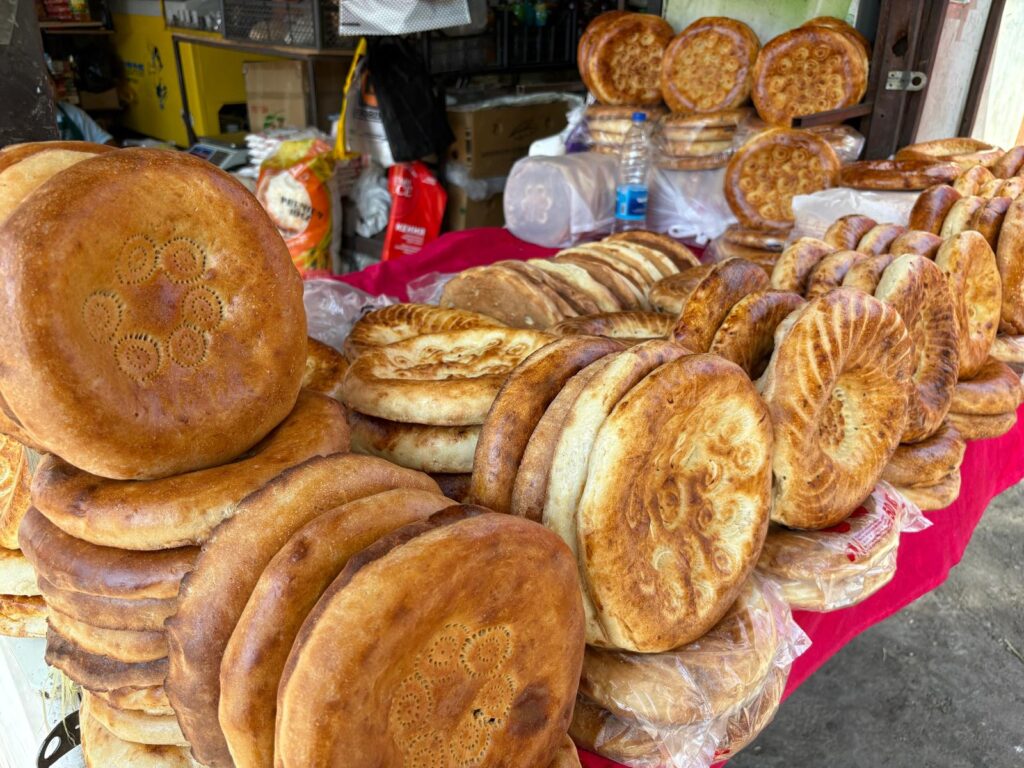
And finally, Bishkek (and Kyrgyzstan more broadly) is a great place to explore other Central Asian cuisines. We enjoyed Uighur food, tried Uzbek dishes, and lived off traditional, springy, satisfying Russian bread on our hikes.
That’s the end of my guide. I only hope you enjoy Bishkek as much as I did!
Trending
If you see this after your page is loaded completely, leafletJS files are missing.