
A Mary Lincoln Double Exposure: A Journey Through Performance and Art – Charing Cross Theatre & RWS Gallery, London
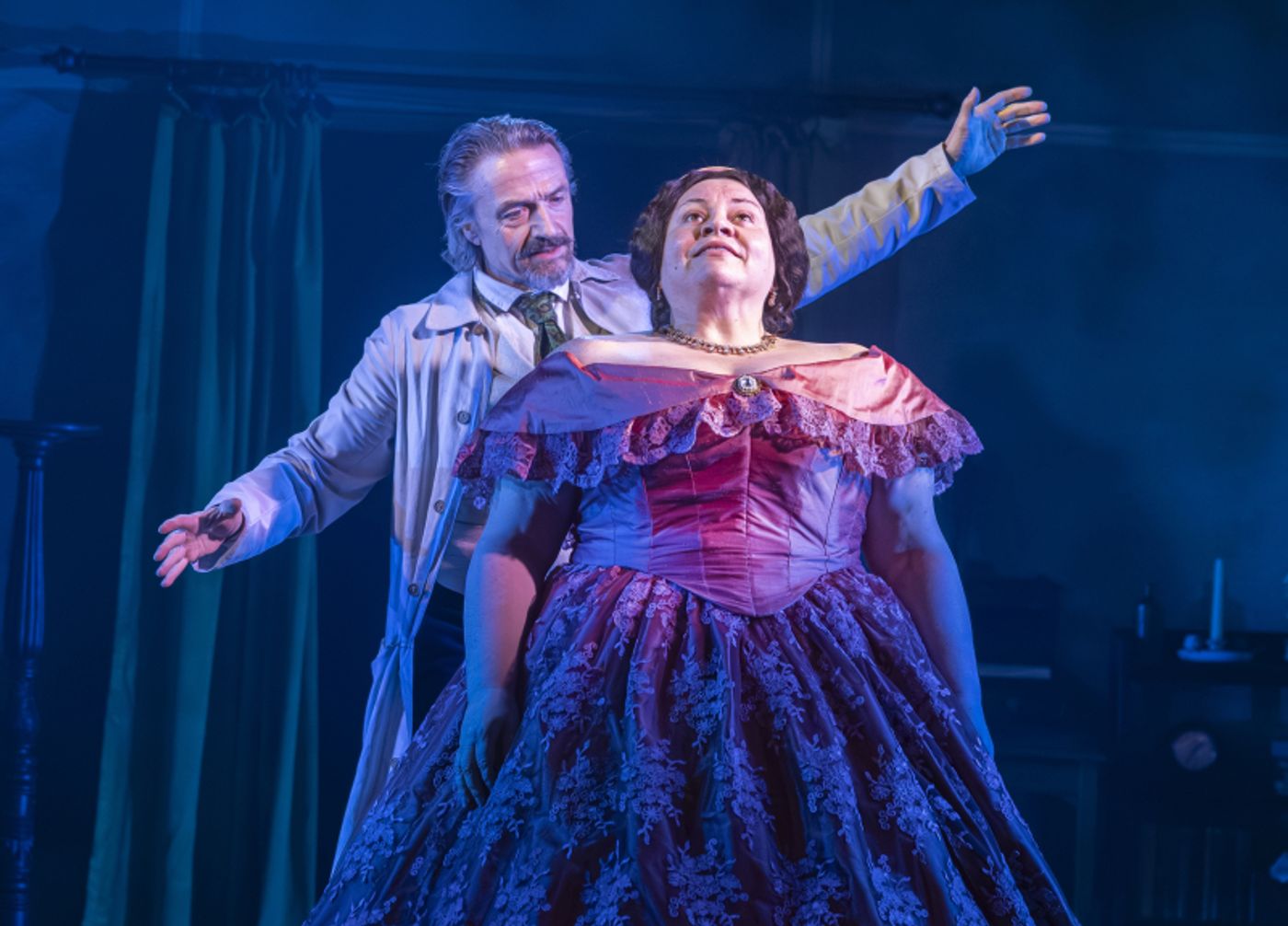
Today’s review is a rare opportunity to engage with an interconnected play and exhibition: Mary Lincoln & Frida Kahlo UNFRAMED at the Royal Watercolour Society Gallery, and Mrs. President at the nearby Charing Cross Theatre. Both are the work of John Ransom Phillips, who took inspiration from Mary Lincoln herself to tell this story.
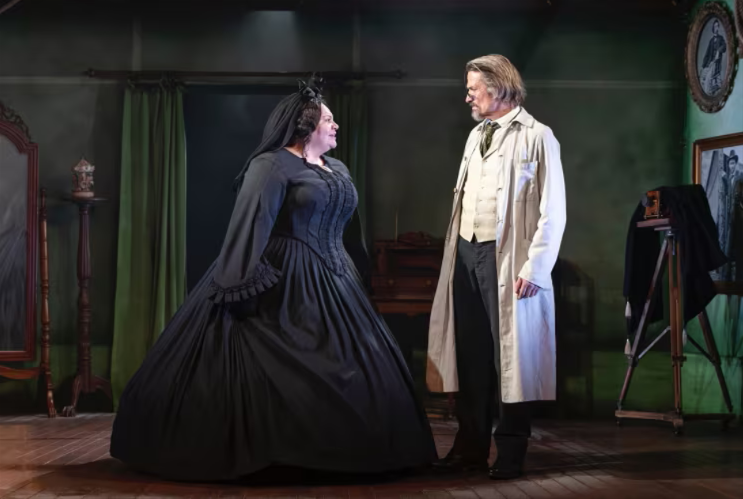
Lead image © Pamela Raith Photography.
A Rare Intersection of Art and Theatre
Although I run a multi-disciplinary blog here at the Salterton Arts Review (read: everything I personally enjoy), it isn’t often my two great loves of art and theatre intersect.* They did memorably once before, when I attended an exhibition of paintings by Cyril Mann followed by a play about his life. Today we are going to visit an exhibition and a play by John Ransom Phillips, where the common thread is Mary Todd Lincoln.
As other reviewers have noted, Mary Lincoln is currently having a moment. As well as today’s play, Mrs. President, there’s also Oh, Mary! playing just a short distance away. The two couldn’t be more different, which I can attest to, having seen both in the same week. Oh, Mary! is utterly camp, ridiculous, and fun. Mrs. President is a more serious affair. It’s a two-hander featuring Keala Settle as Mary Lincoln and Hal Fowler as noted photographer Mathew Brady. But let us not forget, these are not the only US Civil War-era plays on in London right now. Mary Lincoln and her poor public image loomed offstage in Our American Queen, which I saw at the Bridewell Theatre. Is it as simple as looking back to another time when the deep divides in American society were showing? Or is there something else in the water?
Regardless, I’ve had a lot of food for thought. Both about Mary Lincoln, and about plays seeking to investigate or rehabilitate a female figure from history. So let’s do a tiny recap first for those unfamiliar with this particular historic figure. Born Mary Ann Todd in Lexington, Kentucky in 1818, the future First Lady married Abraham Lincoln in 1842. The couple had four sons, two of whom died in childhood, while a third died aged 18. Their surviving son, Robert, infamously if briefly committed Mary to a psychiatric hospital after her husband’s assassination in 1865. She died in 1882 and was buried with her husband and younger sons in the Lincoln Tomb in Springfield, Illinois.
*Editor’s note: the Urban Geographer reminded me this should have been 3 great loves, as he accompanied me yesterday.
Mary Lincoln & Frida Kahlo UNFRAMED – Royal Watercolour Society Gallery, London
We started our evening yesterday at the Royal Watercolour Society (or RWS) Gallery, across from the National Gallery‘s Sainsbury Wing. This was my first visit, but I expect I will be back at some stage to this nice little space. We were fortunate to attend the opening of Mary Lincoln & Frida Kahlo UNFRAMED, by John Ransom Phillips. Ransom Phillips is a New York-based, multidisciplinary artist, working across painting, film, theatre and poetry. He’s held teaching positions including at the University of Chicago, University of California, Berkeley, and Reed College in Portland, Oregon.
Stepping into the exhibition, I was thinking about two things. Firstly, what would I learn about Mary Lincoln (or at least Ransom Phillips’ interpretation of her) that would prepare me for the theatrical evening ahead? And secondly, how would Ransom Phillips bring together the seemingly disparate figures of Mary Lincoln and Frida Kahlo?
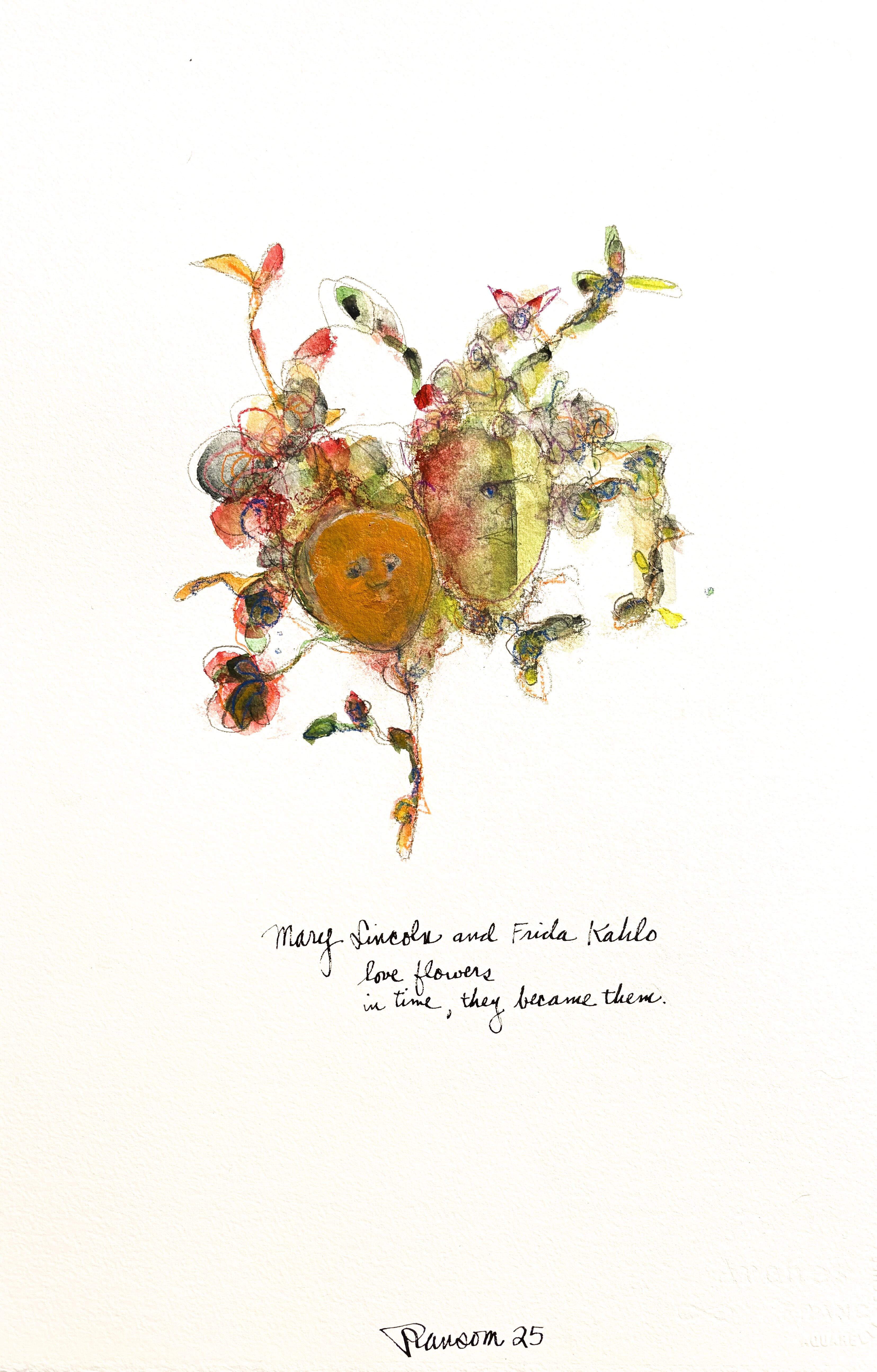
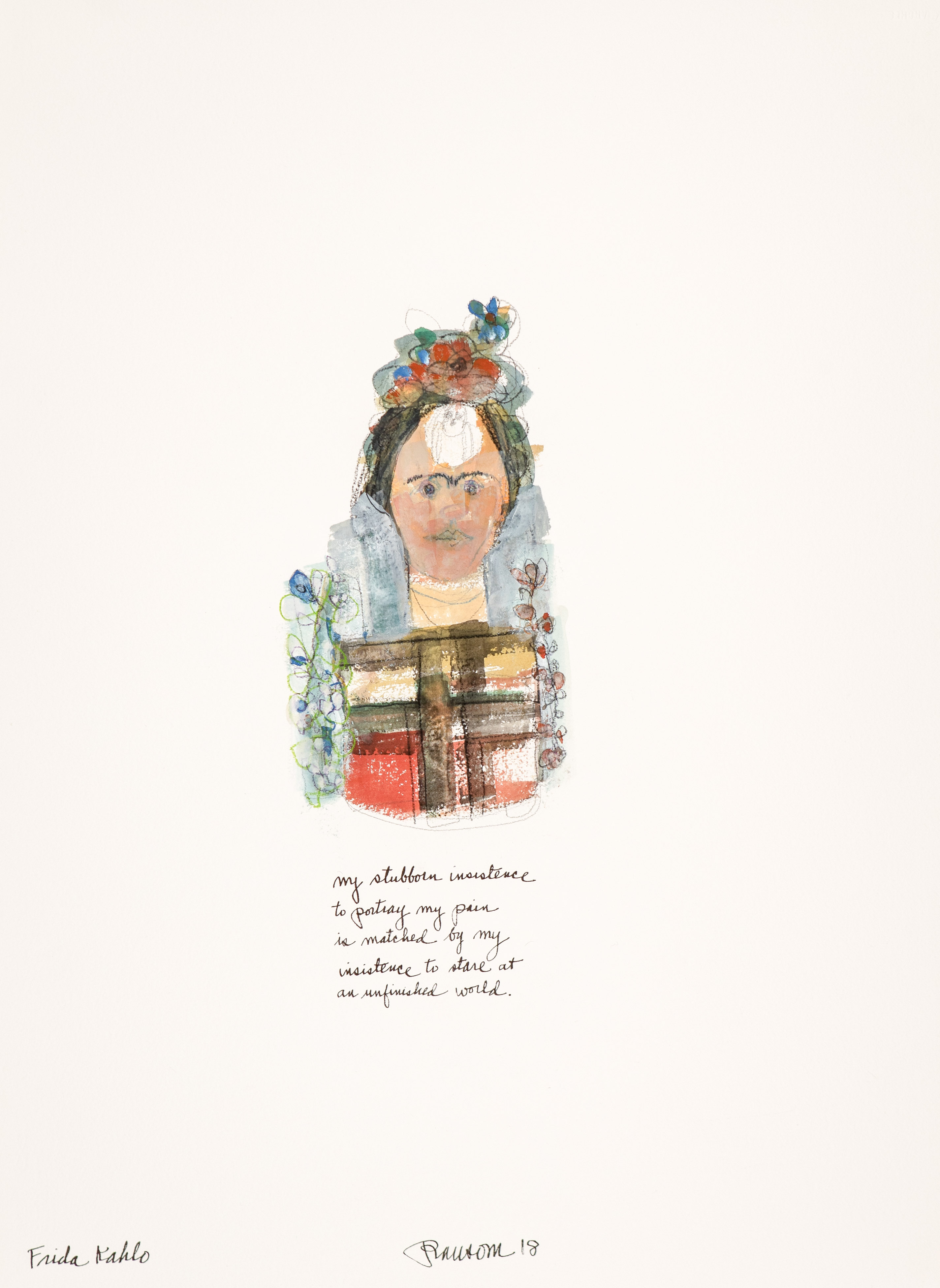
The first thing I noted was that Ransom Phillips, as a true multi-disciplinary artist, brings poetry into all his endeavours. His delicate paintings, which use colour and negative space effectively, have a thoughtful, dreamlike quality, underscored by descriptive titles. I could see influences of earlier American artists. Wayne Thiebaud‘s colourful outlines, for instance, which lift objects off the page or canvas.
As for Mary Lincoln and Frida Kahlo, Ransom Phillips brings them together through his deep interest in identity and transformation. Both Lincoln and Kahlo lived lives in the public eye, defined at first by their husbands, but determined to try to take control of how others perceived them. Both played multiple roles – Lincoln as First Lady, wife, mother, Southerner; Kahlo as wife, artist, Communist, Mexican – and used factors within their control, such as fashion, to assert them. There is a much stronger visual language surrounding Kahlo, so she tends to be the dominant force throughout. But it is interesting to see Ransom Phillips come back to this idea over a number of years.
Mrs. President – Charing Cross Theatre, London
Another first now for the Salterton Arts Review, as I headed to the Charing Cross Theatre. There’s been a theatre here (originally a music hall) since the 19th century, so I really have no excuse not to have visited before. Settling in my seat for the performance of Mrs. President, I looked forward to seeing how Ransom Phillips’ vision of Mary Lincoln would develop on the stage, as opposed to delicate watercolours.
One difference, as the artist and playwright notes in the programme, is that in art, once a work is complete, he does not revise it. Mrs. President, on the other hand, has undergone a long process to arrive at its current form. This includes a run at the Edinburgh Fringe in 2023, and at this very same theatre in 2025.
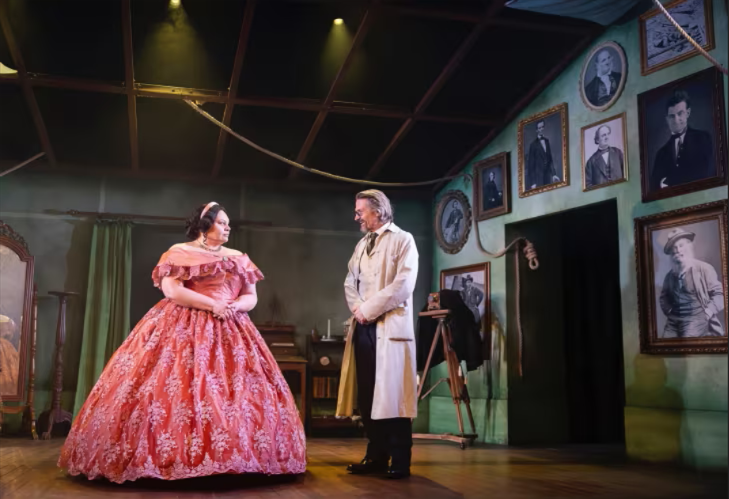
The premise of the play is a series of interactions between Mary Lincoln and Mathew Brady, a photographer who took many images you would recognise, including of Abraham Lincoln, Walt Whitman, and other figures central to a developing American identity. There isn’t exactly a linear plot, though. It’s therefore unclear whether the scenes take place in Brady’s memory, Lincoln’s imagination, or somewhere else. The key point is that we see Lincoln reflect on various key moments as she struggles to find an identity that is not imposed on her by others.
Having just seen the exhibition at the RWS Gallery, I felt I understood the play better than I may have done otherwise. Mrs. President, too, comes from a deep interest in image and identity. Various figures from Brady’s photographs, like artist John James Audubon and Chief Justice Roger B. Taney, come to life to explain how they used Brady’s services and the emerging technology of photography to manipulate a narrative they wanted to tell about themselves.
It’s a really interesting subject. But I come back to one of the questions I ask myself periodically here on the blog: is theatre the right medium? In this case I’m not sure. Even though I found the topic engaging, at the same time I found the play itself a little static, with fairly dense dialogue doing the heavy lifting on exposition, and not too much in the way of character development for Brady. But I thought the performances were good, and loved the set (Anna Kelsey) and lighting (Derek Anderson) design.
Final Thoughts on this Mary Lincoln Double Exposure
Of the US Civil War-era plays doubling as rehabilitation for historic female figures currently playing on the London stage, I think this one probably does the best job of sticking to the topic at hand. Yes, there are men’s stories told here too, but they are minor and all in service of this point around forging your identity and how you are seen by others. I would like to think we understand a bit better now that if a woman is constantly maligned for her spending habits, clothing, and supposedly difficult behaviour, that in itself is as likely to be a perspective serving someone else’s interests as it is the truth. Or maybe not, because it does keep happening. To women, in particular.
Anyway, I’m going off on a tangent of my own special interests, now. Having now sampled the plays and exhibition where Mary Lincoln features as a central or secondary figure, I understand a lot more about her than I did before. The dual perspective from John Ransom Phillips, in particular, allowed me to consider more deeply why she’s remembered as she is: who gained from it, and who lost. If anything, it made me want to see a reversed play about Mathew Brady and his active role in shaping the image of America. And to reflect a bit more about how the same dynamics continue to play out today as public figures shape and control (or on occasion lose control of) their images.
And so I come back to a point I’ve frequently been making recently. There’s a lot for us to learn from looking back to the past. This historic period, in particular, reminds us that some contemporary struggles are not new. From a deeply divided society to individual struggles with grief and loss, others have trodden the path before us. But we always have agency in how we choose to respond.
Salterton Arts Review’s rating:
Mary Lincoln & Frida Kahlo UNFRAMED: 3/5
Mrs. President: 3/5
Mary Lincoln & Frida Kahlo UNFRAMED on until 21 February 2026. More info here.
Mrs. President on until 8 March 2026. More info here.
Do see both together if you can!
Trending
If you see this after your page is loaded completely, leafletJS files are missing.