
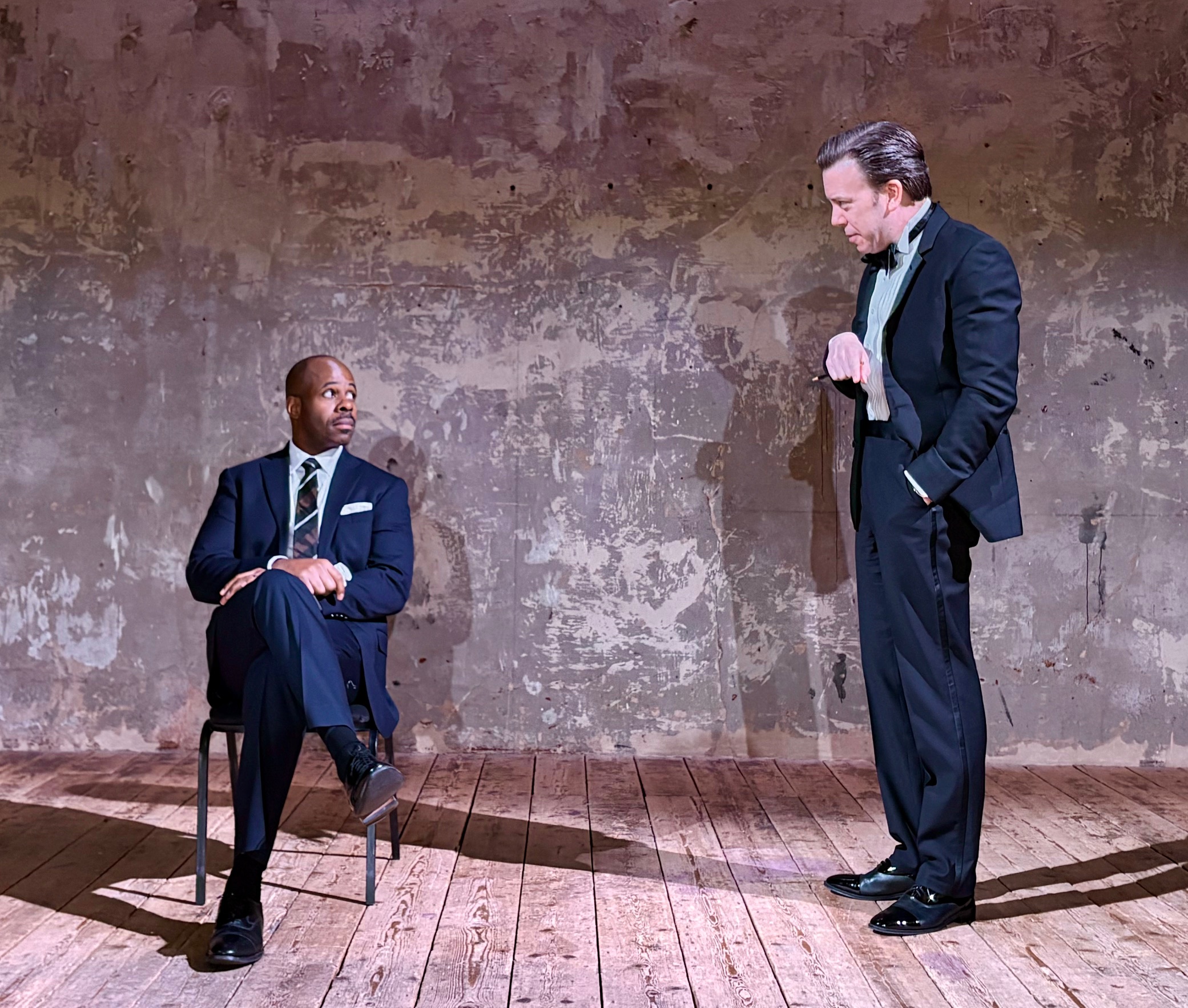
Debate: Baldwin vs. Buckley – the american vicarious / Wilton’s Music Hall, London
Debate: Baldwin vs. Buckley brings a landmark 1965 Cambridge Union Society debate to Wilton’s Music Hall, and proves that it still has plenty to say.
Note: this post uses outdated terminology in a historic context.
Debate: Baldwin vs. Buckley
I love Wilton’s Music Hall for the possibilities its space and programming embody. In the past I’ve enjoyed theatre, mime, singalongs, poetry and other events in this rare surviving East End venue. Now I’ve added another type of performance to that list: the verbatim debate.
Debate: Baldwin vs. Buckley is brought to the London stage by the american vicarious, who are also behind Our American Queen, still on for a couple more days at the Bridewell Theatre. I enjoy the idea of bringing American stories to the London stage. But of the two, I far prefer Baldwin vs. Buckley.
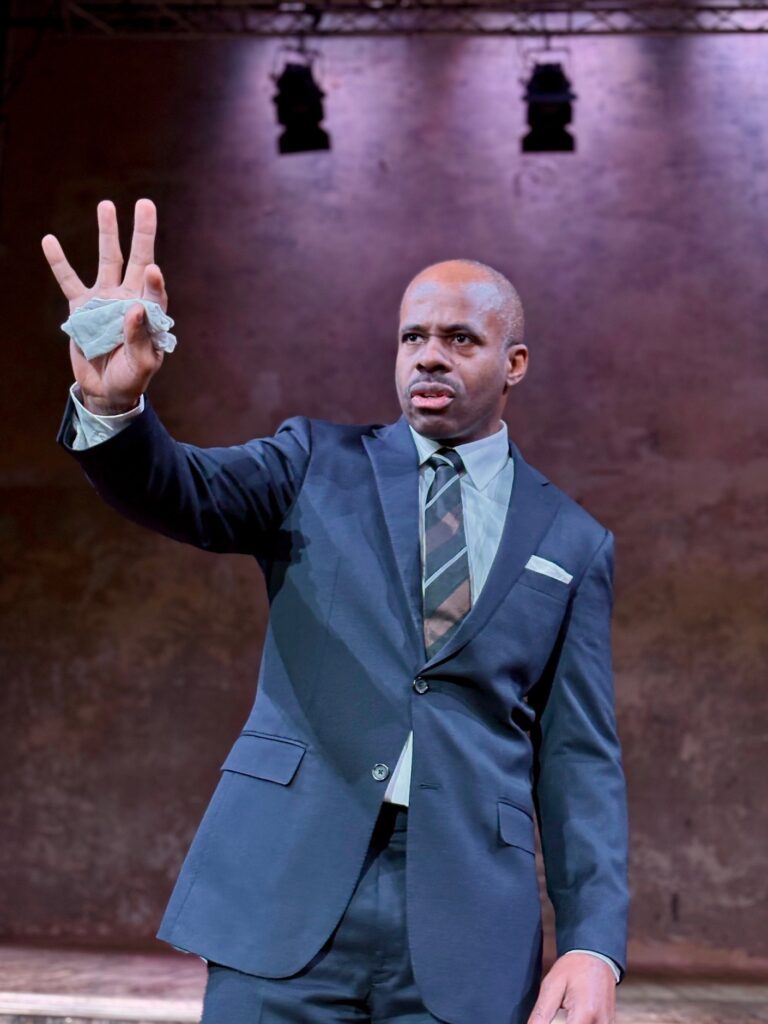
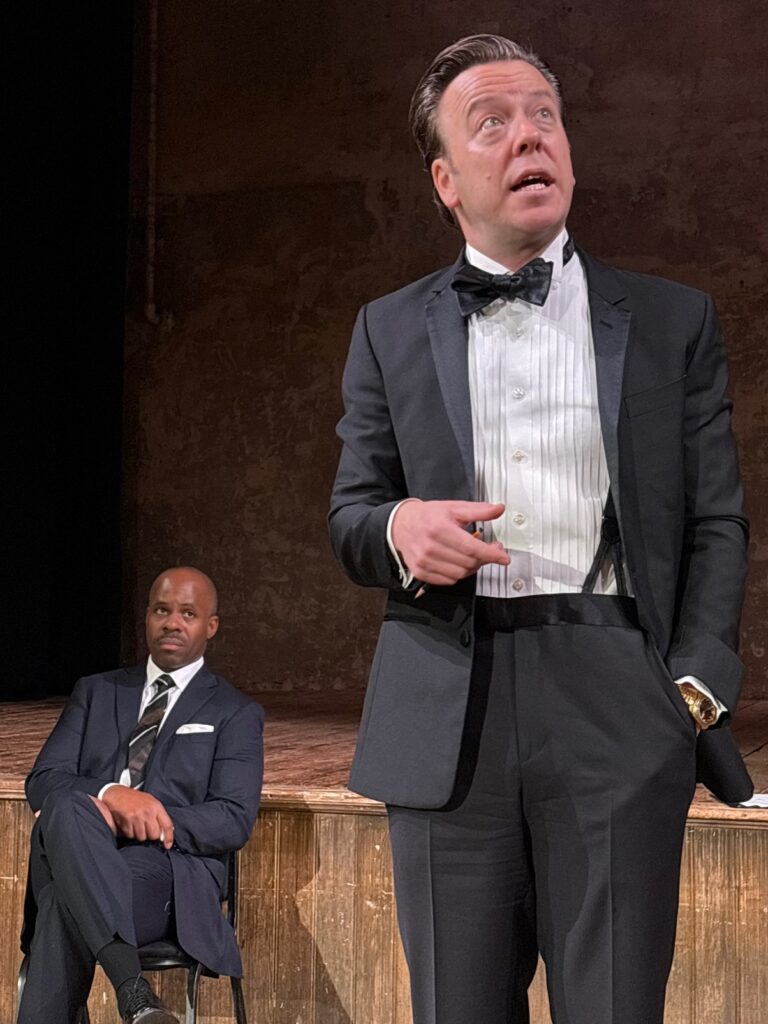
The evening centres on a 1965 debate at the Cambridge Union Society between two American intellectuals. James Baldwin and William F. Buckley Jr. respectively supported and opposed the motion “Is the American Dream at the Expense of the American Negro?”. The hugely popular debate was televised by the BBC, and footage from the original recording appears throughout the production. It frames the speeches by Baldwin (Arnell Powell), Buckley (Eric T. Miller), and Cambridge students David Heycock (Christopher Wareham) and Jeremy Burford (Tom Kiteley).
This raises an obvious question. Does recreating the debate verbatim add anything to what you could glean from watching the recording on YouTube? For me, the answer is a firm yes. Firstly, although the debate exists on film, 1965 was a long time ago. The quality is poor, and the presenter’s RP introduction reinforces the temporal and cultural distance (while at the same time being rather endearing). Sitting in the audience and being addressed directly, as if you were a student attending the debate, feels very different, and far more impactful.
Second, although the dialogue is verbatim, some editing has taken place. There were many more student speakers on the night. Here, we see only the two who introduce and oppose the motion, before jumping straight to Baldwin and Buckley. Those examples are enough to demonstrate the ideological leap between the students and the masters. Would it have been nice to include Sheena Malhosa, seemingly the only woman to debate that evening? Perhaps. But I’m not convinced it would have added much beyond a reduced gender imbalance. And the recordings I could find don’t include those later contributions anyway.
A Question that Cuts to the Soul of America
Back to the motion itself. The four speakers take very different approaches. The students lean on statistics to support or refute claims about repression and progress. Baldwin then takes the stage and offers something entirely different: a personal and powerful argument that the American Dream is impossible in a society that has destroyed the lived reality of its Black citizens. The foundations of that dream were the labour of the enslaved, but its rewards remain out of reach. The applause, both live and recorded, is resounding.
Buckley follows, with a difficult task ahead of him. I wondered whether what we saw were a series of buttons which, when pressed for an American audience, produce a predictable result. His warnings about race wars, and his exhortations for an oppressed community to pull themselves up by their bootstraps, fall flat. The victory is Baldwin’s.
Other than enjoying this as a debate unfolding before our eyes, there are two things to take away. The first is how little has really changed since 1965. Yes, the Civil Rights Movement brought legislative progress. But given that the impetus for this production was the murder of George Floyd, can we honestly claim deeper change? Or, watching this in London, can we ignore similar dynamics at home?
The second is a reminder that disagreement can be civil. Hard to recall in an age of clickbait and social media. But here are two men taking opposite sides of a question that cuts to the soul of America, doing so with respect and dignity.
At heart, this is a very simple affair: four actors, some archival footage, and an audience. But I think it’s well worth seeing, as we continue our 2026 habit of looking to the past to extrapolate lessons for our present and future.
I was also interested to learn that the production has toured to a number of small locations across the US, with post-show debates. That feels very much in keeping with the spirit of the original event. And it makes sense. This isn’t something that feels complete when it wraps up neatly at the curtain call. It’s the kind of material that invites further conversation, and probably a fair bit of disagreement too.
Salterton Arts Review’s rating: 3.5/5
Debate: Baldwin vs. Buckley on until 7 February 2026. More info and tickets here.