
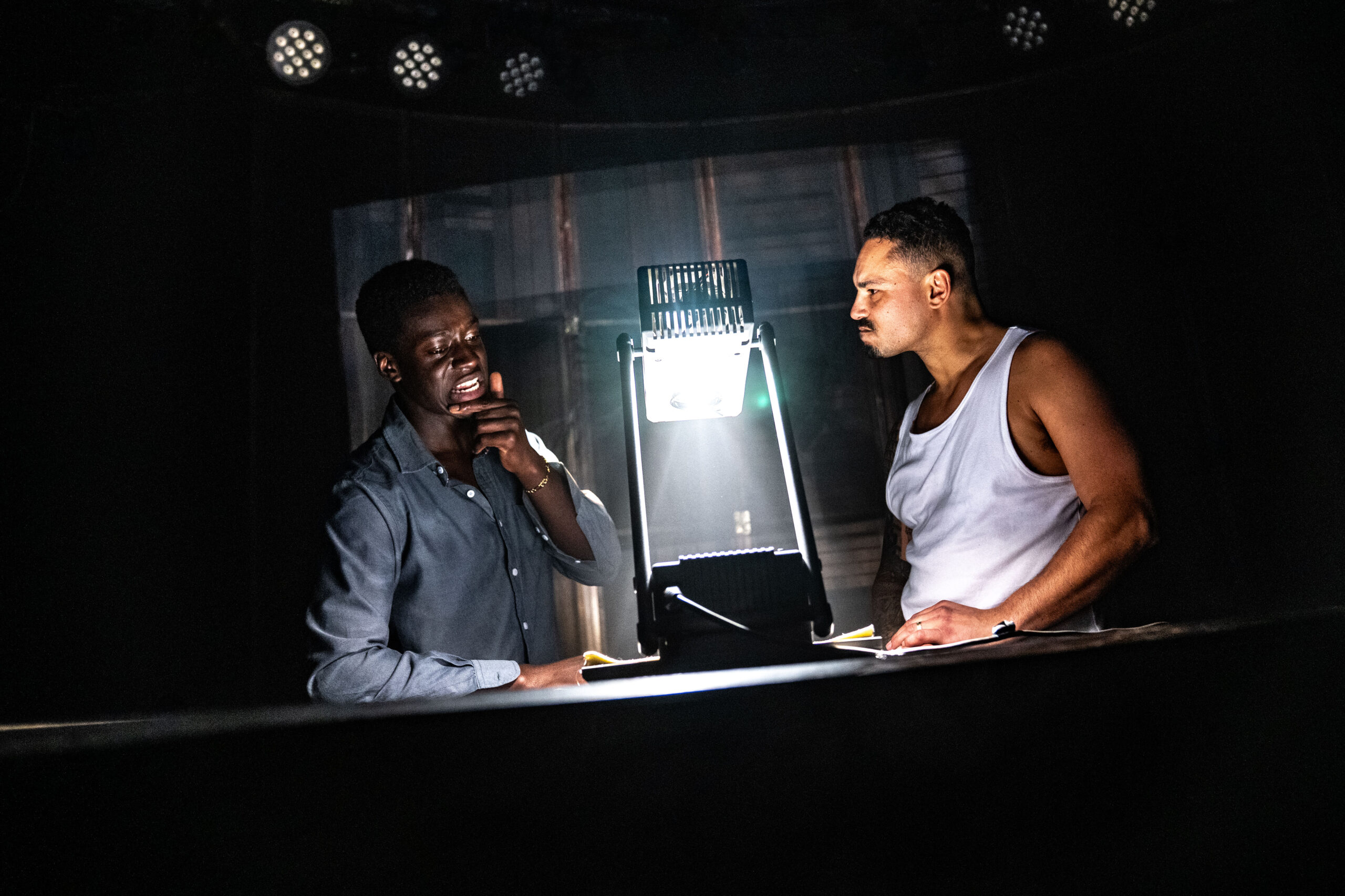
MILES. – Southwark Playhouse Borough, London
MILES. at the Southwark Playhouse feels less like a conventional play and more like a piece of live jazz, with all the unpredictability that implies.

MILES.
I was thinking, as I watched MILES. at the Southwark Playhouse Borough, about a pre-show talk I once went to by the Jazz at Lincoln Center Orchestra. I’m not especially knowledgeable about jazz (which is why I’d gone along), but I was struck by the idea that pushing the form forward means continually defying expectations. Unexpected notes, moments that feel almost atonal, tension and release – all still somehow resolving into a coherent whole. MILES. comes close to feeling like jazz in that sense. It has a complex structure, jumps between moments and ideas, echoes the past, and resists straightforward storytelling. But when you take a step back, it comes into focus as something thoughtful and cohesive.
The Miles of the title is, of course, Miles Davis. Jazz trumpeter Jay Phelps (to whom is due credit for the concept) plays a fictionalised version of himself, struggling with both record label expectations and his own desire to create something worthy of Davis’s 1959 masterpiece Kind of Blue. As he listens to the master tapes, Davis appears as a ghostly mentor, pushing Jay (or “Dave”, as Miles insists on calling him) to stop chasing his heroes and find his own voice.
Since its Edinburgh Fringe run, the production has been extended by around 30 minutes and now runs at 90. That extra time allows for deeper conversations between Phelps and Davis about music, race, legacy, and the personal cost of genius (which, from the examples given, goes hand in hand with addiction). Benjamin Akintuyosi, making his professional debut, brings real presence to Miles, while Oliver Kaderbhai’s writing and direction allow the piece to unfold organically rather than forcing it into a traditional narrative shape.

Music, Memory and Imagination
There may still be moments that could be trimmed, but then again, who am I to judge? Perhaps those are the discordant notes I don’t yet have the ear for. The staging is creative and fluid, though the Southwark Playhouse’s deep seating on three sides makes sightlines important: sitting as front-on as possible helps you fully appreciate Colin J. Smith’s video design working alongside Ellie Wintour’s set and costumes.
I mentioned recently seeing a Fringe transfer that didn’t quite survive the move to a larger space. MILES. very much does. The blend of live music and theatre feels organic and exciting rather than decorative, Akintuyosi’s Miles brings Phelps along with him emotionally, and Phelps’s trumpet playing carries real weight throughout.
What I appreciated most is that the show doesn’t try to be definitive. It isn’t a full biographical portrait of Miles Davis, nor a neat success story about an artist finding himself. Instead, it sits somewhere in between, as a conversation across generations filtered through music, memory, and imagination. Yes, it’s episodic, and not everything lands perfectly. But that feels fitting for a piece about process, pressure, and trying to make something new while living in the shadow of a giant like Miles Davis.
I think this is a Fringe transfer that genuinely works in a larger space. The performances have room to settle, the music comes through clearly, and the whole thing feels confident. It’s not flawless, but importantly, as MILES. points out, neither are some of the works of art we consider masterpieces. What it is instead is thoughtful, musically rich, and well worth a look.
Salterton Arts Review’s rating: 4/5
MILES. is on until 7 March 2026. More info and tickets here.
Trending
If you see this after your page is loaded completely, leafletJS files are missing.