
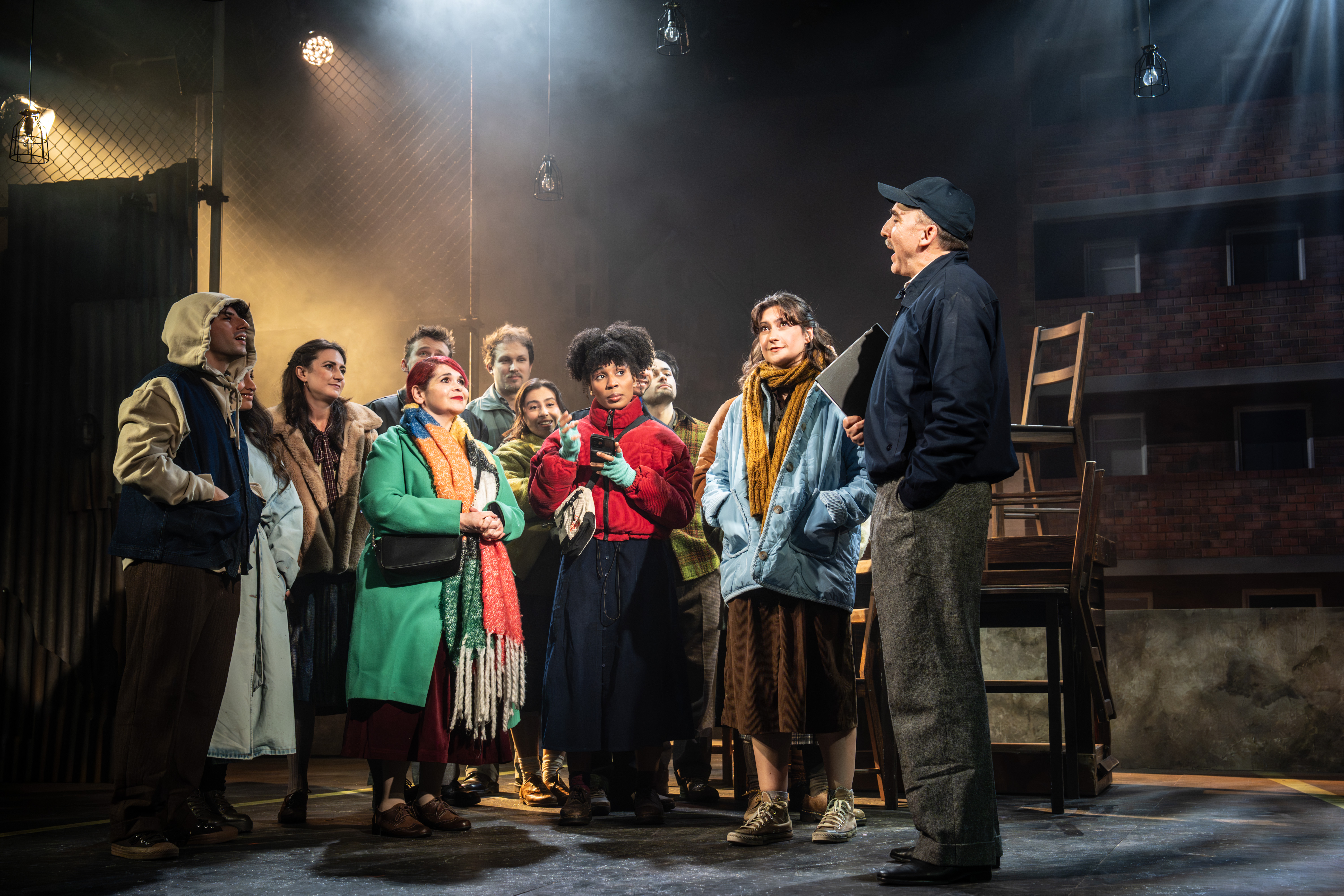
Cable Street – Marylebone Theatre, London
Cable Street returns to London at a moment when its story of community resistance to fascism feels worryingly relevant.
Cable Street
Well. I can’t imagine that when Tim Gilvin and Alex Kanefsky independently had the idea for a musical about the Battle of Cable Street back in 2018, they quite realised how timely it would feel on its third run at the Marylebone Theatre. Or maybe they did. The writing has been on the wall for a while now. Either way, a musical about a community coming together to stand up against fascists really couldn’t be more relevant.
In one sense, it’s pretty sad that we’re back here again, ninety years on from that stand against Sir Oswald Mosley and the British Union of Fascists. In another, it gives me a bit of hope. Rising fascism can be challenged, even if it can’t, seemingly, be permanently defeated.
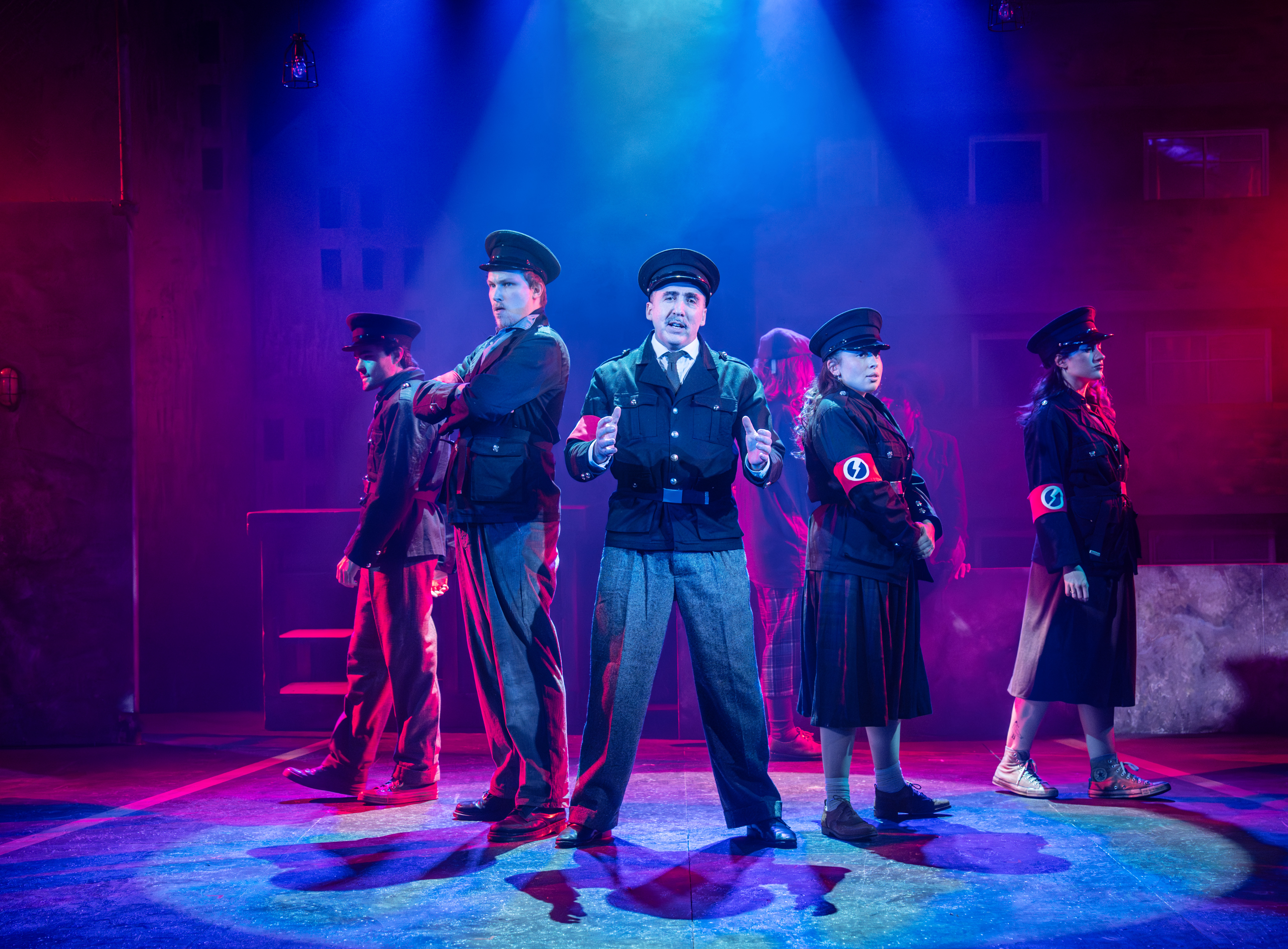
Shall I just do a brief reminder of the Battle of Cable Street, then? Set the scene a bit? Picture London’s East End in 1936. Still primarily Jewish, but with British, Irish, Chinese and other populations living side by side. Times are tough. Unemployment is high. Mosley, possessor of a signature pencil moustache, spots a vulnerability he can exploit. His movement of Blackshirts offers pride and belonging to young men who feel hopeless, along with a convenient enemy. Immigrants, rather than landlords or employers, are to blame for rising rents and fewer jobs. It all sounds depressingly familiar.
That narrative proves convincing enough for Ron Williams (Barney Wilkinson), newly arrived from Lancashire and struggling to make a start in London. Some of his neighbours, including Sammy Scheinberg (Isaac Gryn) and Mairead Kenny (Lizzy-Rose Esin-Kelly), are not exactly Mosley’s target audience. They gravitate instead towards the local Communist Party.
At this point, we’re mixing truth and fiction a little. But the broad outline holds. On 4 October 1936, Mosley planned to march through the East End: a deliberate provocation to the Jewish community. People had had enough. Despite a petition with over 100,000 signatures, and little formal backing from political or religious organisations or their MP, resistance was organised locally and quickly.
A Battle and its Aftermath
Residents dragged furniture from flats to form barricades. Women threw household objects from upper-storey windows. Clashes broke out across several locations between the Blackshirts, the police assigned by the Home Office to protect their right to march, and hundreds of thousands of anti-fascist counter-demonstrators. Ultimately, Mosley and the BUF abandoned their plans. They didn’t reach any of their four intended destinations across East London.
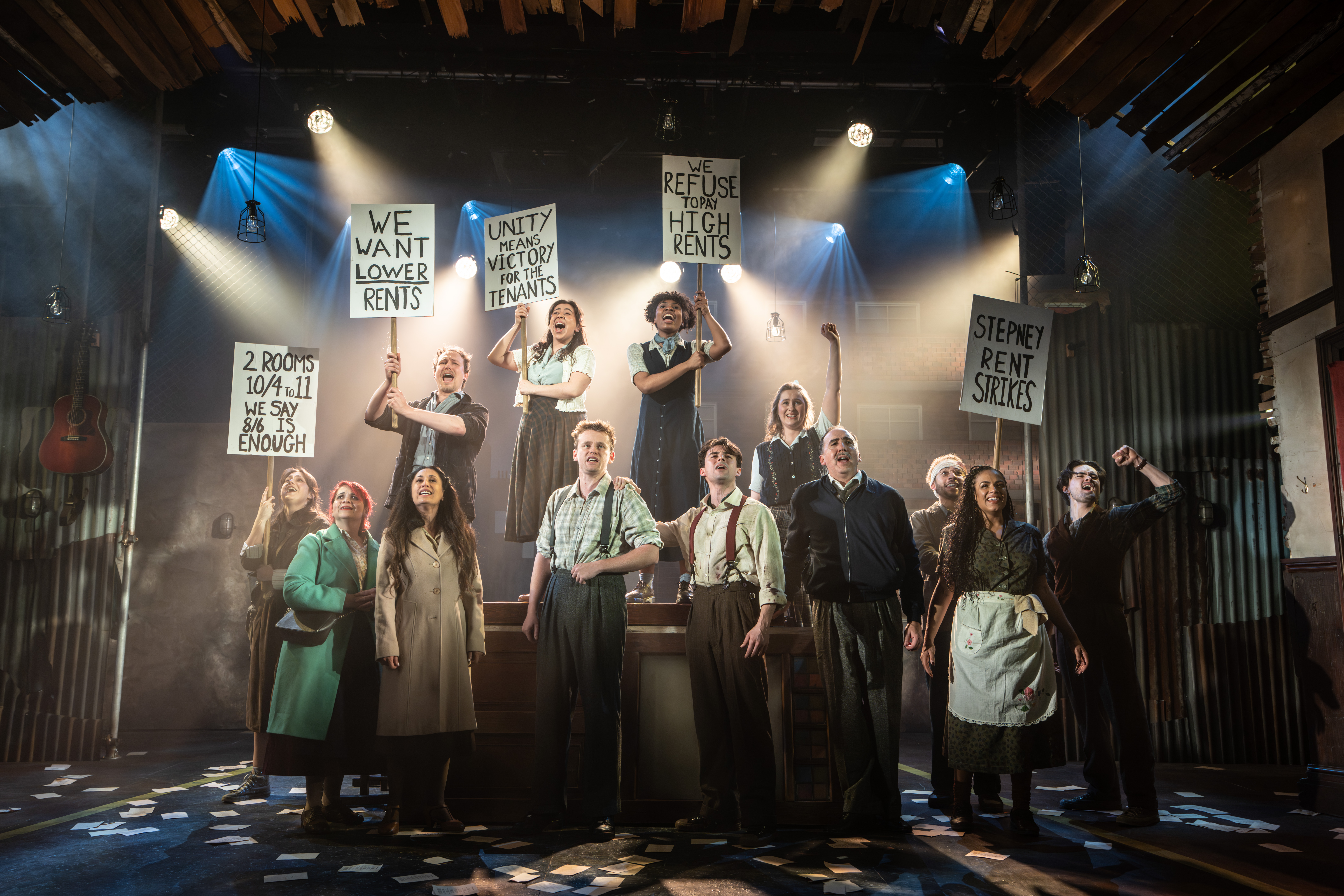
In the weeks that followed, anti-Semitic violence increased. But the Battle of Cable Street did weaken Mosley’s hold. It also prompted some anti-fascist groups to look more closely at what drove so many young men towards the BUF in the first place. Further organising followed, including work around rent protection and strikes. Cable Street covers all of this ground: the drivers, the confrontation, and the aftermath.
It does so in just over two and a half hours. Some might say that’s a bit long. The Salterton Arts Review is, notoriously, a fan of an early bedtime. But honestly, I don’t know what I would cut. Luckily, I’m not a dramaturg, so I don’t have to face that challenge. What’s constructed in that time is a work with strong musicality, excellent performances, engaging and overlapping storylines, and a hopeful message that steers clear of naivety.
The people of Cable Street are complex characters. The battle isn’t a victory that fixes everything. Coming together to support your neighbours is framed as an ongoing process. It requires resolve and solidarity, not just a single day of resistance. Only by making the effort to continue finding common ground, and to fight for a shared good, can differences begin to be overcome. Again, it’s hard not to see the relevance.
Creating a New Musical
New musicals are notoriously difficult. They’re expensive to get off the ground, and even harder to build momentum for. The crowd-pleasers aren’t always the most theatrically interesting works. Cable Street manages to be both.
I was particularly impressed by the songs, which range from genuinely heartrending ballads to energetic full-cast numbers. There’s live music, including on-stage guitar and fiddle playing, ranging from folk to contemporary. This makes for a very nice part for Max Alexander-Taylor, a valuable addition to any new musical. I also liked the way Sammy, whose diary the narrative is built around, has a distinctive musical style that veers much more towards rap. It marks him out as important, but also suggests a kind of rebellion against expectations and social strictures. It’s a small but effective choice.
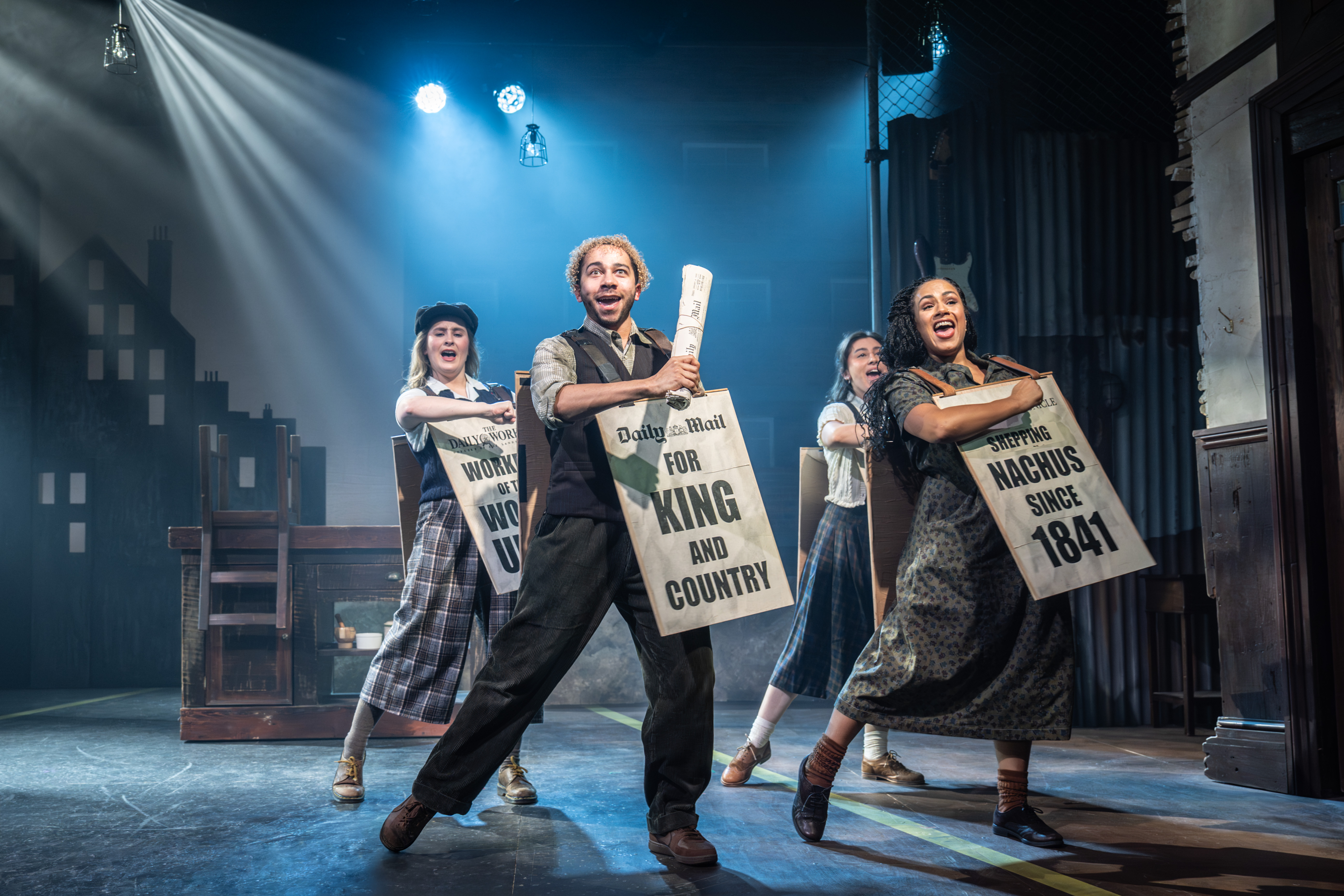
The storytelling is also pleasingly complex. We first meet Oonagh (Debbie Chazen), a tourist who’s joining Steven’s (Jez Unwin) East End walking tour hoping to connect with her family’s history. We quickly slip back in time, following three families living, or more accurately eking out a living, in Camelot Mansions on Cable Street. From very different backgrounds, they face the same pressures in different ways, with varying degrees of trust in political movements, religious groups and other organising forces. Interspersed throughout are music hall-style interludes in which we hear the viewpoints of different newspapers of the time. This feels like a stroke of genius. It references East End entertainments of the period, offers a neat lesson in media bias, and is consistently very funny.
Despite my grumbles about the running time, and a small gripe about the sound (I struggled to catch some dialogue, including what I assume was a recording of Mosley himself), I thoroughly enjoyed Cable Street. This is a story from history that has the potential to act as a clarion call for those facing a rising tide of fascism. Gilvin and Kanefsky’s combined forces have produced a musical that feels entertaining as much as it is urgent. The performances are uniformly excellent, as is the quality of the vocals. Yoav Segal’s set is inspired: drawing the eye in by framing the stage with a tenement block. Adam Lenson‘s direction keeps the narrative strands clear and the emotional impact strong. If you, like me, regret not seeing Cable Street back in 2024, now feels like a very good moment to catch up.
Salterton Arts Review’s rating: 4.5/5
Cable Street on until 28 February 2026. More info and tickets here.
Trending
If you see this after your page is loaded completely, leafletJS files are missing.