

The Standard of Living – Theatre Royal Haymarket, London
Economics and ballet sound like a strange pairing, but come together beautifully in The Standard of Living, a play about John Maynard Keynes.
The Standard of Living
The Urban Geographer was the one who spotted and booked The Standard of Living. It combines two things he really enjoys – economics, and stage performances by Rory Kinnear. It was also the Urban Geographer who booked us in to see Rory Kinnear in Young Marx at the Bridge Theatre many years ago. As in that production, Nicholas Hytner directs.
Rather than the economics/Kinnear combo, it was the economics/ballet that intrigued me about this play. Not that I have anything against Rory Kinnear. I think he’s a very good actor, actually, and he’s very good in this. But more than learning about economics, I wanted to see how a live performance by a ballerina would be incorporated into a work of theatre. In the end, I did also enjoy the economics to a surprising degree.
But anyway, let’s set the scene. As I learned from this play John Maynard Keynes, born in 1883, was a free thinker in life as well as in economics. Studying business cycles and macroeconomics, he proposed a more interventionist economic approach than the laissez-faire standard of the day. Roosevelt’s New Deal, post-WWII rebuilding efforts, and even COVID-19 stimulus responses follow the ideas Keynes set out. His was a rather humanist world view, arguing that markets might well correct themselves in the long run, but a lot of people suffer needlessly in the meantime. The opposing view – as later adopted by Thatcher and others – is represented in the play by Austrian-born economist Friedrich Hayek (Laurie Kynaston).
I mentioned, though, that Keynes was a free spirit in life as well as in economics. I was not at all aware of his connection to the Bloomsbury Group. He effectively bankrolled them, cutting cheques that allowed them to continue pursuing their art in Bohemian comfort. The play makes the point that, as outsiders, Keynes and the Bloomsbury Group were found family. Keynes, whose relationships in his early life were exclusively with men, also counted Duncan Grant (Thomas Flynn) and Lytton Strachey (Pip Carter) amongst his partners. The play portrays the group’s fairly fluid sexuality, including Keynes marriage to Ballets Russes dancer Lydia Lipokova (Natalia Osipova).
A Hopeful Play
This, as it sounds, is a lot of detail to pack into a play. Biographical detail. Economic detail. Art historical detail. 20th century historical detail. I’ve critiqued plays before for seeming like a long-form essay come to life (including this one also directed by Hytner). I don’t know if the difference was that I just gelled with this play a bit more. Or perhaps that I had a bit of a head start. I think if you weren’t already familiar with the Bloomsbury Group, you might be a bit lost on who’s who and what’s what. It’s probably just about at the limit of how much information you can fit into a play and still have time for a plot.
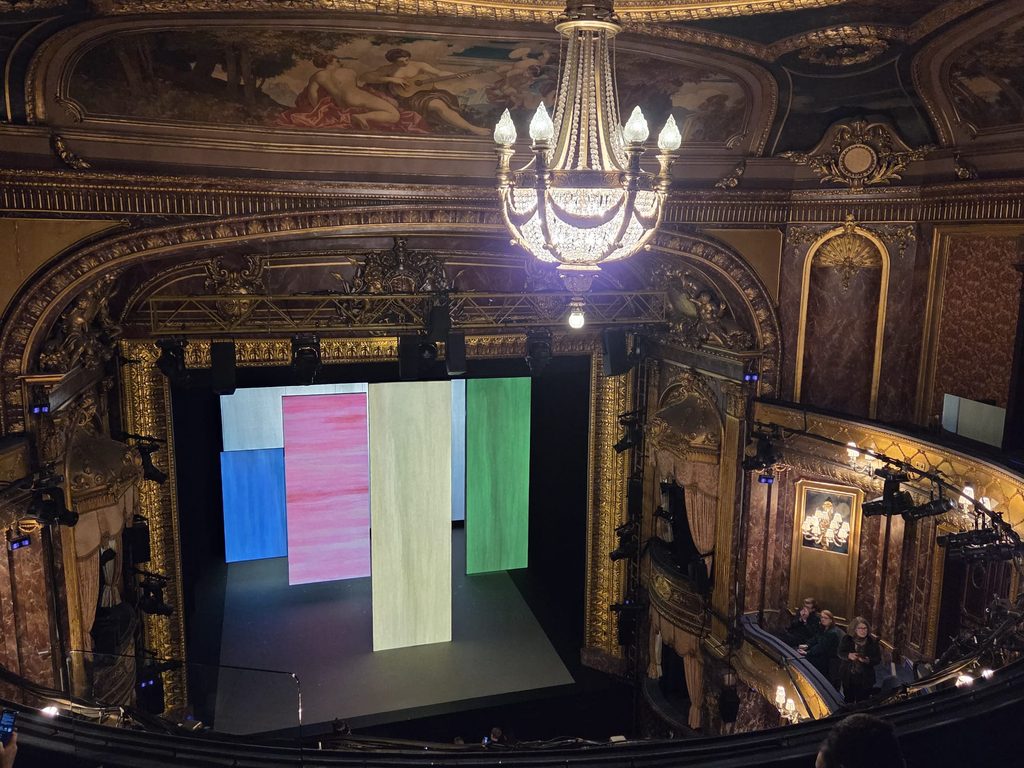
The quality of the production helps enormously with the storytelling. Bob Crowley’s set has stylish, complex, moving parts, upon which paintings and archival images are projected. The set also makes for very fluid scene changes. And then there is the dancing and movement direction. At first, Royal Ballet principal Natalia Osipova (here in her acting debut and excellent in the role) appears in brief interludes, as the Firebird and other Diaghilevian roles. Once Lipokova is introduced as a character these interludes disappear for a time, but dance remains an important element of the production. I appreciated a final ballet scene at the play’s conclusion.
What is a good life? That is a question Keynes comes back to again and again throughout the play. It’s clear that, for the ‘father of macroeconomics’, a good life is about more than numbers. Art, dance, desire, and beauty permeate the play. A timely reminder that, even though the play suggests the world will continue to swing between free market and Keynesian economics, we can dare to dream of something more.
Salterton Arts Review’s rating: 3.5/5
The Standard of Living on until 12 December 2026.
Trending
If you see this after your page is loaded completely, leafletJS files are missing.