
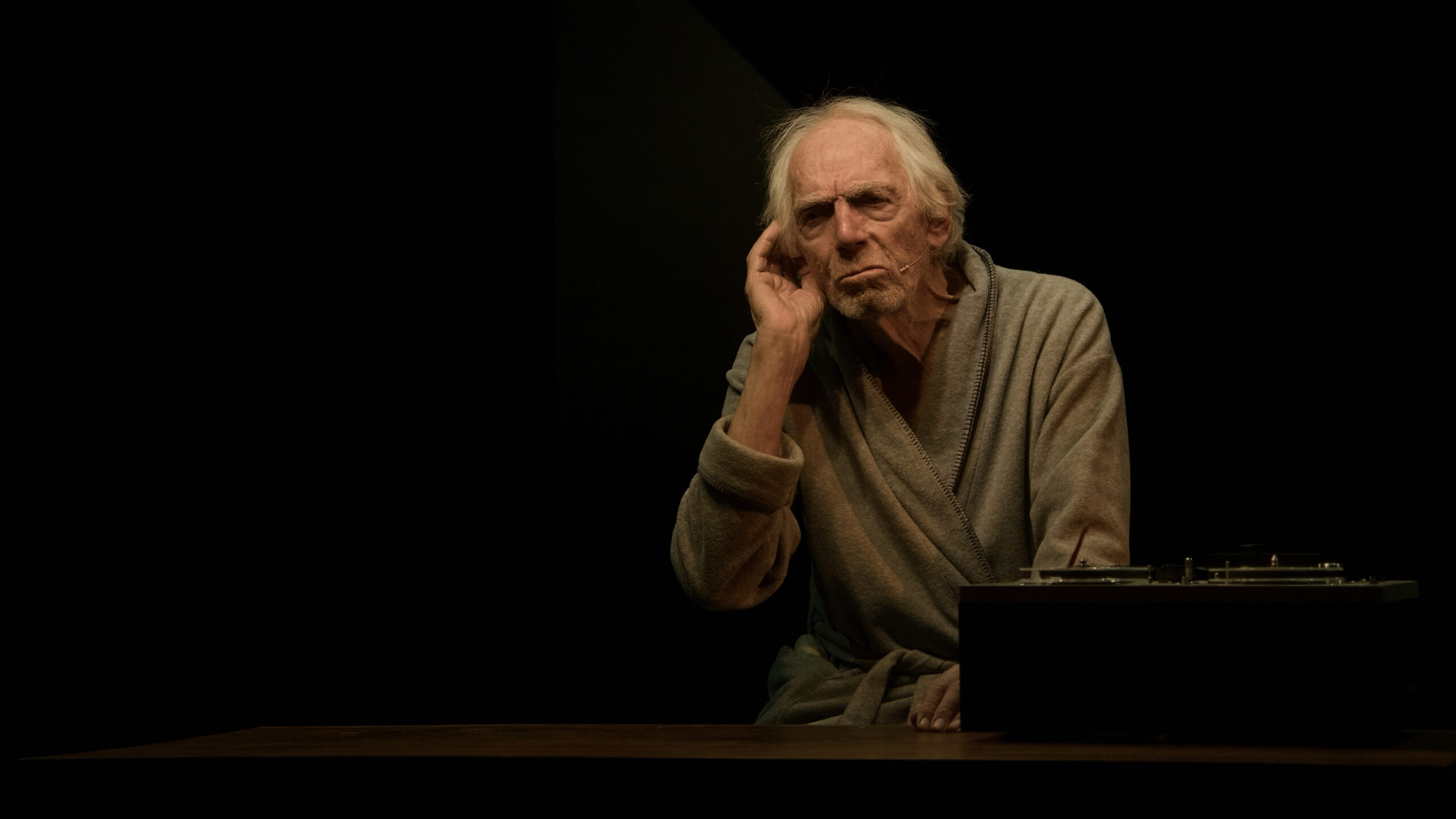
Krapp’s Last Tape – The Cockpit, London
A remarkable version of Beckett’s most autobiographical work, Krapp’s Last Tape, is currently on at The Cockpit. To what extent does our memory of past selves constitute our identity?
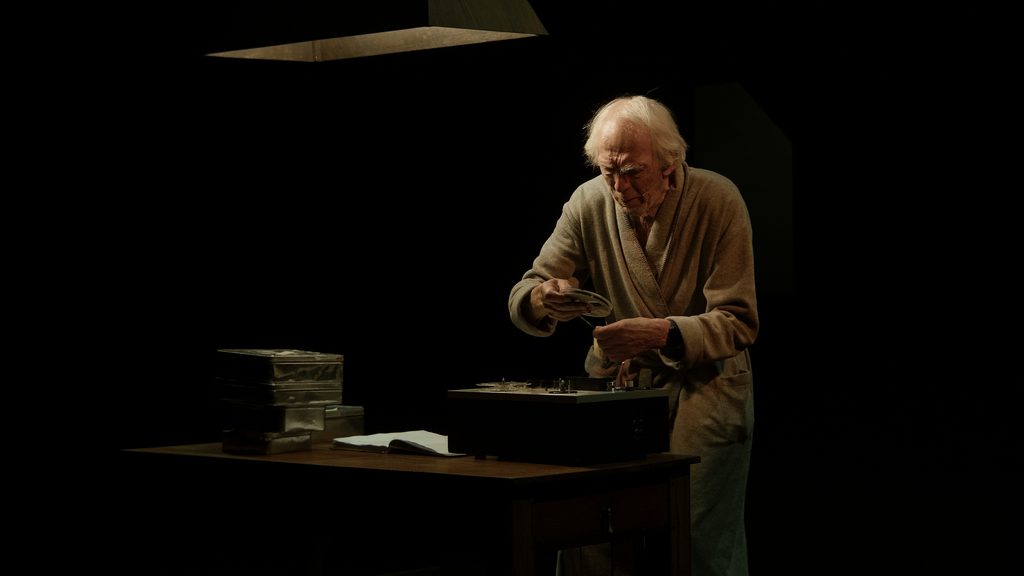
Krapp’s Last Tape
Yes, remarkable really is the word I would use to describe this production. Actor Peter Marinker, recently diagnosed with Alzheimer’s, brings decades of experience performing works by Samuel Beckett to the role of Krapp in Krapp’s Last Tape. This one-act monologue is said to be Beckett at his most autobiographical. In it, a man celebrates his birthday alone, recording, as he does each year, his thoughts on the year. At the age of 69, he listens to a recording of his younger self, which in turn references earlier recordings. Over the course of the piece, Krapp reflects on memory and his relationship to his younger self, choice and regret, love lost or never pursued.
Like many works by Beckett, at least in my experience, Krapp’s Last Tape is equal parts funny and bleak. The most notable part of Krapp’s year, it seems, is his momentary revelling in the word ‘spool’. Does he still share his younger self’s lack of regret for the path he has trodden, and the choices he has made? There is ambiguity there, as there is in the title itself. Is ‘last’ a reference to the last tape Krapp made, or is this his last birthday and last recording?
The circumstances of this production allow Marinker, and director Dave Wybrow, to deeply explore some themes of the work. The relationship between memory and remembering, for instance, and its relevance to one’s sense of self, and the idea of awareness and its return in response to stimulus.
To return to the word ‘remarkable’ once more, Marinker’s career provides the perfect set up for the experiment before us. One element in an extensive career in stage and voice acting has been a long connection with Samuel Beckett. Marinker worked closely for many decades with Beckett’s publisher John Calder. He was also a founding member of The Godot Company in the early 2000s. In this case, the reel to reel recordings of Krapp’s younger self are from Marinker’s last time performing this role in 1983. Surely one of the very few times Krapp has genuinely been able to listen to his younger self’s voice. Remarkable indeed.
Rethinking Participation and Support
“If someone loses mobility they take a stick, a walking frame, a wheelchair, a cab – in order to sustain an active relationship with everyday life. For the person with a memory deficit there are, currently, few such aids or accessories beyond notes on a phone (provided you remember where you left it). Where memory loss cannot be compensated or bridged, the loss of participatory ability and the isolation that follows can be profound, progressive, and damaging beyond repair.”
Dave Wybrow, artistic director of The Cockpit and director of Krapp’s Last Tape, in the production’s souvenir programme
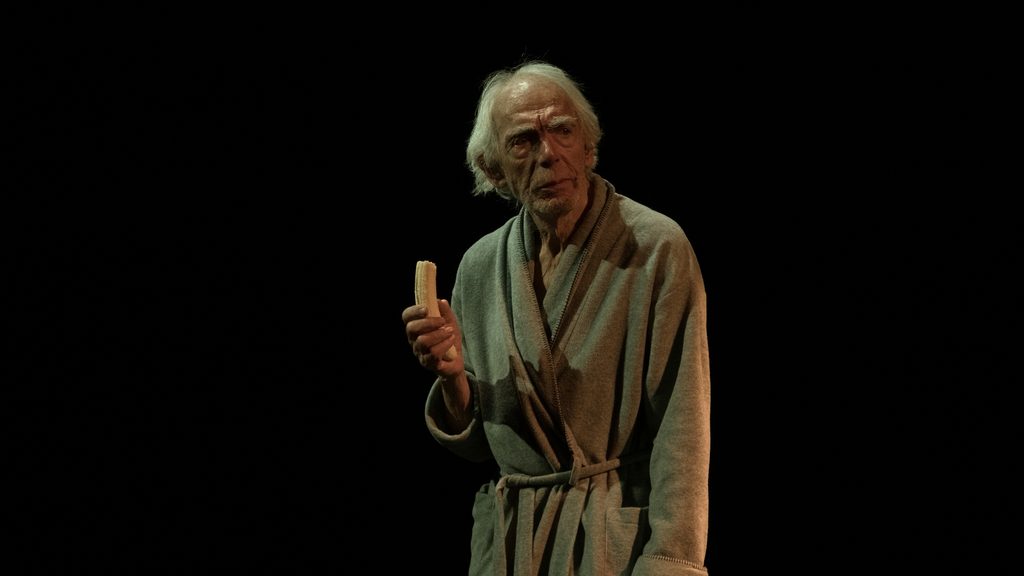
Approaching this production was always going to require creative solutions, given Marinker’s Alzheimer’s diagnosis. Supporting materials for the production explain in advance that audiences should expect the presence of a stage manager (Marta Fossati), and in-ear prompts as required. Marinker is also able to read lines from props and screens. Duncan Henderson’s set design also takes into account what might help Marinker feel most supported. It is simple and minimalistic, while keeping the interplay of light and dark that’s central to the work. The production as a whole takes an approach of centring the best opportunity for the actor’s comfort and success, while keeping the audience experience in mind as well.
This was my first time seeing Krapp’s Last Tape, perhaps surprising given it’s one of Beckett’s more frequently performed works. I am also an easily-distracted person, so I think I might have been able to better immerse myself in Krapp’s world rather than the mechanics of the production if I had seen it before. However, I was impressed by Marinker’s ability to connect with the material even when very much being in the moment and responding to Fossati’s gentle prompts. His Krapp is sombre, brooding, but also wry and nostalgic. No matter how many other versions I might see in the years to come, I will never see another production of this work that comments so uniquely on the idea of reaching back into the past to connect with versions of oneself. The imperfection and beauty of memory.
Krapp’s Last Tape on until 5 September 2026. More info and tickets here.
Trending
If you see this after your page is loaded completely, leafletJS files are missing.