
Grand Egyptian Museum, Giza
The silver lining of only making to Egypt for the first time in 2026 is that I had the opportunity to see the impressive and long-awaited Grand Egyptian Museum, the largest museum in the world for a single civilisation.
A Long-Awaited Museum on a Long-Awaited Trip
What a first day on my tour of Egypt. Well, official first day. On our first day in Egypt, we went to the Egyptian Museum in Cairo, and then for a walk to al-Mu’izz Street in the medieval quarter of the city. But that was an extra day we had added on so we could see something of Cairo. That evening, we met our tour group and started the tour proper. The following morning we headed to the Giza Plateau and saw the Pyramids and the Sphinx. After lunch at a nearby farm (our tour was with G Adventures who always include social enterprises on the itinerary), we headed back to Giza and the Grand Egyptian Museum.
Getting to see the Grand Egyptian Museum felt like a real treat. Ahead of our trip, when people found out we were going to Egypt, the number one question they asked was “are you going to the new museum?”. I was very excited that we were. Despite that, I didn’t know an awful amount about it. I’d read a bit about the origins of the project and how it gave new opportunities to show off the Egyptian national collection of antiquities. I knew that, like many major projects, it had gone over budget and past its deadline. And I knew that it had finally opened to much acclaim and a bit of controversy.
When we arrived at the Grand Egyptian Museum, our guide first explained something of the architecture to us, before taking us to the treasures of Tutankhamun, and then giving us free time. If you’re a really serious museum-goer, you could spend a full day here. For starters the main Grand Egyptian Museum is not the only one on the site. There’s an extra pavillion housing Khufu’s beautiful solar boats. We will look at everything I’ve mentioned already, as well as what else is on view, and how to make the most of your time there. But first a bit more background.
The Grand Egyptian Museum (GEM, المتحف المصري الكبي), a Brief History
The idea to build a new national archaeological museum in Egypt had been in the works for quite a while. Farouk Hosni, who was Minister of Culture from 1987, said in the early 1990s that what is now the Egyptian Museum in Cairo gave him “headaches and depression and its restoration was a disaster”. Not my experience of that museum, but I’m not as close to it as he was.
A foundation stone was laid in 2002, and construction began in 2005. The museum was due to open in 2020 (already a fairly long time), and can all guess what happened then. There were further postponements due to logistical challenges, before the museum finally did a trial opening in October 2024. After yet another delay caused by the political situation in West Asia, it was then inaugurated in a big ceremony in November 2025.
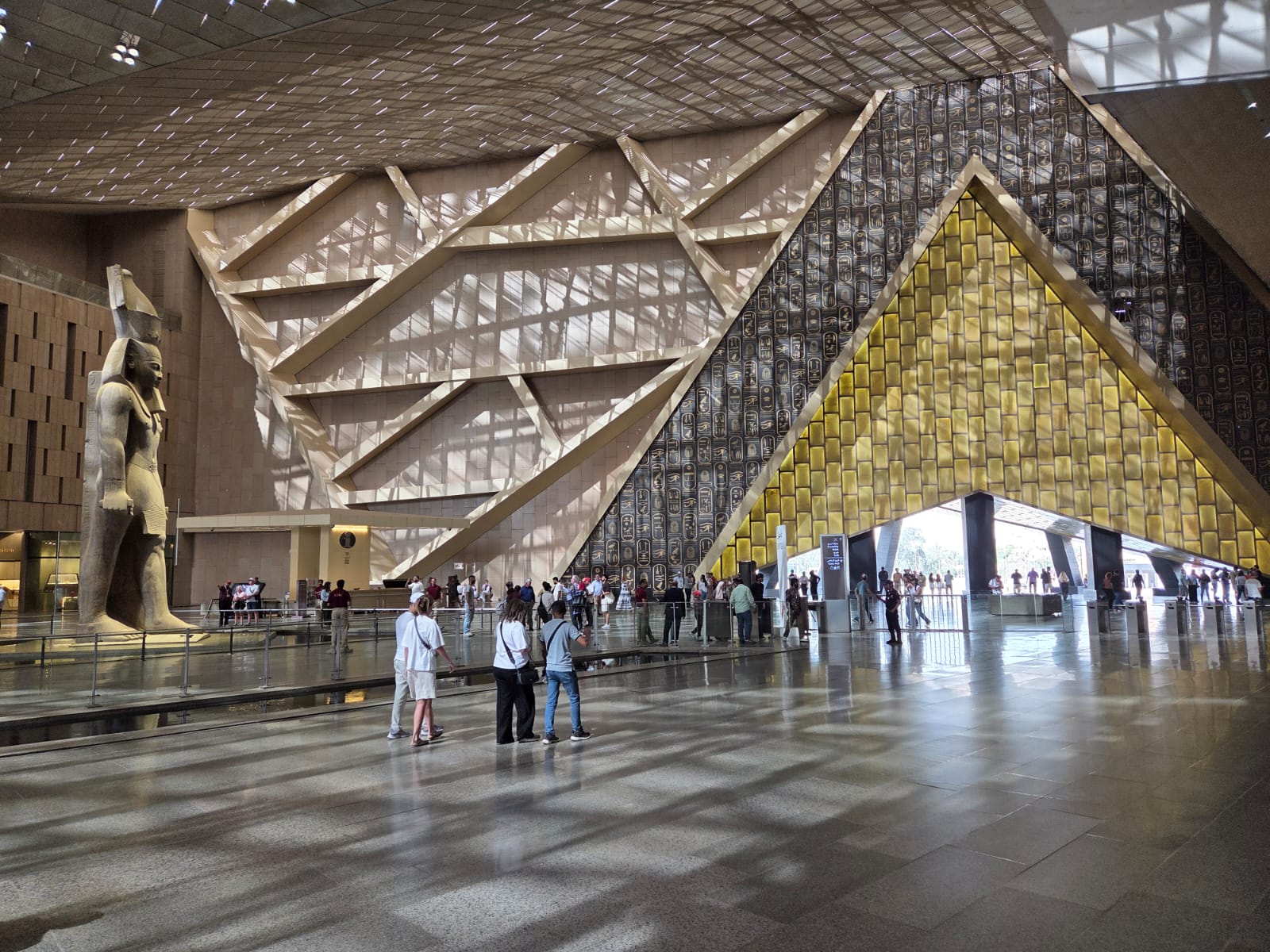
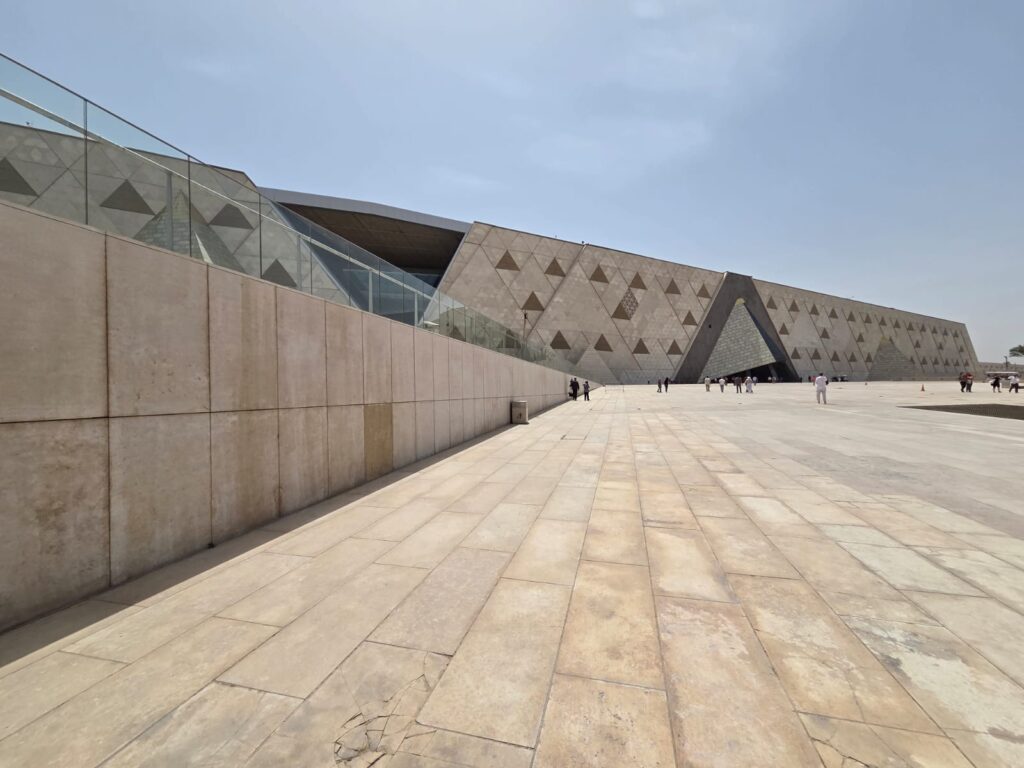
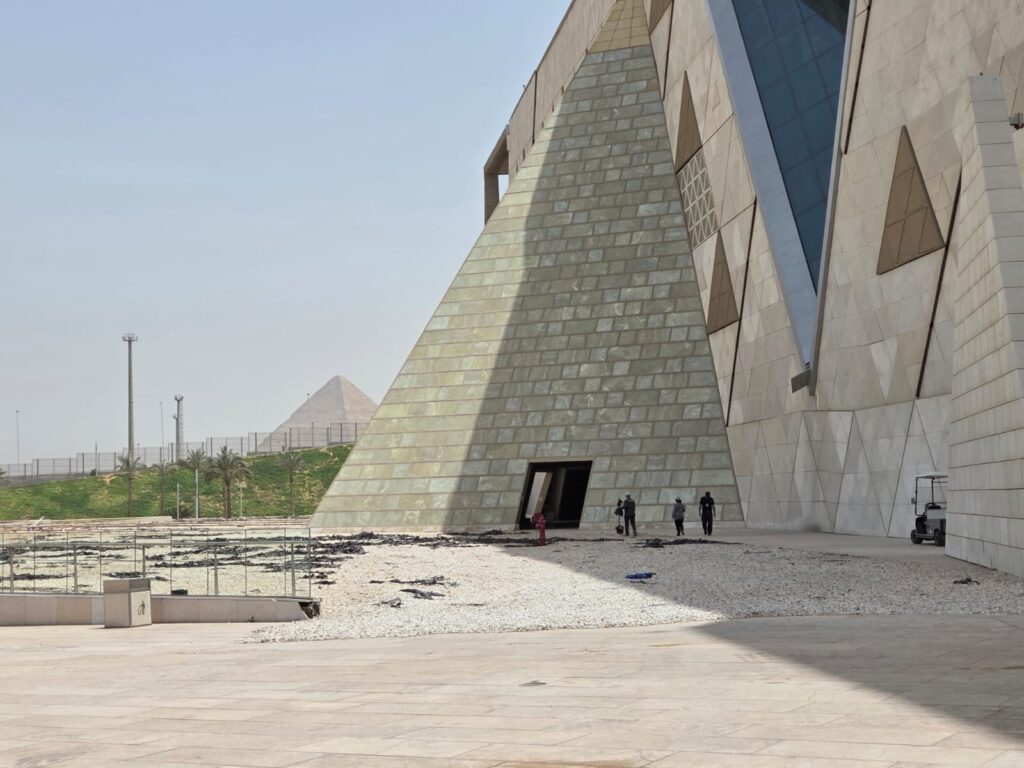
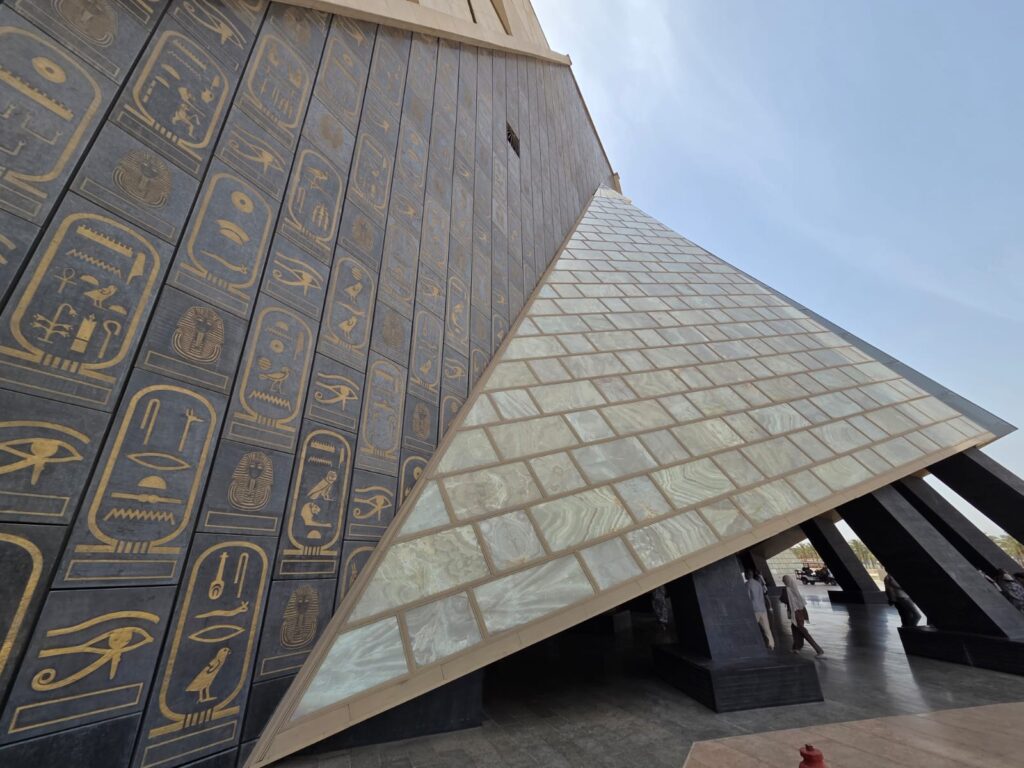
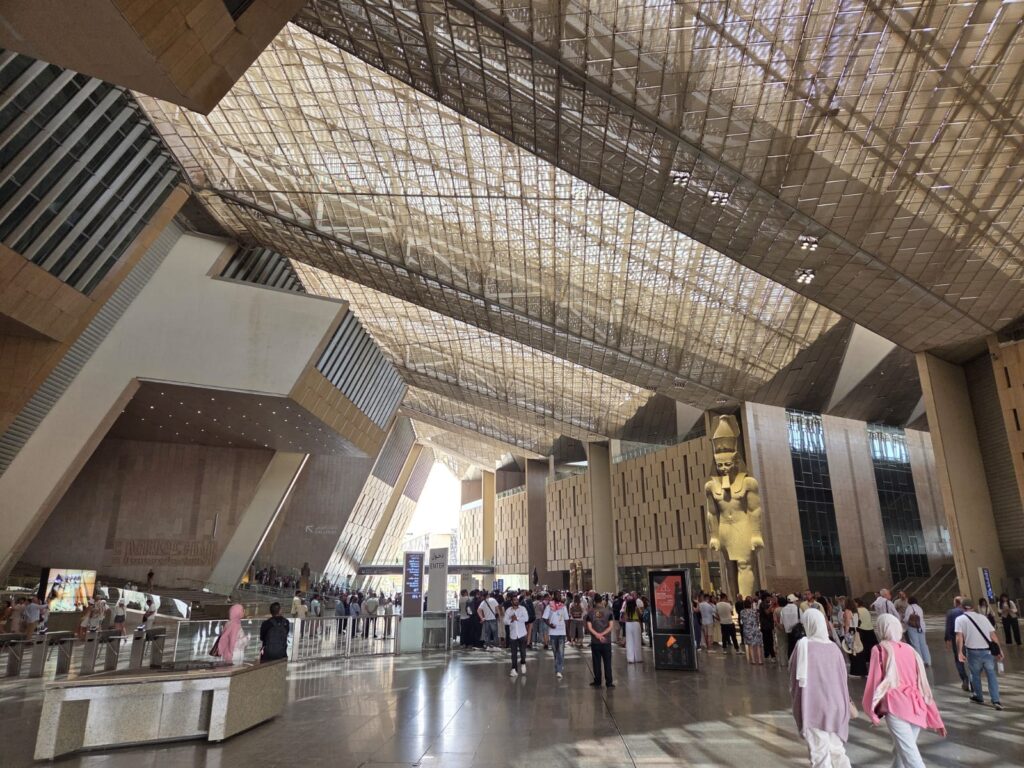
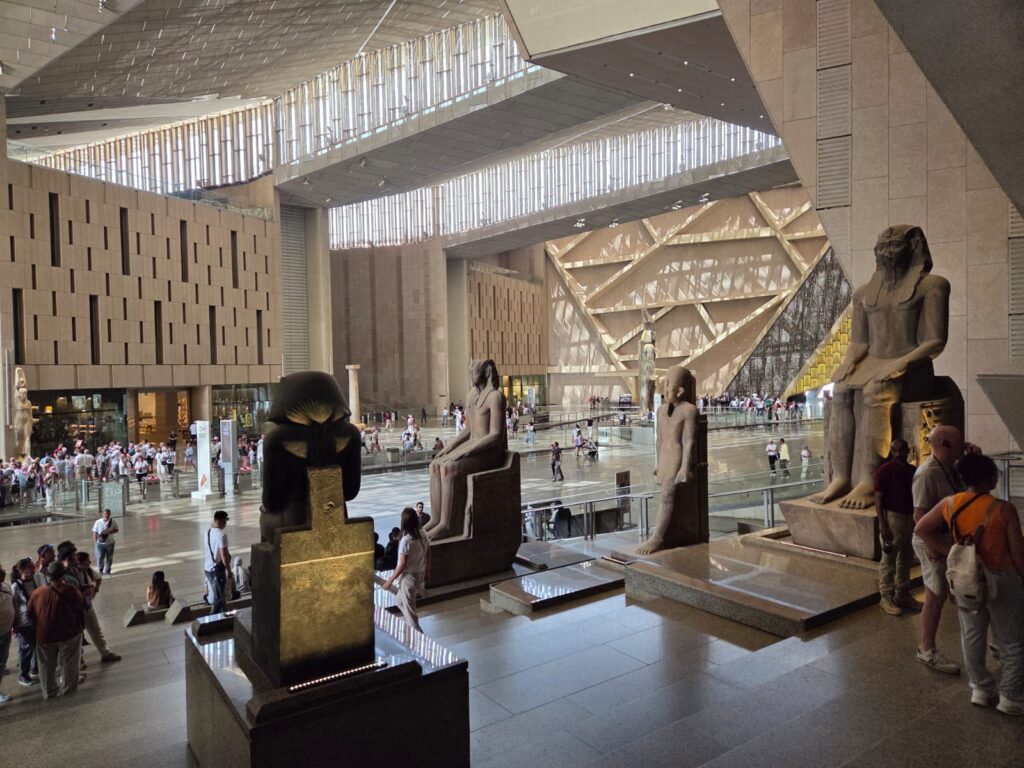
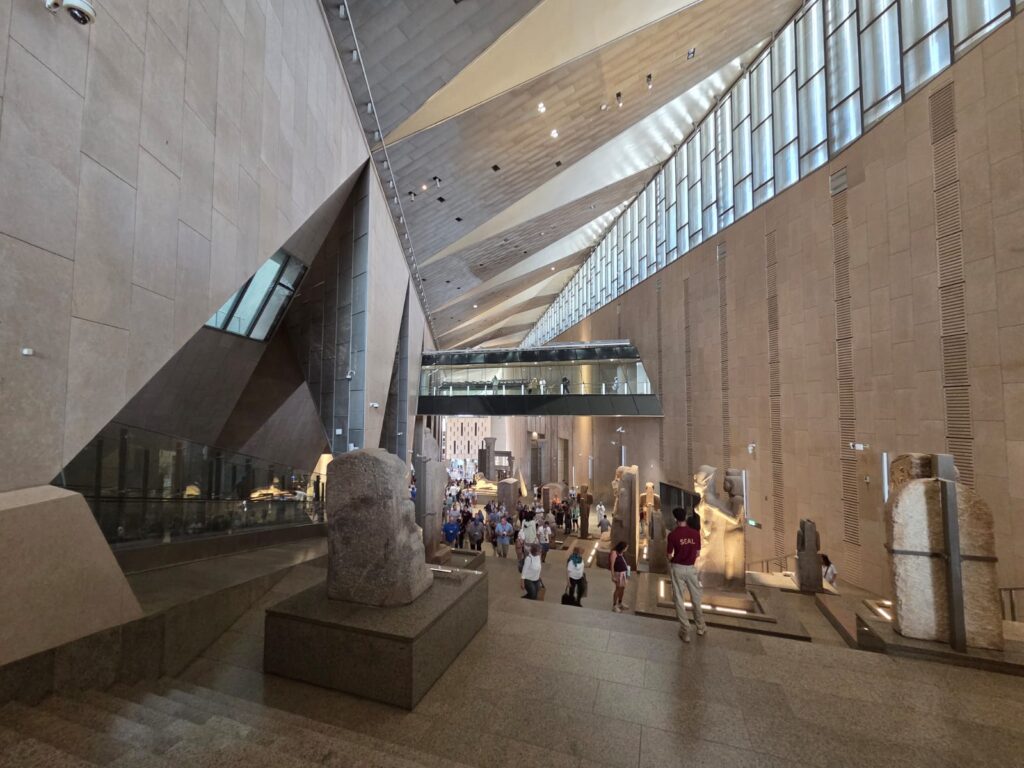
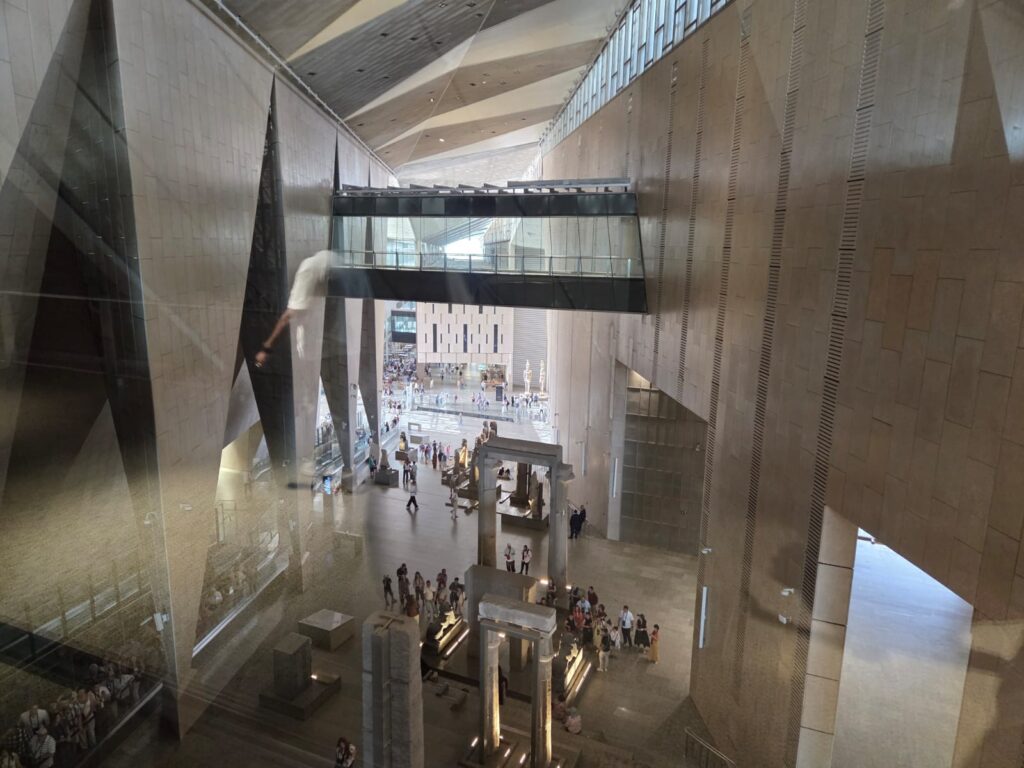
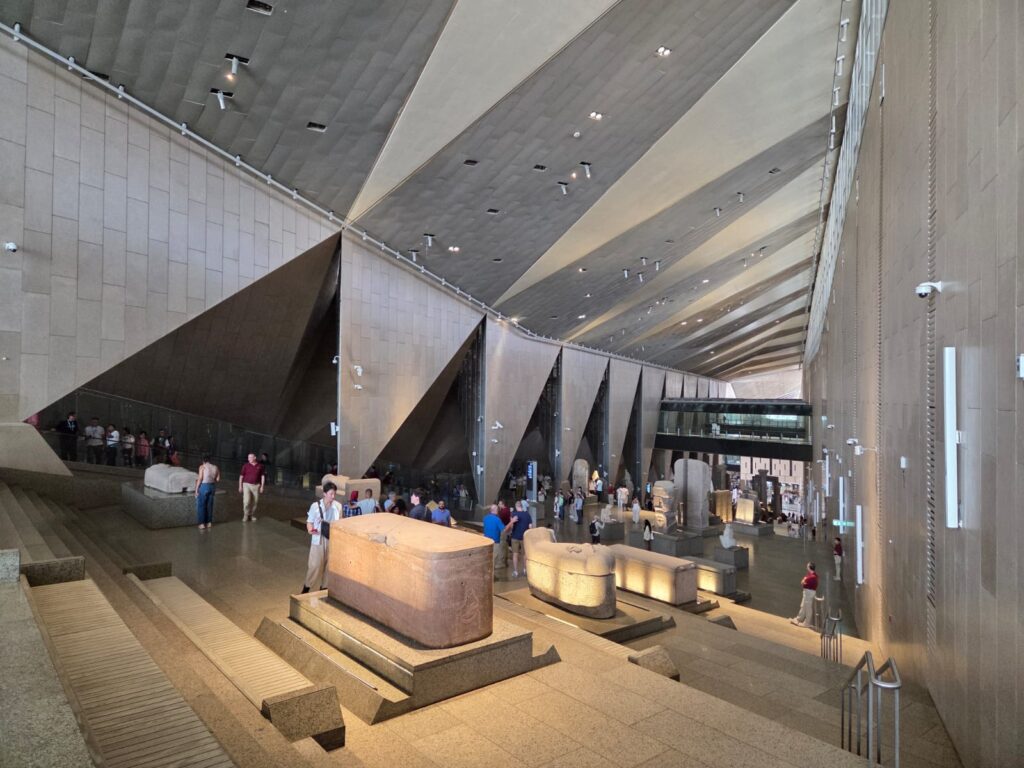
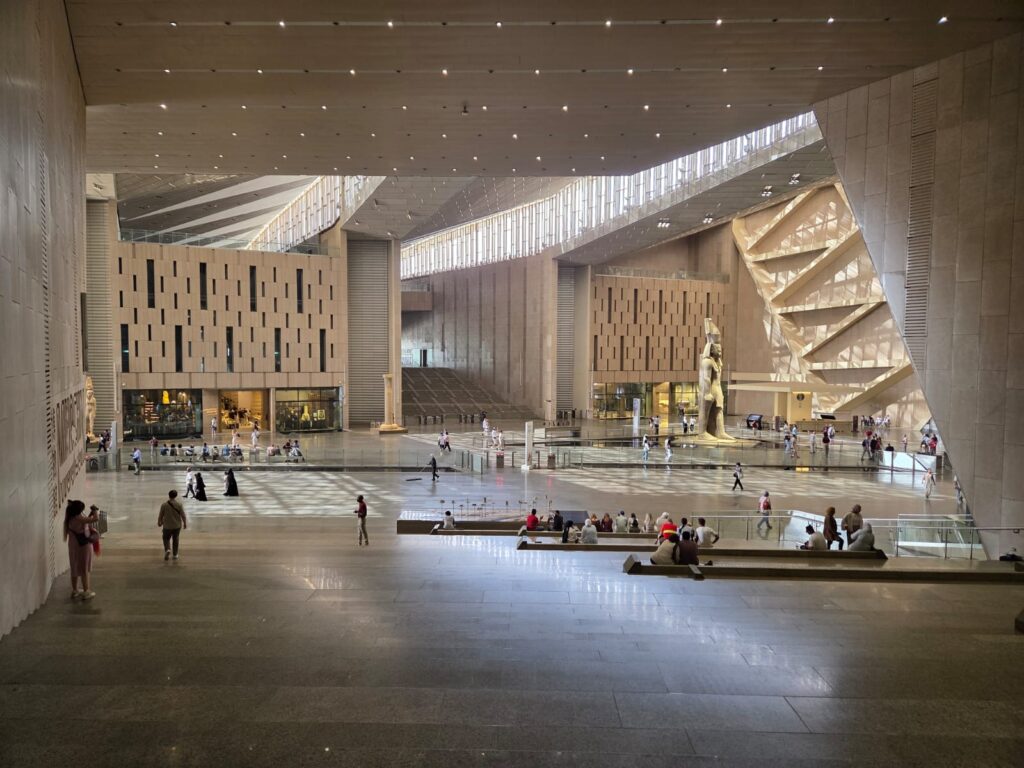
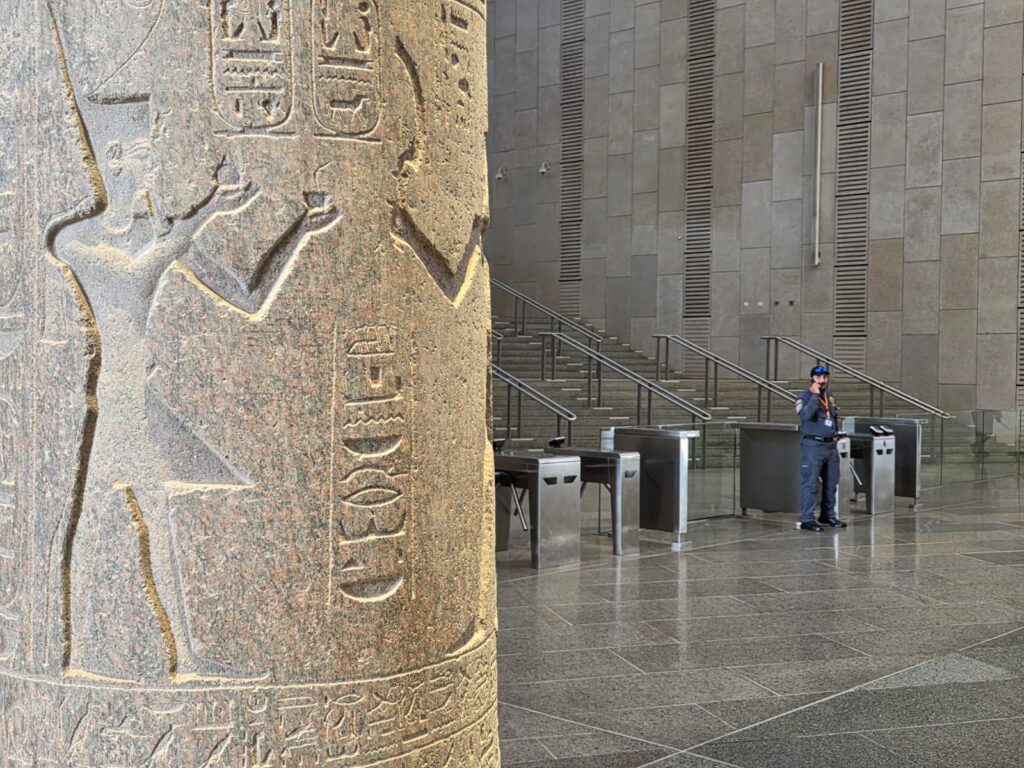
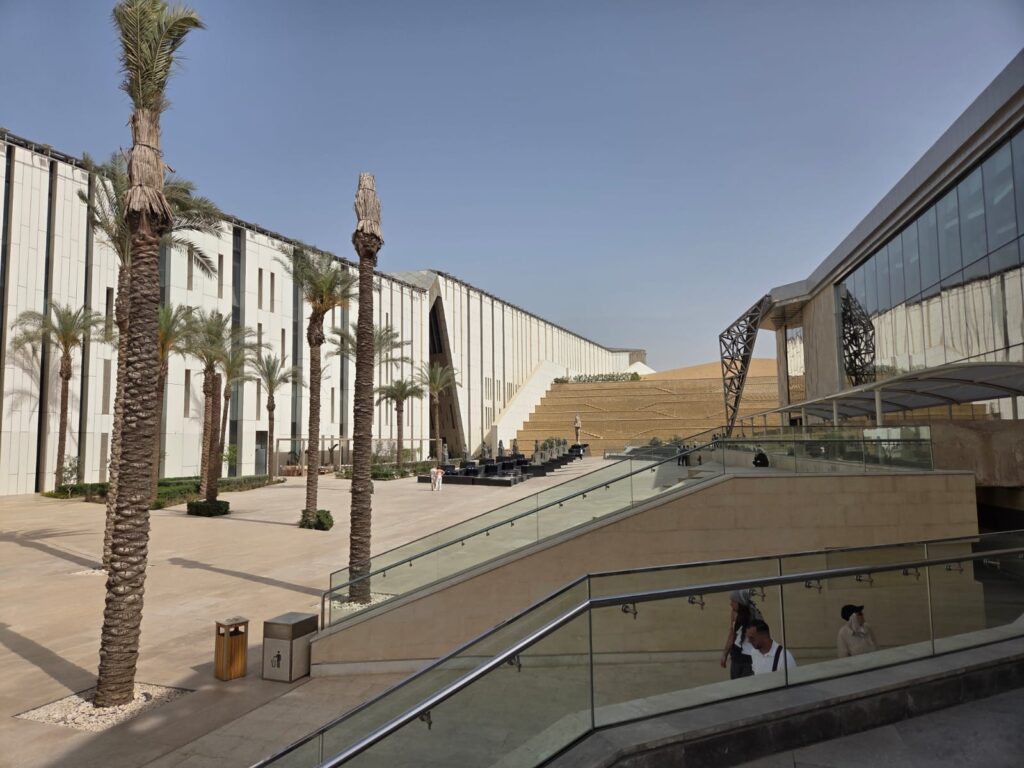
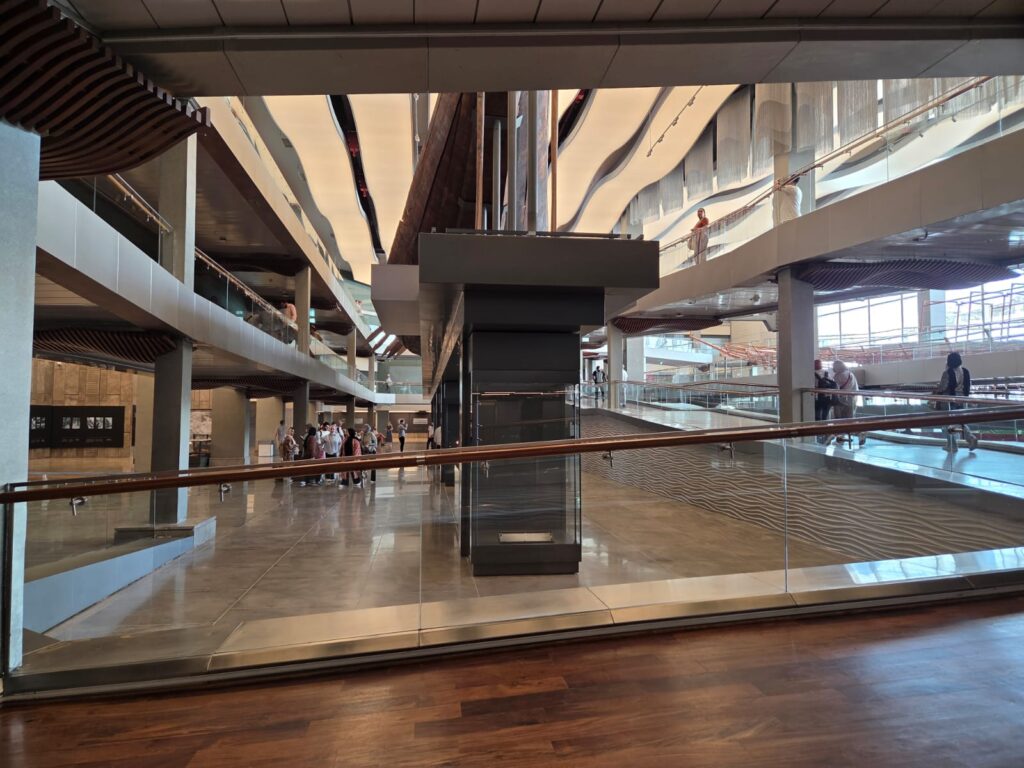
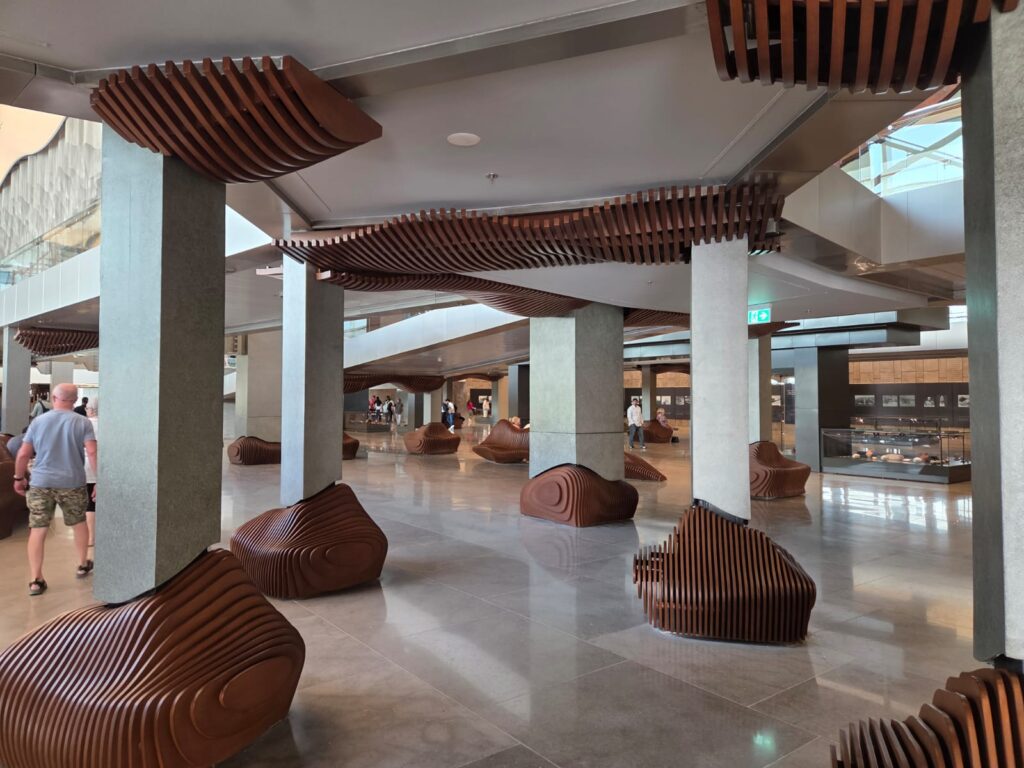
Located about 2KM from the Pyramids of Giza, the museum reflects this important environment. The work of Heneghan Peng Architects, it is an 81,000 sq. m. wedge-shaped structure, its roofs sloping parallel to the sightlines to the Pyramids, and featuring triangular alabaster and glass facades which frame them. It also uses thermal massing to control interior temperatures, as it’s partly built into the edge of the desert. The entrance is clever, its dark stone displaying the names of Egypt in various languages, including the Ancient Egyptian Kemet, meaning ‘Black Land’. Inside there is a Great Hall (or Atrium) and a Grand Staircase, before you explore twelve collection galleries. There’s also the boat museum I mentioned, a Children’s Museum, and AR experiences.
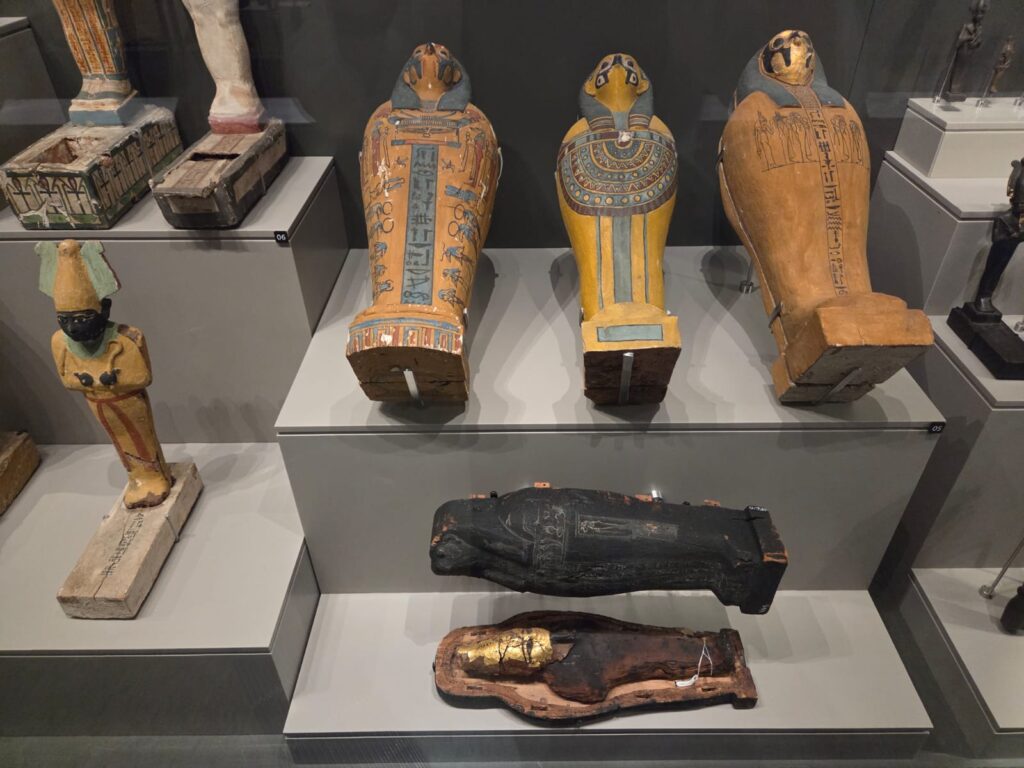
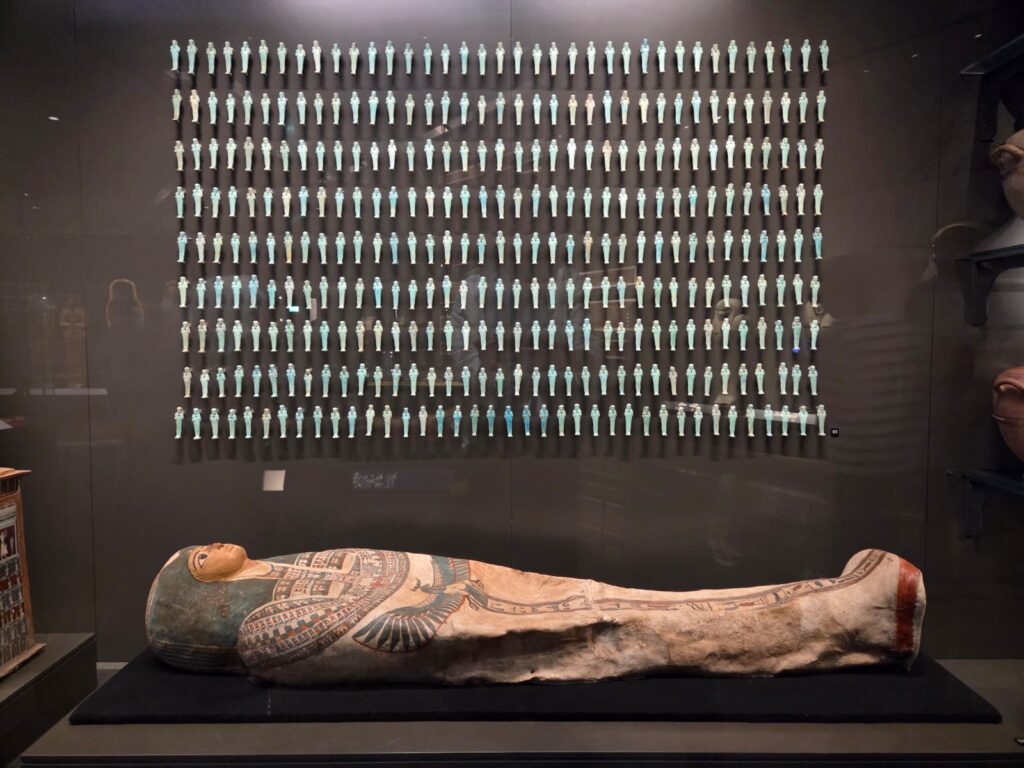
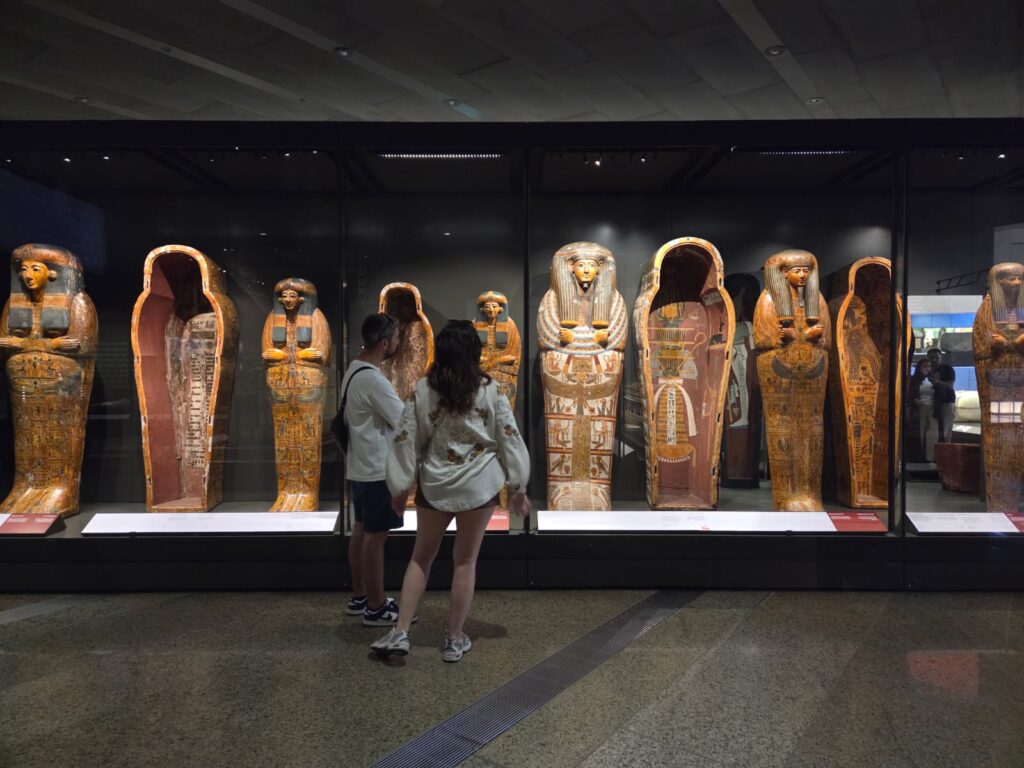
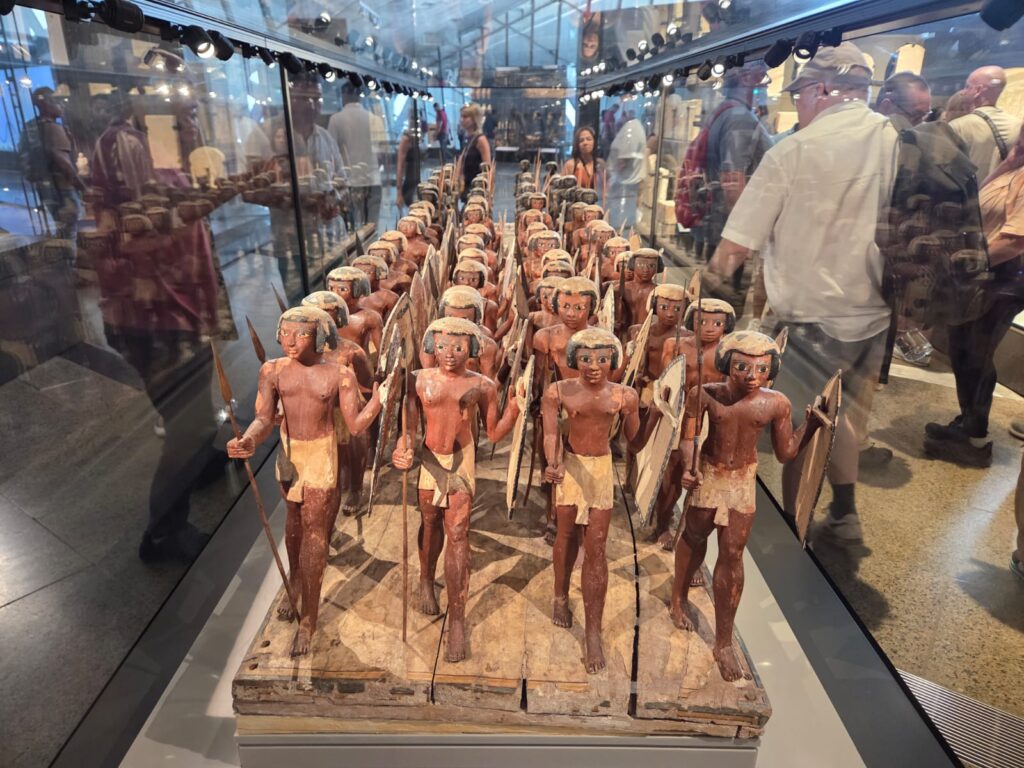
The museum covers all periods from Predynastic Ancient Egypt to Roman Egypt. Over 100,000 artefacts are on display, about a fifth of which are out of storage for the first time. Rather than fully being a state-run institution, the GEM is actually a public-private partnership. The building and collection are under the control of the Egyptian government (via the Ministry of Tourism and Antiquities) while the operations, management and visitor services are private. Since opening, over 7 million visitors have already passed through its doors.
Tutankhamun
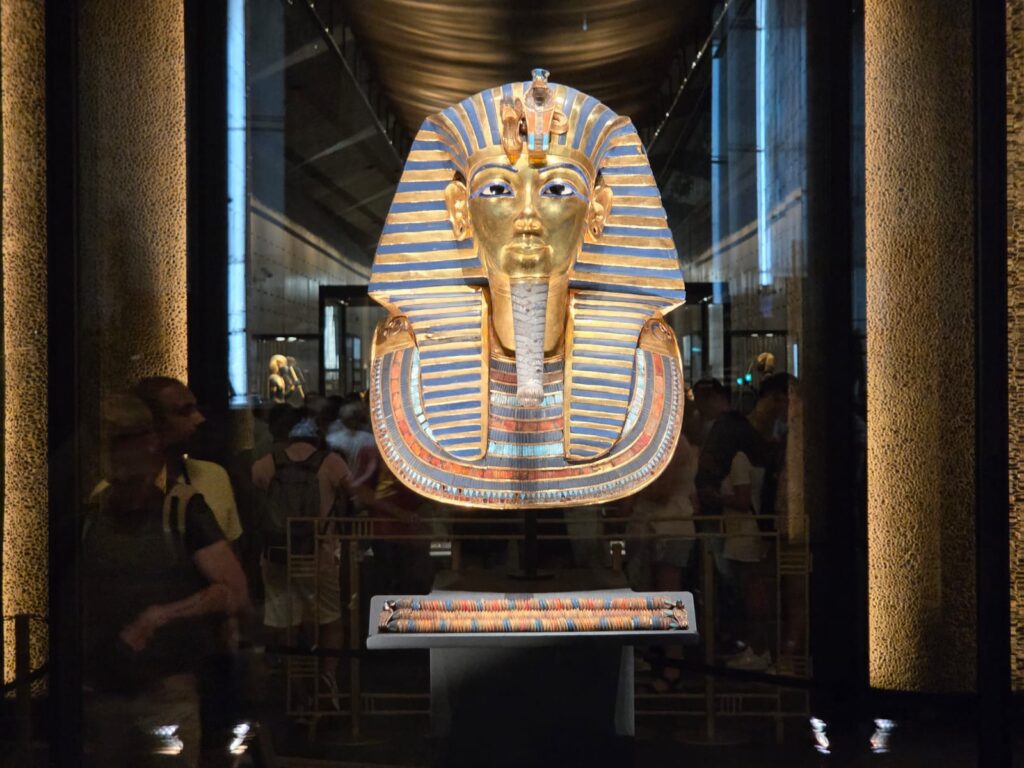
If you’re anything like me, the treasures of Tutankhamun will be the thing you’re most anxious to see at the GEM. So let’s start there. Tutankhamun was a pharaoh of the 18th Dynasty of Ancient Egypt. The thing is, though, he was such a minor pharaoh that he didn’t even make it on the pharaoh list. And yes, there was literally such a list. I’m being a tiny bit unfair, probably. It was a combination of having a short reign, and a bit of later erasure of the whole period where his father Akhenaten went a bit overboard and changed the state religion.
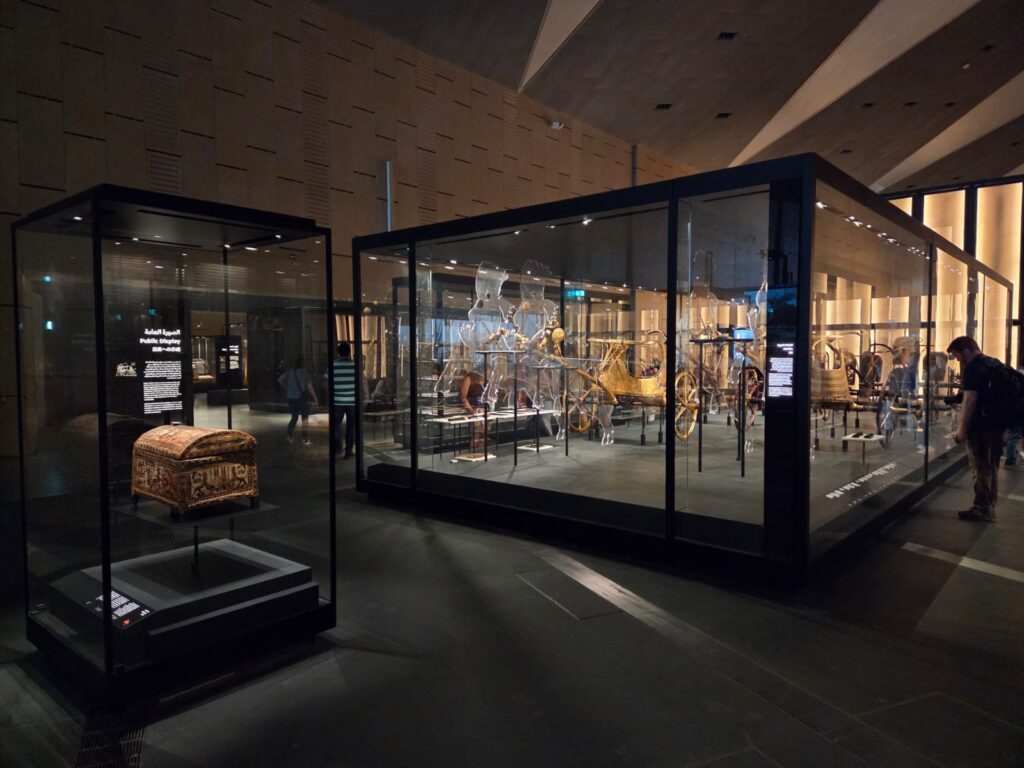
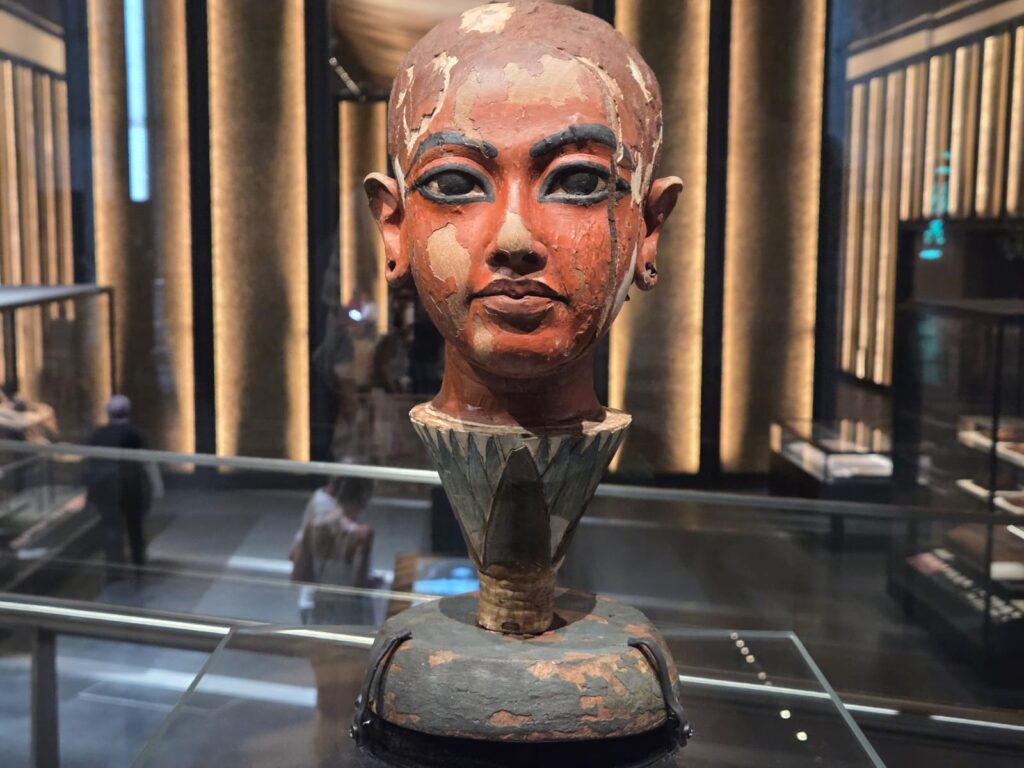
The point here is that, when Howard Carter found Tutankhamun’s nearly intact tomb in 1922, it was a surprise and a mystery. A good surprise, though – treasures that are unparalleled and greatly increased our knowledge of Ancient Egypt. And if this was a fairly minor pharaoh, imagine what the burials of the others looked like! The “wonderful things” uncovered by Carter included furniture, statues, chariots, jewellery, and of course Tutankhamun’s sarcophagi and mummified body.
Carter was a thorough guy (to an extent that everyone else found rather annoying) and spent over a decade cataloguing the finds. Nonetheless, the first artefacts went on public display at what is now the Egyptian Museum in Cairo in 1923. The famous Golden Death Mask arrived in 1925. There was never space for all of them in this museum, though, and so the new display at the GEM is the first time they have been on display together.*
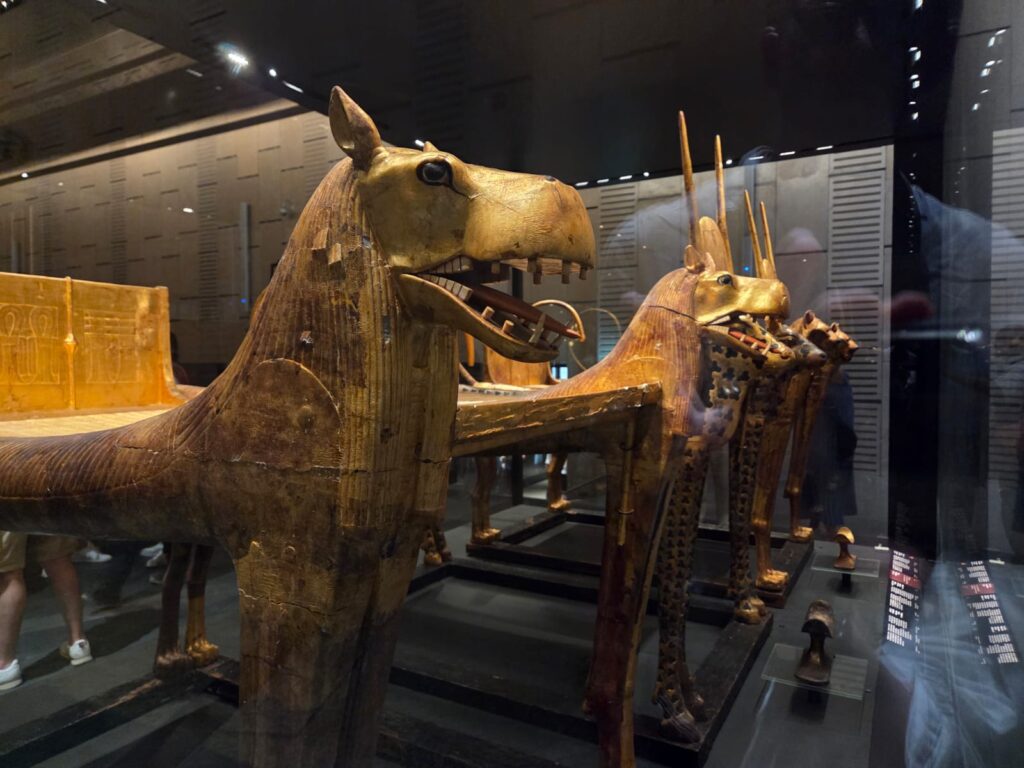
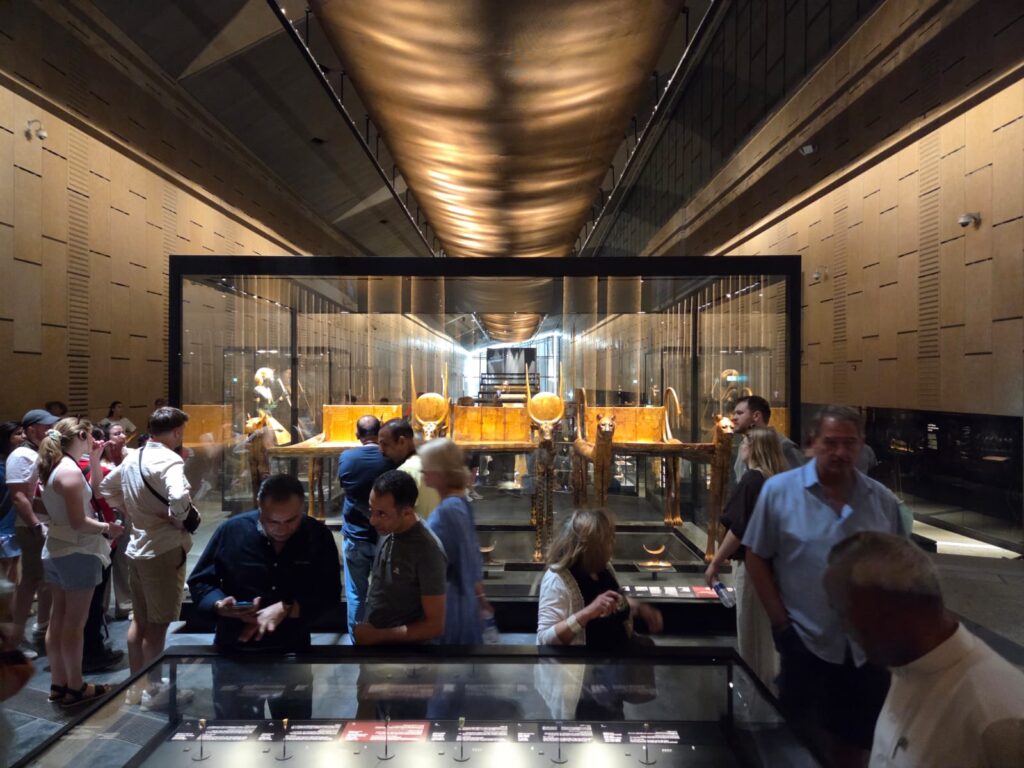
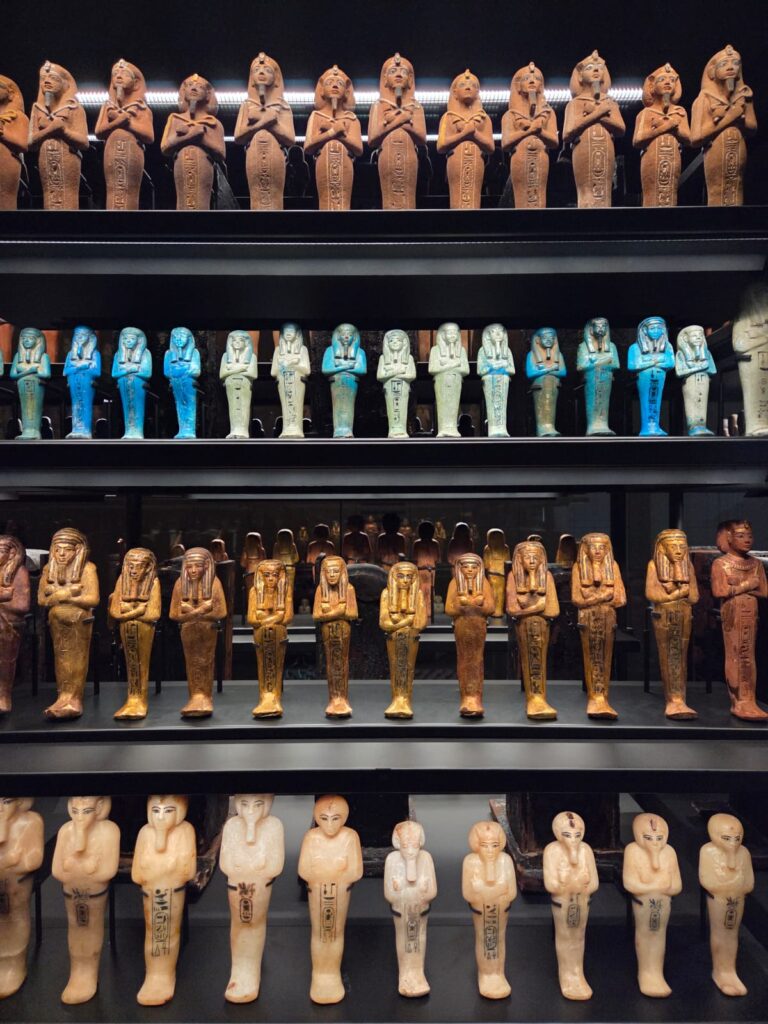
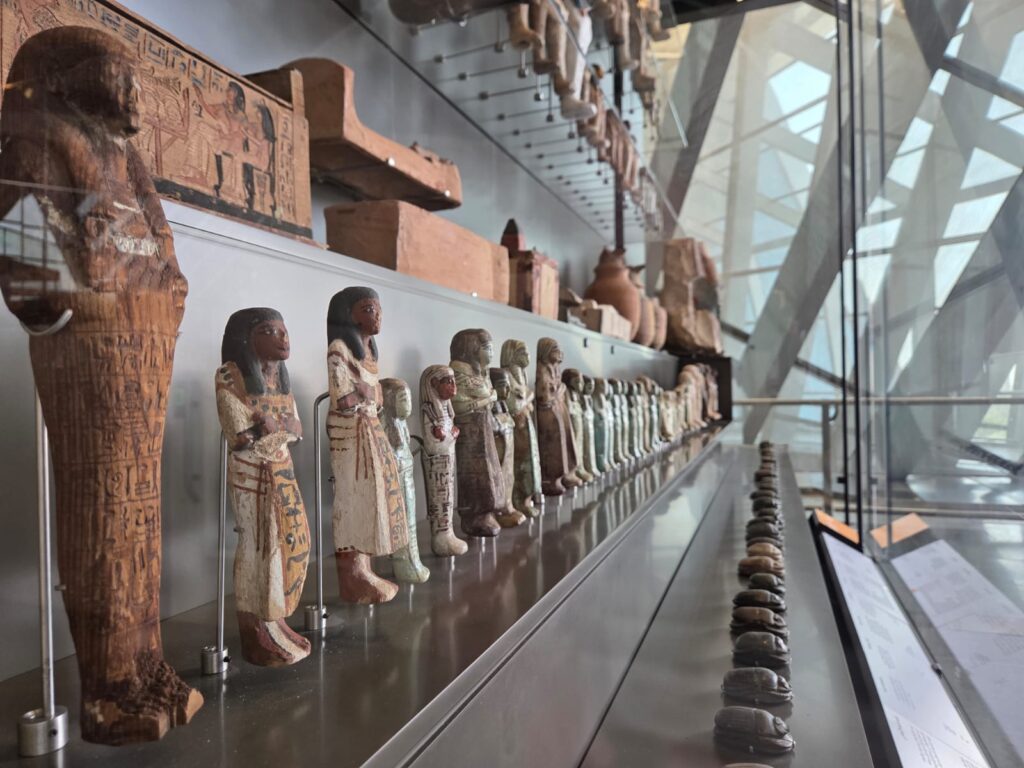
Two of the museum’s twelve halls are dedicated to the treasure, with 5,398 artefacts on display. The golden mask is the main event, with its own queueing system and a guard moving people on so everyone can get their Instagram moment. But I most enjoyed some of the less blingy objects. The famous animal-shaped couches, for instance, that you may well have seen in images from Carter’s expedition. Or the aesthetically-pleasing displays of more mundane items like shabti (servants for the afterlife) or food storage containers.
Leave plenty of time to look around this section, and expect it to be busy. I think it varies, though – someone I was talking to said they had a long queue to even get into this area, which we didn’t experience. Either way, it’s worth it.
*Aside from anything travelling around the world, and also Tutankhamun’s body, which is back in his tomb. There’s seemingly a space for him at the GEM, though, so who knows how long the current arrangement will last. Unless that will be some sort of multimedia thing?
What Else to See at the GEM
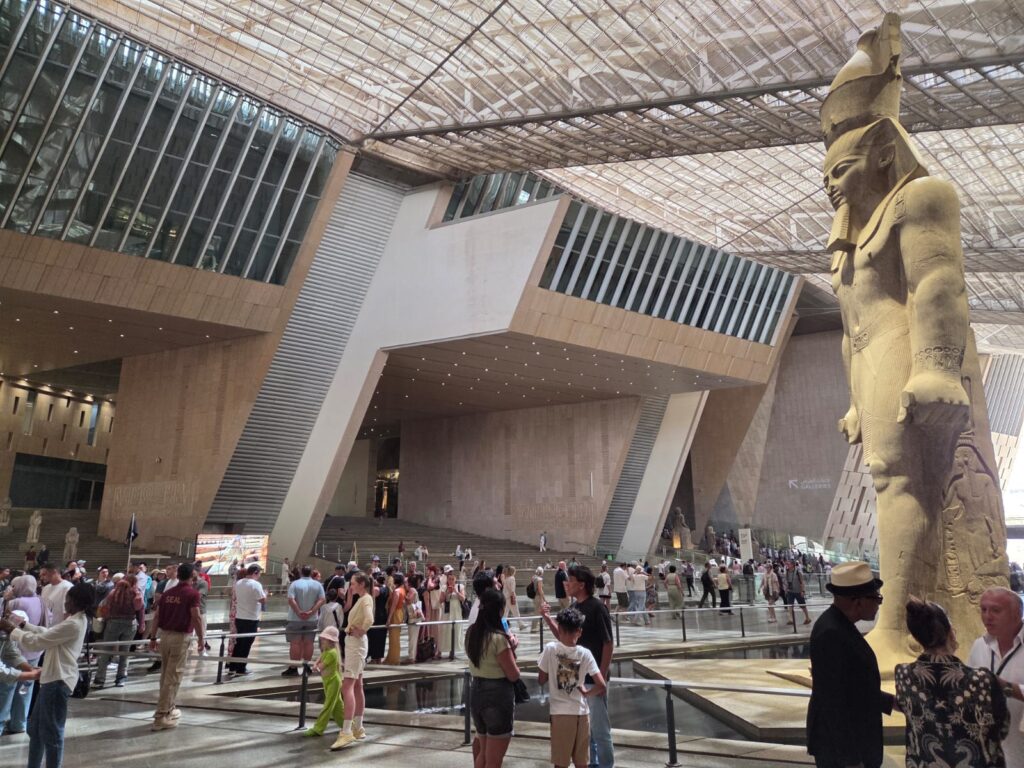
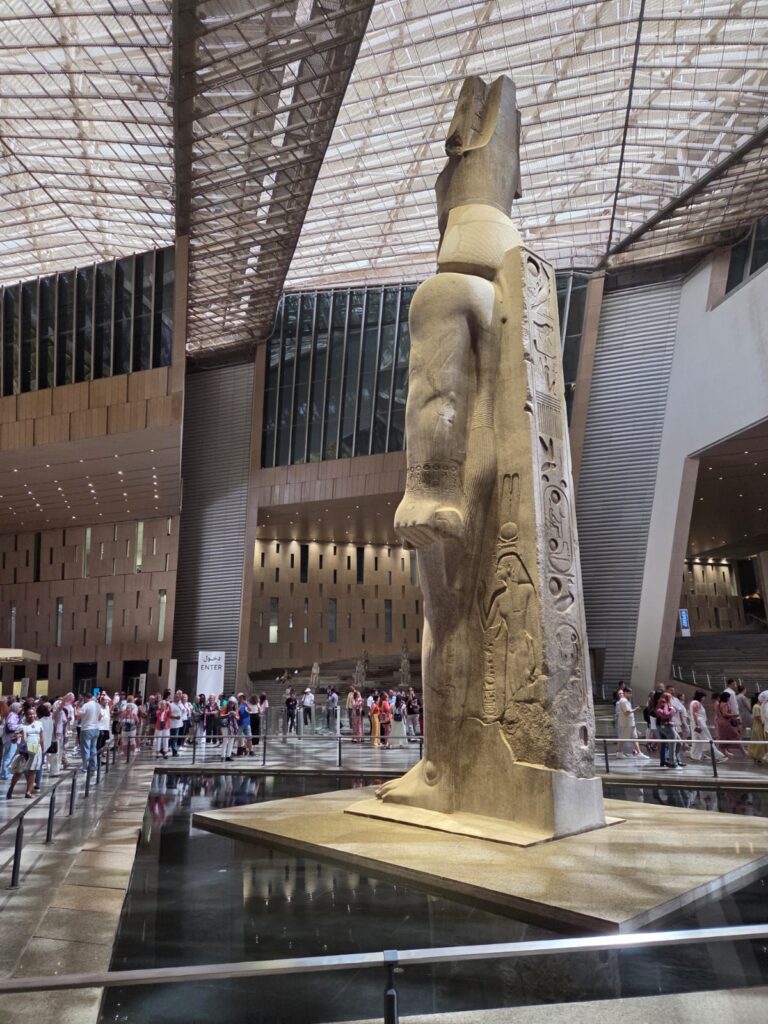
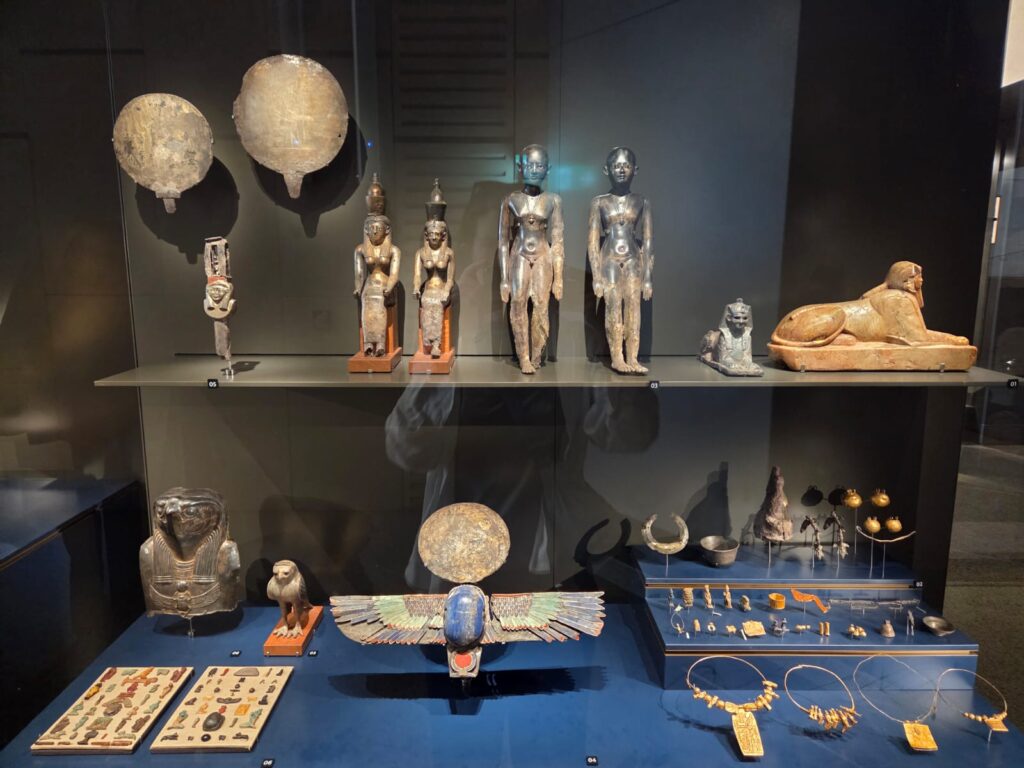
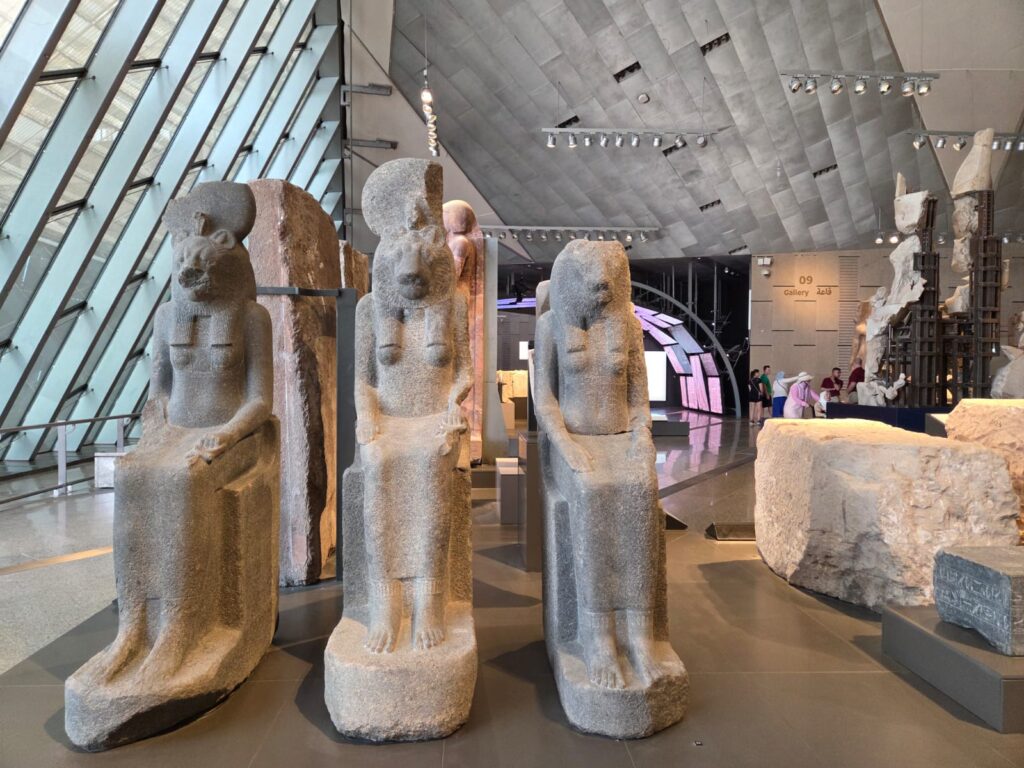
Having seen the treasures of Tutankhamun, there are still ten galleries to go, and a wealth of other archaeological riches. Let’s go back to the start: the atrium. The first thing you’ll notice as you enter, other than the impressive architecture, is the colossal statue of Ramses II. Standing 11 metres high, he is a sight to behold. Such a sight, in fact, that visitors kept walking into the pool surrounding him while filming their approach. By the time I visited, there was a low barrier to prevent this. The statue was previously in Ramses Square in Cairo.
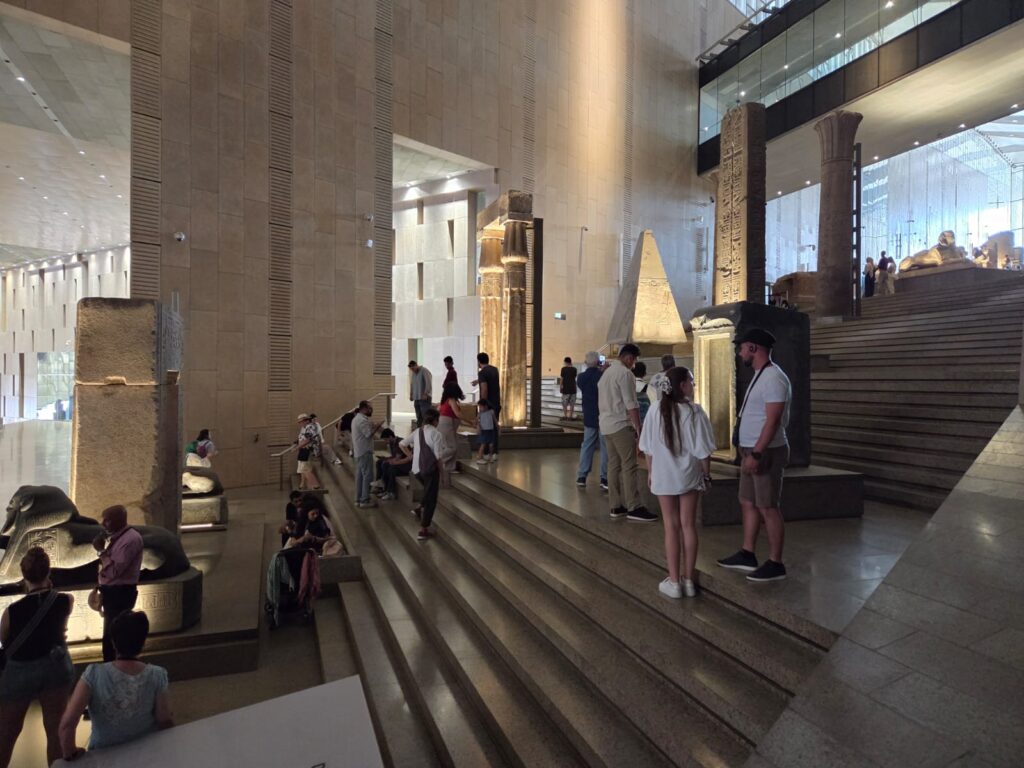
The galleries are connected by the Grand Staircase. Whether you walk amongst the statues or take the option of the travelator/moving walkway, you’ll enjoy a view of about 60 sculptures from different periods. Our group got off the travelator to see one or two of them, including the important Stela of Akhenaten and Horemheb, showing the former worshipping the sun deity Aten. The arrangement on the Grand Staircase is thematic, covering Royal Image, Divine Houses, Gods & Kings, and a Funerary Section.
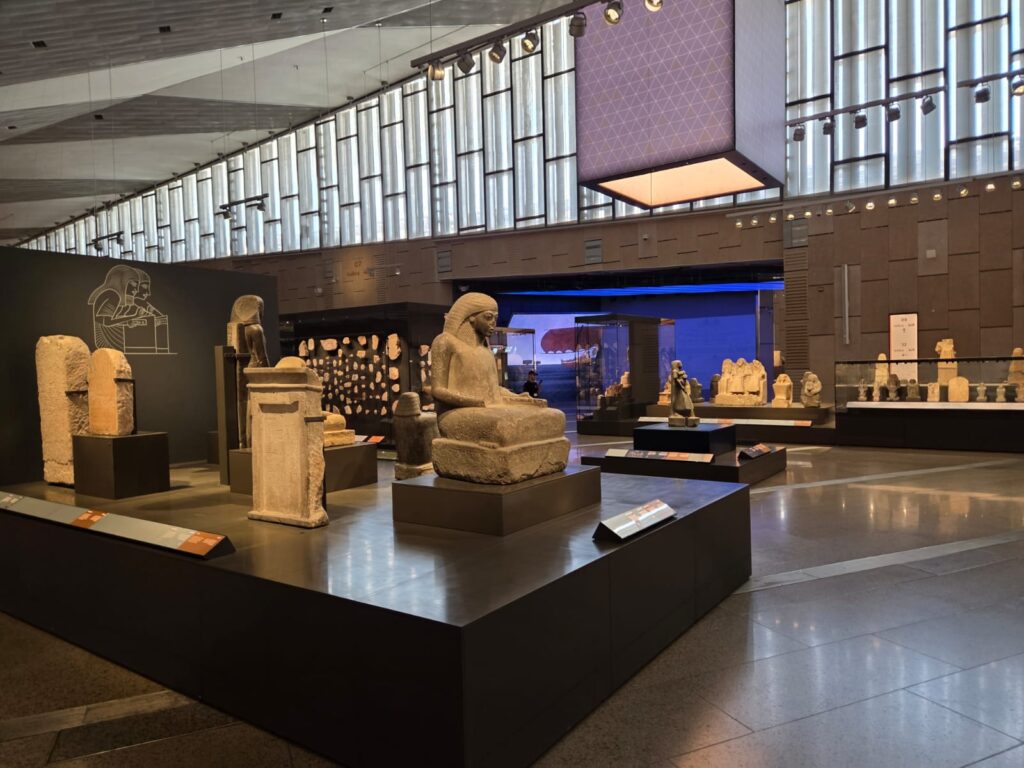
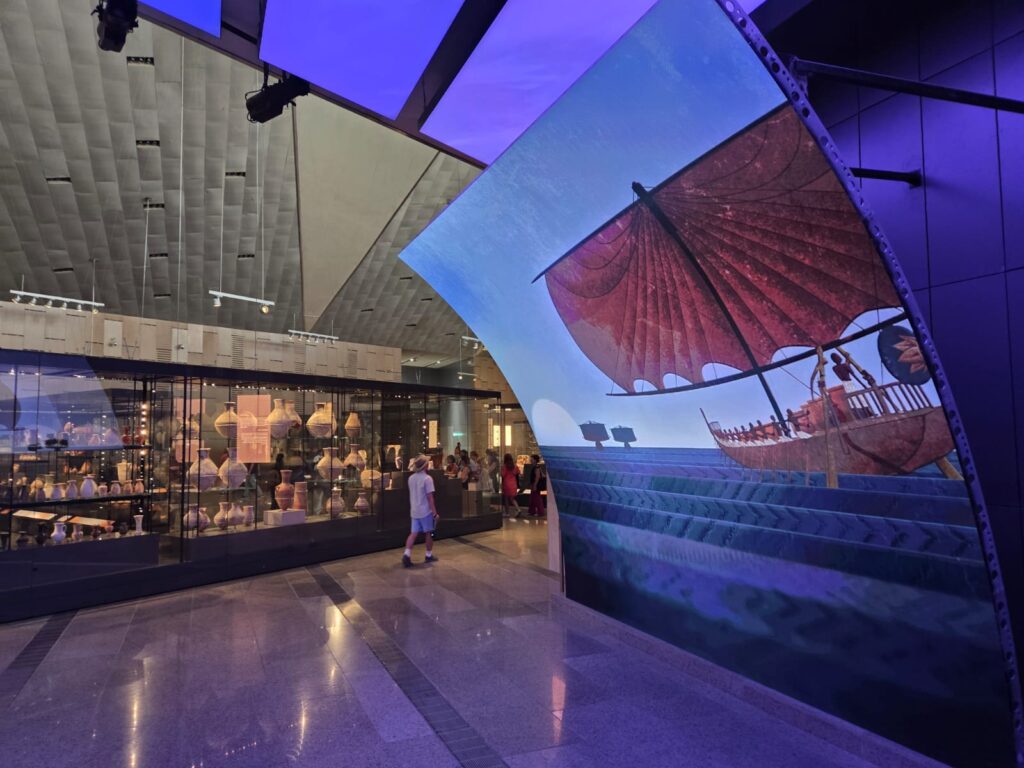
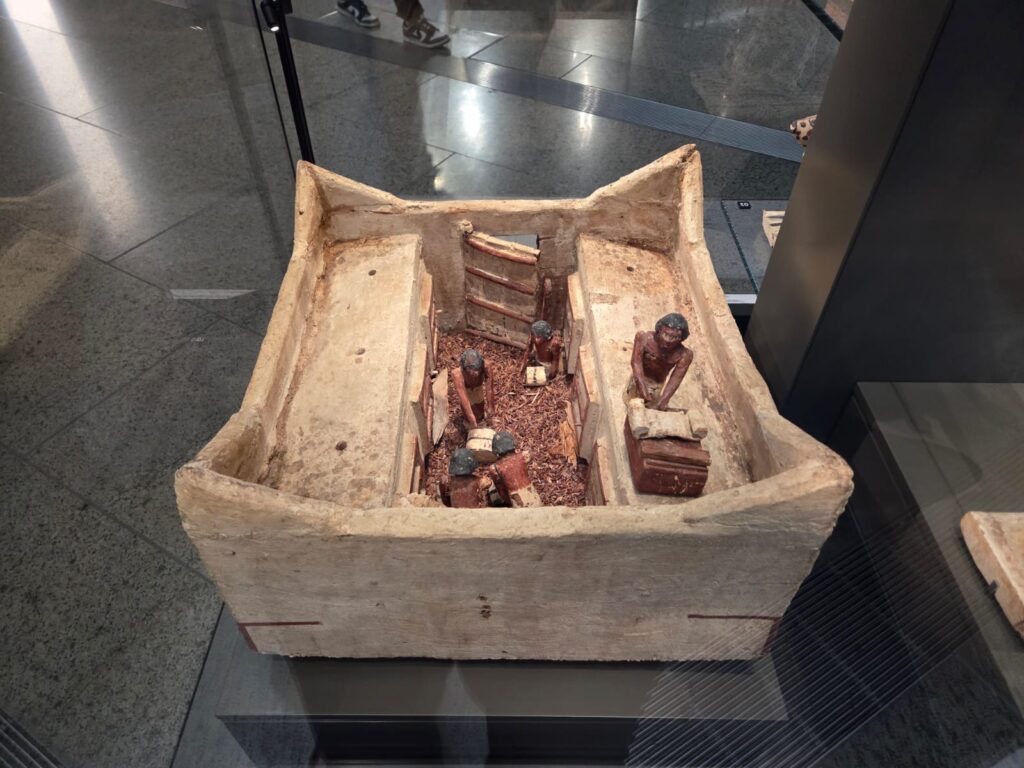
As for the galleries, they are chronological. They cover thousands of years of history, from 3100 BCE to 400 CE. As well creating space in the Egyptian Museum in Cairo and getting some of that institution’s collection out of storage, artefacts have come here from storage and museums in Cairo, Luxor, Alexandria, and other locations around Egypt. As the galleries are quite broad I found myself wandering back and forth between time periods. Visitors should also head into the downstairs galleries which cover specific themes like the workers’ village at Deir el-Medina, and underwater archaeology.
The Visitor Experience at the Grand Egyptian Museum
Visiting the Egyptian Museum in Cairo and Grand Egyptian Museum on consecutive days was an enlightening experience. Both museums follow the Western museological conventions of their time. The former is charming, with galleries arranged around a central court, light wells and mezzanines. The latter is an extension of the monumental architecture trend in museums – think of the various Guggenheims. And like the Guggenheim Bilbao, which I visited some years ago now, I felt like there was somehow a lot more building than there were objects on display. What I mean is that the GEM’s footprint is very big compared to its gallery space.
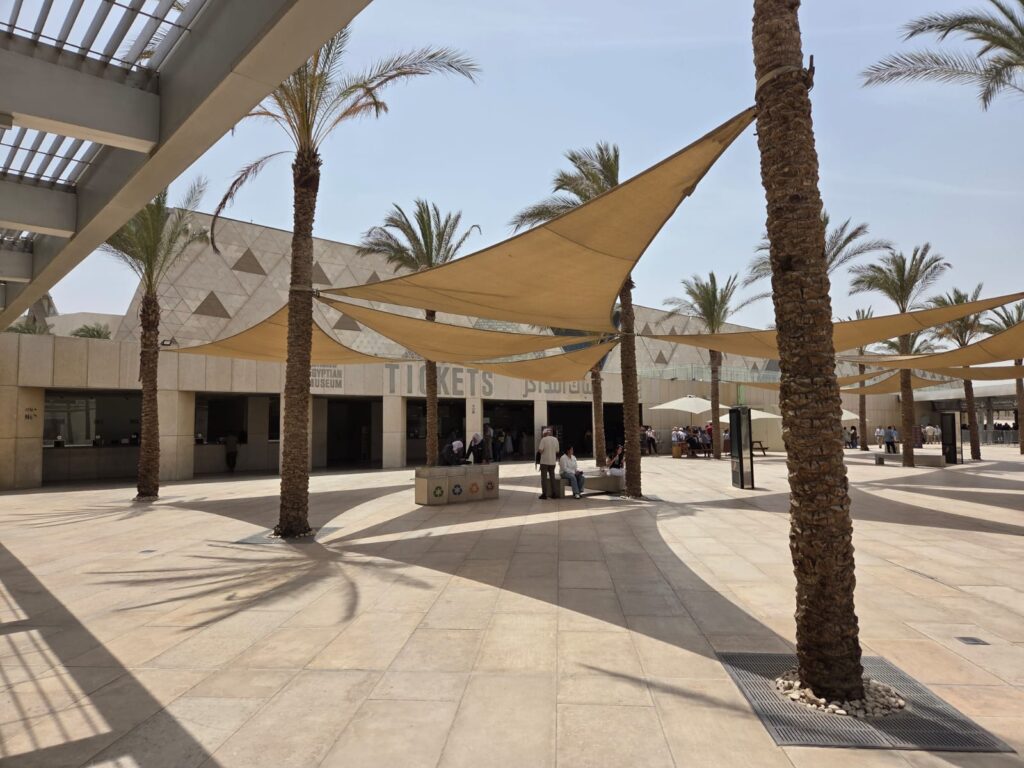
Is that a problem? Not necessarily. It means that the visitor experience is a comfortable one. The objects never feel crammed in, and despite high visitor numbers there is enough space. If you get tired during your visit, you can exit, peruse the shop, and stop for a gelato. Frequent museum visitors will understand how to navigate the space – there’s nothing specifically Egyptian about going to the Grand Egyptian Museum. The main question is how to divide up your time so you see everything you want to.
Well, I say visitors will understand how to navigate the space, but I didn’t quite. The floor plans are very basic, showing the gallery spaces as one block. It took me quite a while to understand that the galleries were all on one level. I rather rushed through as a result. On the plus side, I did have time for that gelato. On the minus side, I could have taken a bit more in.
But all in all, I’m very happy I was able to see the Grand Egyptian Museum. As both a museologist and an archaeology lover, it was one of the highlights of the week’s itinerary. But before we finish, we have one more thing to see – Khufu’s Boats Museum.
Khufu’s Boats Museum
In my last post about the Pyramids and the Sphinx, I explained a bit about Ancient Egyptian religion. It was a little bit free-form as religions go, but there are three important points to know. The first is that the world order relied on the Pharaoh making it to the afterlife. The second is that pharaohs, and everyone else, followed the path of the sun to get there. The third is that the Nile came up to the Giza Plateau at the time. So, as far as we can tell, pharaohs’ bodies arrived by boats that doubled as solar boats for that final voyage.
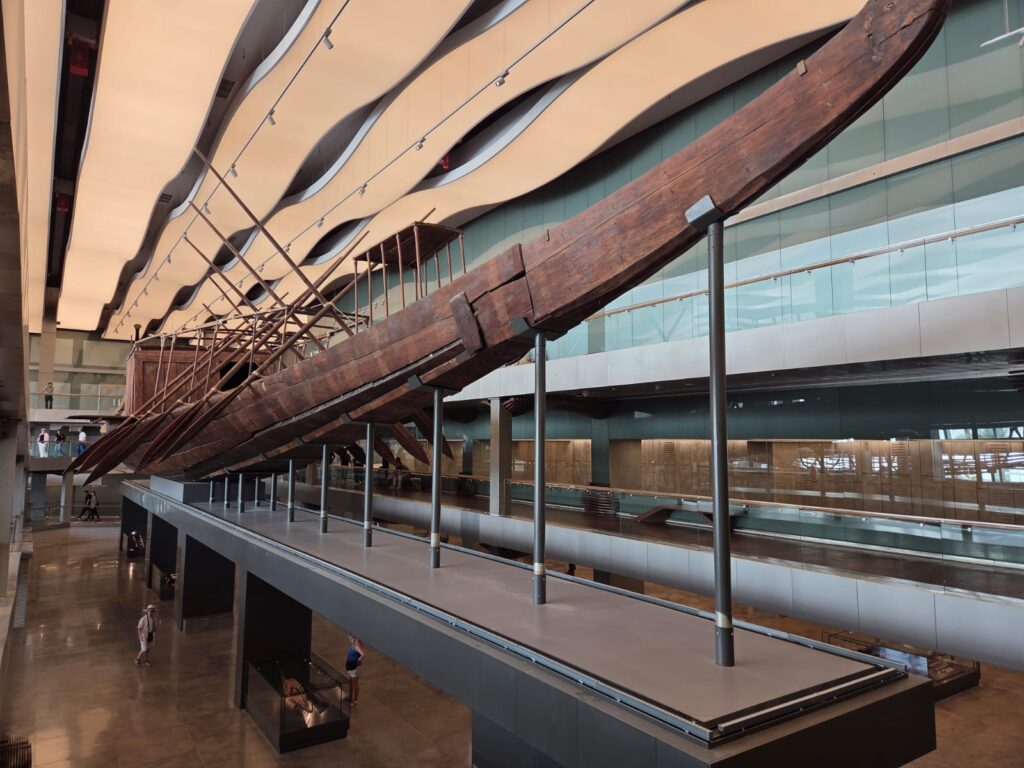
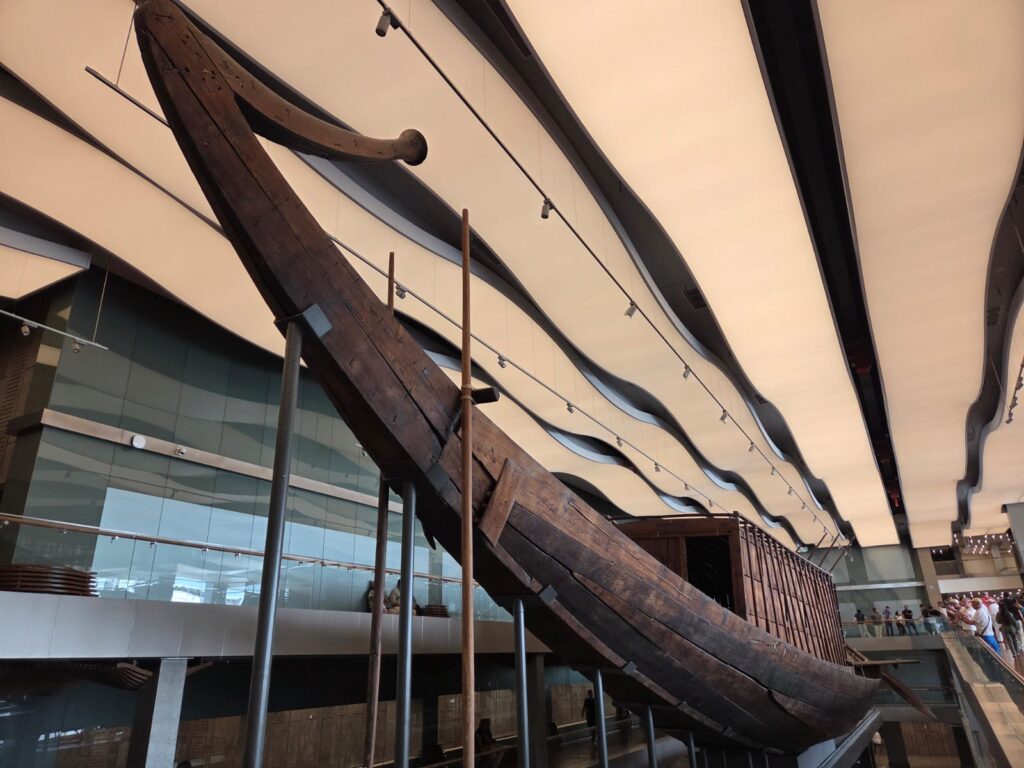
Although no treasures remained in the Pyramid of Khufu (the Great Pyramid), excavations in 1954 revealed five boat pits. Three were empty, while the other two revealed dismantled boats. These are the oldest wooden ships ever discovered, around 4,600 years old. It took more than ten years to reassemble the first boat, which was originally in its own museum just next to the pyramid. This museum, which was constructed between 1961 and 1982, was dismantled after the boat was transferred to the GEM in 2021. Just moving it those eight kilometres was a major feat of engineering.
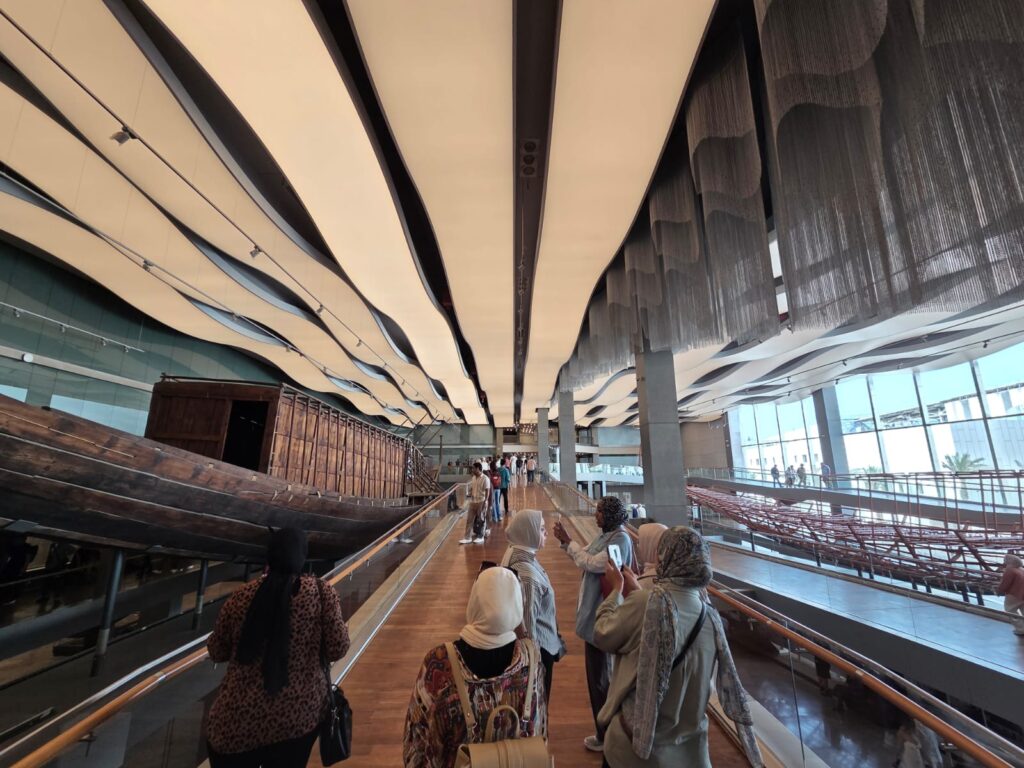
If you visit the GEM, don’t miss this additional museum/pavillion. The boat is absolutely beautiful – elegant and of an impressive scale (over 40 metres long). Visitors wind their way up a walkway which gives a good view from all angles. There’s also an interactive display which explains the boats’ apparent purpose.
The new museum also gives an opportunity to excavate, conserve and reconstruct the second boat. Visitors will see this project progress – an amazing chance to see one of the oldest organic archaeological artefacts handled according to the latest techniques.
Trending
If you see this after your page is loaded completely, leafletJS files are missing.