
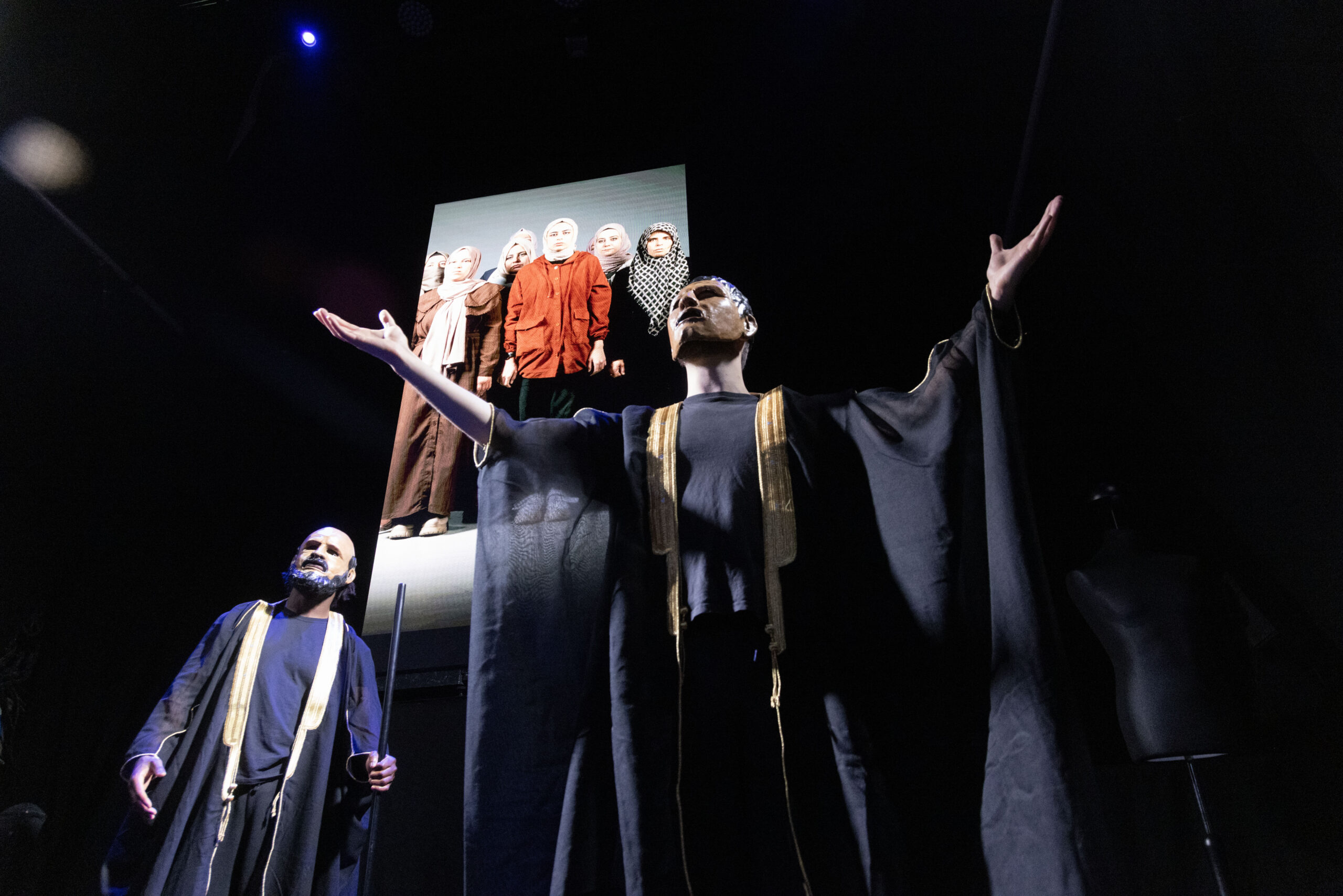
Suppliants of Syria – Border Crossings / Hoxton Hall, London
Suppliants of Syria is not just a play but an evening-long event, using Aeschylus’s ancient tragedy as a starting point for a discussion about asylum, testimony and hospitality today.
Suppliants of Syria
Like most of the (I imagine) fairly self-selecting audience for Border Crossings’ Suppliants of Syria, I arrived with an open mind – both about the theatrical experiment ahead of me and about the comparison it proposes between ancient and modern experiences of exile. What we’re given is a devised work full of ideas. If anything, perhaps a few too many.
If you opt for the full programme, the evening begins with dinner and conversation. Then there is the performance itself, followed by a short musical set that changes each night. I skipped the meal, which meant arriving to the slightly surreal sight – from Hoxton Hall’s balcony – of the plates being cleared away below, the smells of the kitchen still hanging in the air. It’s an unusual prelude to a piece of theatre, but in a sense it sets the tone. This is an event that sets out to blur the boundaries between performance, gathering and discussion.
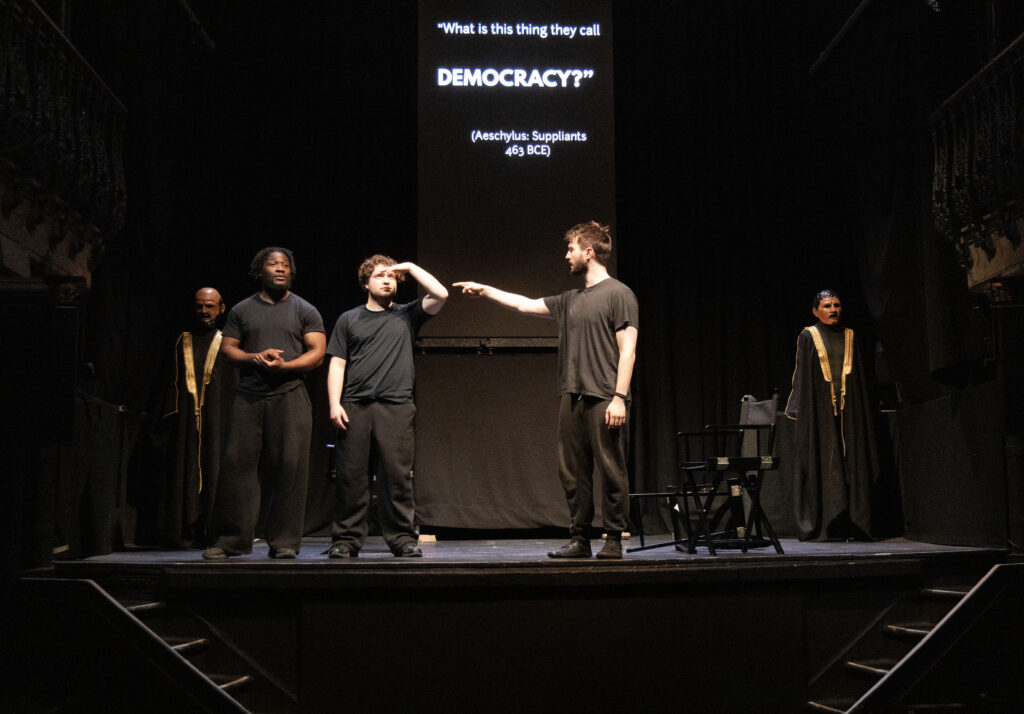
The theatrical section runs about 100 minutes and folds together several strands. The starting point is The Suppliants by Aeschylus. One of the earliest surviving plays of Greek tragedy, it was first performed in the fifth century BCE. In the original drama, a group of women flee forced marriage in Egypt and seek asylum in the Greek city of Argos, where King Pelasgus ultimately submits their fate to a democratic vote. The play’s later sequels are lost, but the premise remains strikingly relevant. Asylum seekers from Syria arriving in Greece and asking to stay.
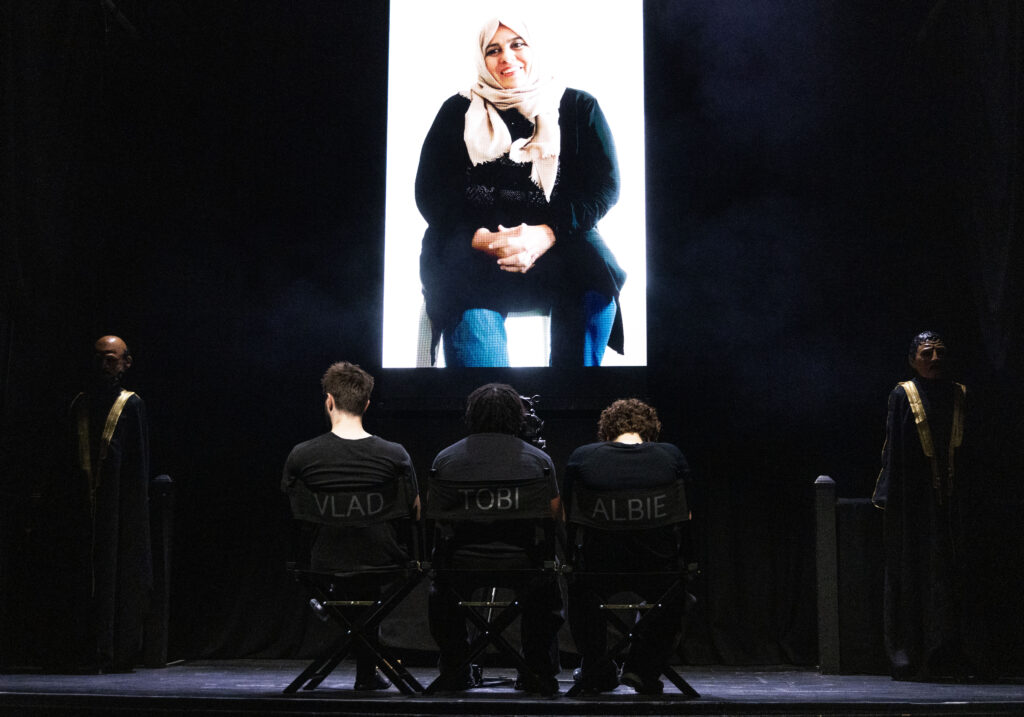
Border Crossings draws a direct line from that ancient story to the present. As part of the project, members of the creative team travelled in 2023 to Türkiye to work with Syrian women living in exile. Their filmed interviews appear throughout the performance, alongside recordings of the women speaking lines from Aeschylus’ chorus (the Danaids), collapsing the distance between classical text and contemporary testimony.
Sanctuary, Hospitality and Belonging
Inside the room at Hoxton Hall, three performers carry the live performance element – Tobi King Bakare, Vlad Gurdis, and Albie Marber – who also helped devise the piece. They shift between roles: narrators, characters from the ancient play, moderators of debate. At various points they stage scenes from Aeschylus (using striking masks by Erin Jacques), perform movement sequences, and guide the audience through a brief primer on recent migration politics. Most strikingly, they invite the audience to take on the role of the citizens of Argos. After hearing the women’s stories, we’re asked to debate and ultimately vote on whether they should be allowed to remain.
Community, theatre, debate and music: Suppliants of Syria contains all of these elements. But considered purely as a piece of theatre, the abundance can also be its difficulty. There’s a lot happening at once, and the production occasionally feels stretched between its many ambitions.
Some of the tensions are fairly inseparable from the concept itself. Three male performers mediate the stories of women who, for understandable (if unfair) logistical and political reasons, cannot be present in person. The production frequently calls out moments that might verge on exploitation, from filming in Antakya to drawing on the performers’ own biographies. Whether pointing out these dynamics resolves them is another question.
The audience debate, meanwhile, felt slightly formalised on the night I attended. It’s hard to imagine anyone who would buy a ticket to this and then vote against offering refuge. The intention is admirable; the outcome a little stilted.
Still, the project’s underlying impulse is a compelling one. By placing a contemporary crisis alongside one of the oldest surviving works of European theatre, Suppliants of Syria reminds us that questions of sanctuary, hospitality and belonging are hardly new. With a little more refinement, there is the kernel of something genuinely powerful here.
Salterton Arts Review’s rating: 3/5
Suppliants of Syria on until 8 March 2026. More info and tickets here.
Trending
If you see this after your page is loaded completely, leafletJS files are missing.