
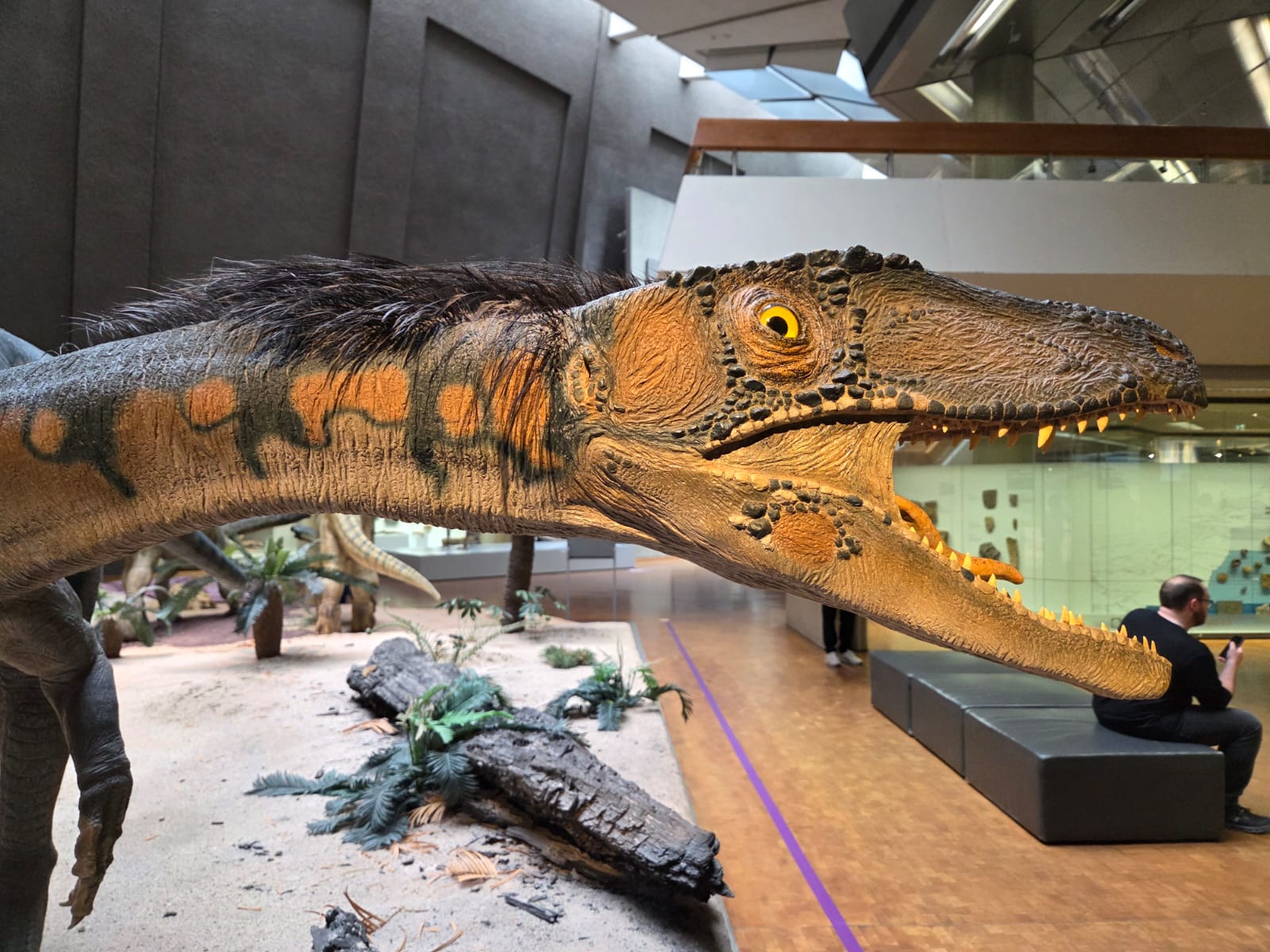
Museum am Löwentor, Stuttgart State Museum of Natural History (Staatliches Museum für Naturkunde Stuttgart)
On a last stop in Stuttgart, I learn about the region’s rich paleontological history at the Museum am Löwentor branch of the State Museum of Natural History.
One Final Stop in Stuttgart
Regular readers know that the Urban Geographer and I recently went on a trip to Germany, where Stuttgart was a new location for both of us. We had a full day, during which we explored the city, went to the Staatsgalerie Stuttgart, and then went on a bit of an expedition in the afternoon to the Weissenhofmuseum im Haus Le Corbusier. The following morning the Urban Geographer had some work commitments to take care of. So it was up to me to decide which additional cultural institution I wanted to visit. I briefly considered the Porsche or Mercedes-Benz Museums, but I’m just not interested enough in automotive history to make another trip out of the central city. I had, however, seen part of the Staatliches Museum für Naturkunde Stuttgart (Stuttgart State Museum of Natural History) on a morning run, and thought it looked an interesting spot.
Upon further investigation, I learned the State Museum of Natural History is split into two parts. Schloss Rosenstein is the one I’d seen. Schloss Rosenstein is at one end of Stuttgart’s Unterer Schlosspark. A key thing to understand here is that Schloss means ‘palace’ in German. Schloss Rosenstein was originally a summer palace, built in Neo-Classical style for King Wilhelm I of Württemberg in the 1820s. It had various uses after the end of the monarchy, suffered heavy damage in WWII, and was reconstructed after the war. Since the 1950s it has housed the Museum of Natural History.
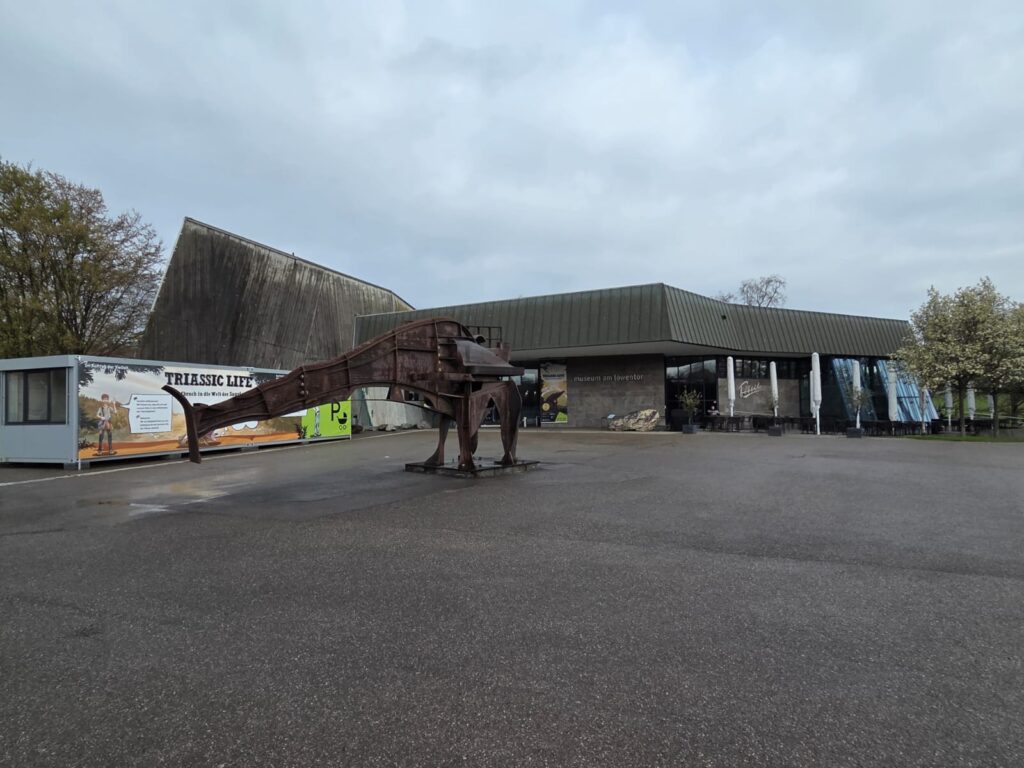
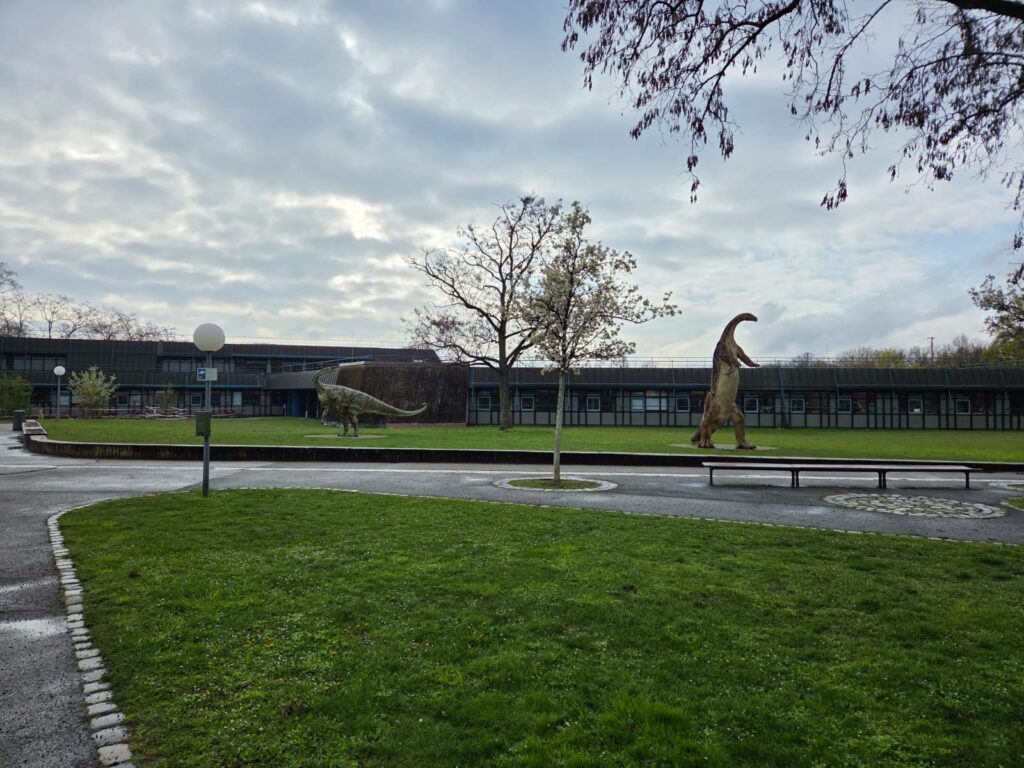
As nice as a former summer palace undoubtedly is, though, by the 1980s it was not big enough. The Museum am Löwentor (Lion Gate) was the result. This museum is at the other end of the palace’s former English-style garden. The division between the two is broadly this: Schloss Rosenstein focuses on biology, as in species that are alive, while the Museum am Löwentor focuses on paleontology and geology, as in things that are not alive (or at least not any more).
Which one to visit? I liked the idea of visiting a museum I’d encountered in the wild, so to speak. But, and this is an important point, dinosaurs are very cool. A fact the Urban Geographer doesn’t necessarily agree with. So a morning on my own could be a perfect time for dinosaurs. When I read that the Museum am Löwentor also has an extensive collection of specimens in amber, my inner geek knew exactly which museum I’d be visiting.
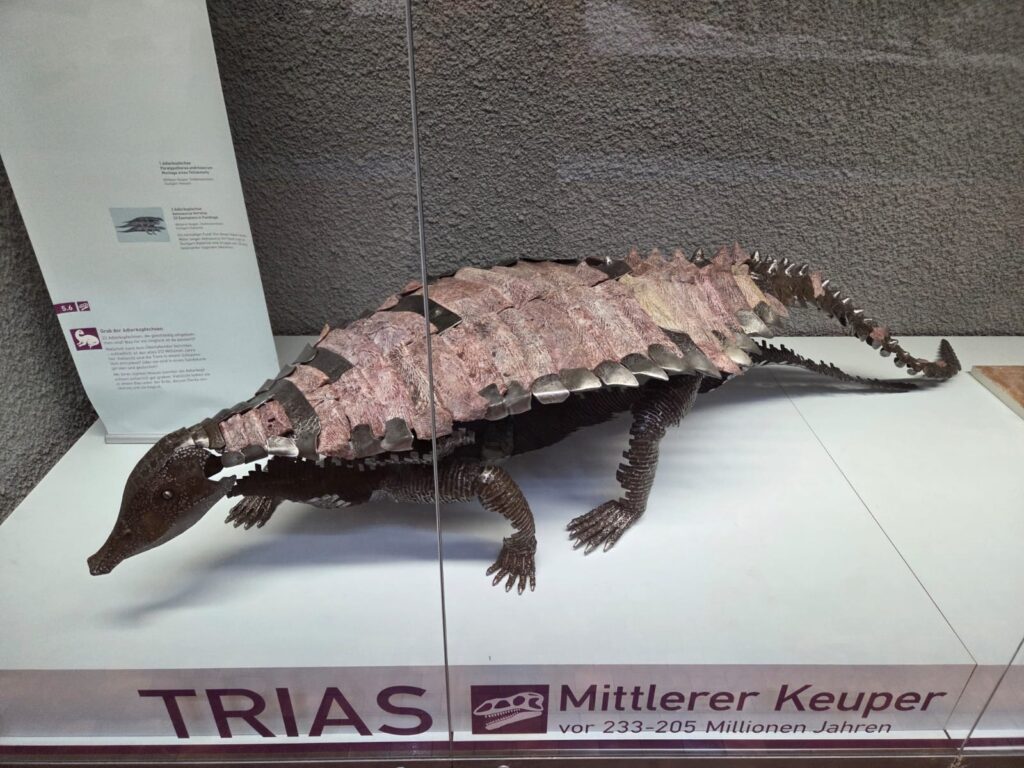
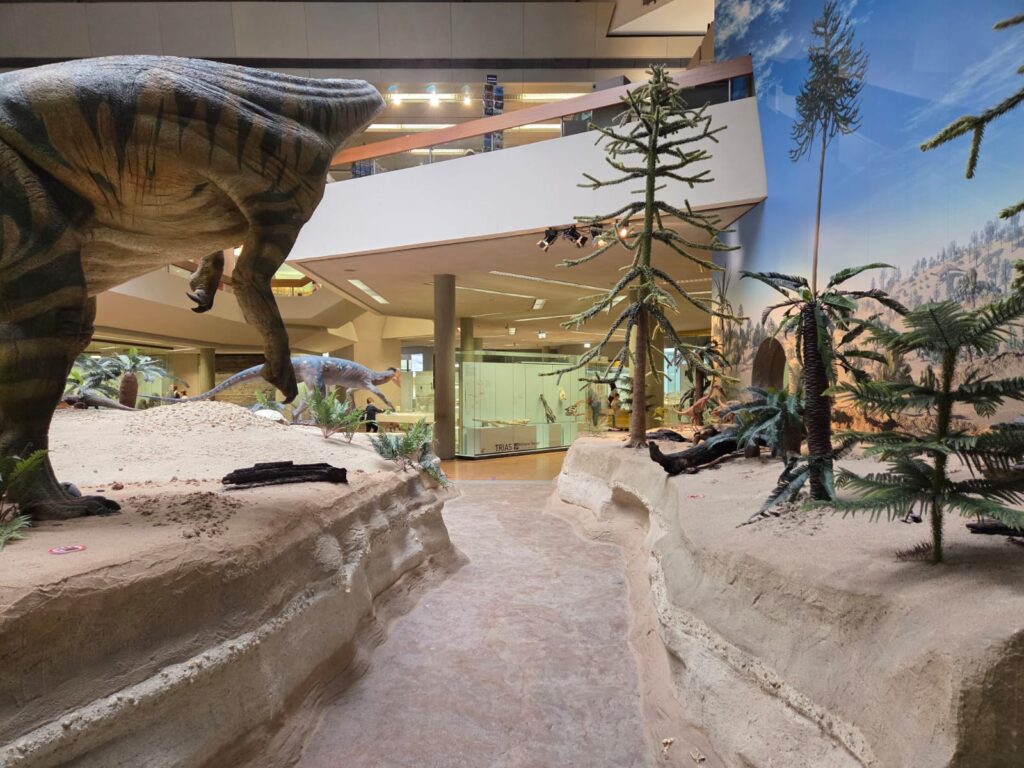
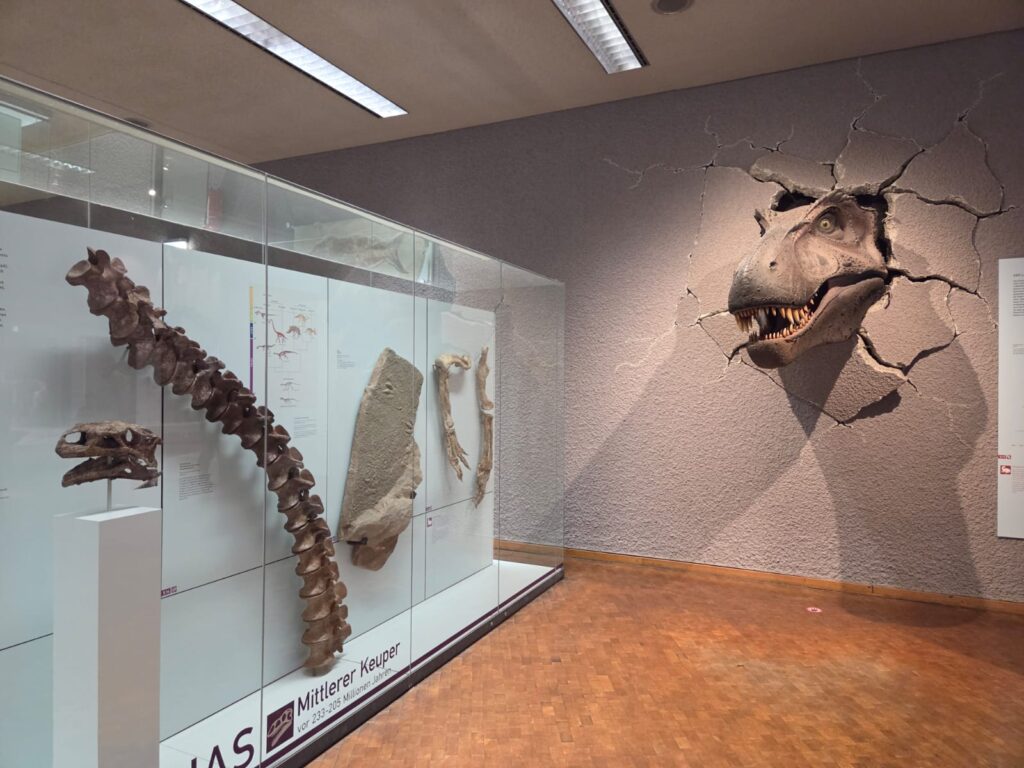
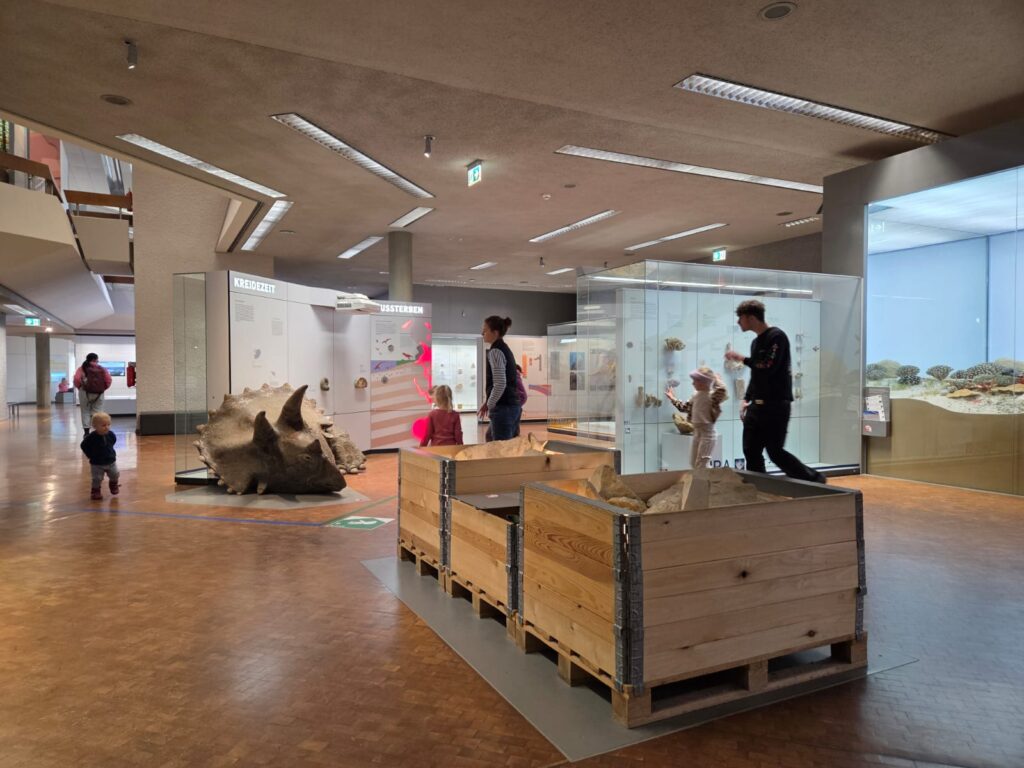
The Staatliches Museum für Naturkunde Stuttgart and Museum am Löwentor: A Brief History
I gave a tiny history of the buildings of the Staatliches Museum für Naturkunde Stuttgart above. But there is more to say about the evolution of the collection into the museums we see today. The origin of the museum(s), as with the Staatsgalerie Stuttgart, was the Württemberg royal collection. And the man who made the collection public in both cases was King Wilhelm I. Yes, he of the summer palace above.
The museum was not originally in the summer palace, however. And it didn’t originate with King Wilhelm. Before the leaders of Württemberg were kings, they were dukes. And back in the 18th century, when it was fashionable to have a cabinet of curiosity, the Dukes of Württemberg established one. This royal Wunderkammer origin is something the Staatliches Museum für Naturkunde Stuttgart has in common with the Naturhistorisches Museum in Vienna, and the Green Vault in Dresden. The former is also today a more expansive natural history museum, while the latter has retained its cabinet of curiosities format.
Anyway, King Wilhelm I declared this collection a public one in 1817. He had a museum built in the city, starting in 1822. Father and son Oscar and Eberhard Fraas worked through the rest of the 19th century to make the collection a bit more scientific and expansive. The first half of the 20th century was fairly uneventful, but you can probably guess what happened during WWII. Yes, the museum burned down. Luckily the bulk of the collection was already offsite for safe-keeping. But a number of type specimens (the very first scientifically-described example of a species) were lost.
In the 1950s Schloss Rosenstein was converted into a museum, opening in 1956. And from there we know that space ran out in the 1980s, necessitating a whole extra museum at Löwentor. This time the museum was purpose-built, a ‘one-room’ museum design over three floors by local firm Siegel, Wonneberg and Partner. Construction began in 1981 and the museum opened in 1985.
The Visitor Experience
I have to say, I found this one-room design a little confusing. It took me a couple of attempts to figure out how to actually get into the museum. The first time I got past the ticket desk, gave up, and retreated back to the rooms displaying the museum’s amber collection. The second time I decided to go through the temporary exhibition and work it out from there. I could also have entered via the cloakroom/facilities area downstairs.
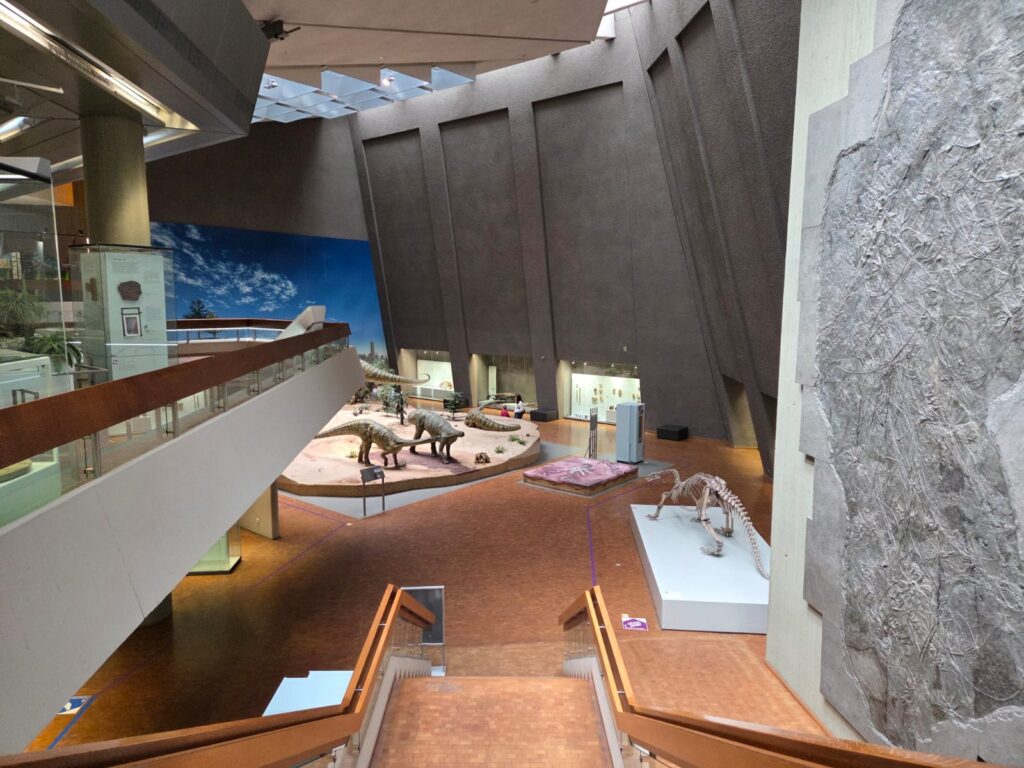
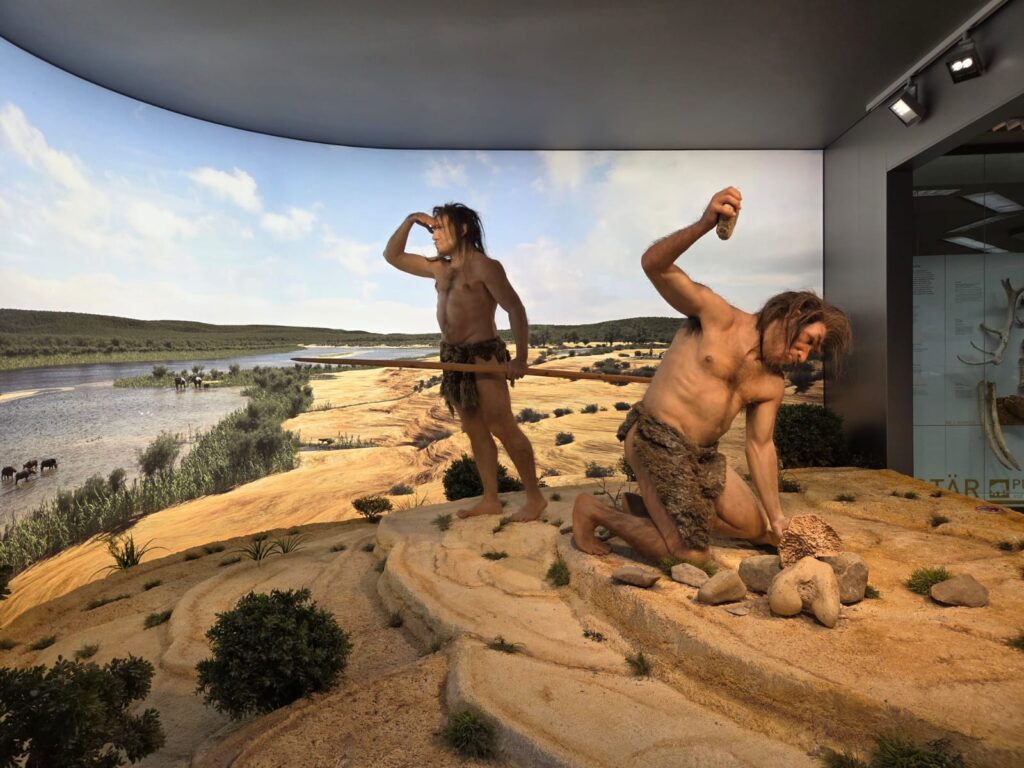
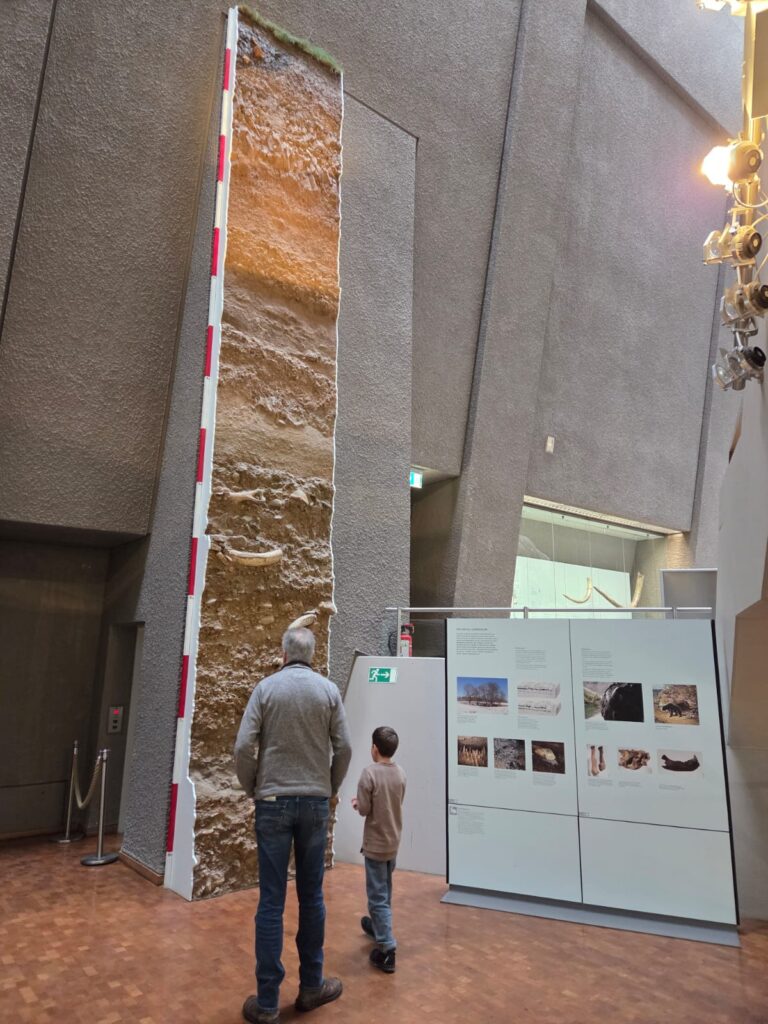
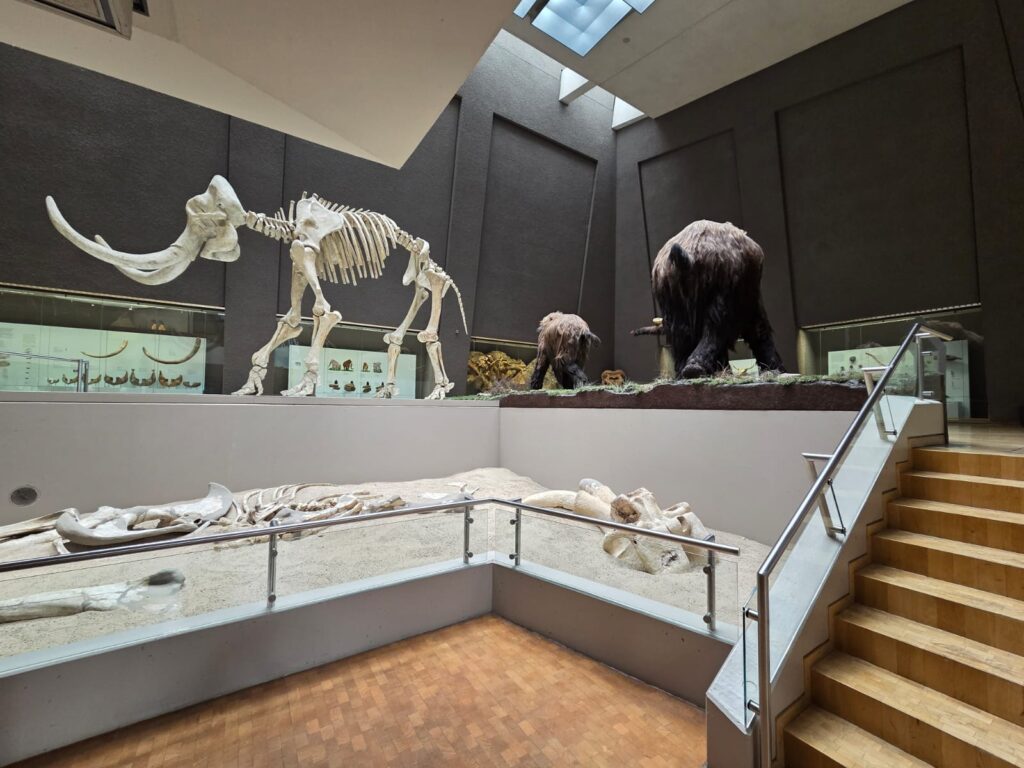
Visitors enter the Museum am Löwentor via the uppermost of three floors, and in my opinion using the top floor for temporary exhibitions detracts from the overall impact of the space. It’s not just working out how to get into the museum. It’s also that it is a visual barrier to an otherwise really great museum space where you can take in some of the enormous specimens and dioramas below.
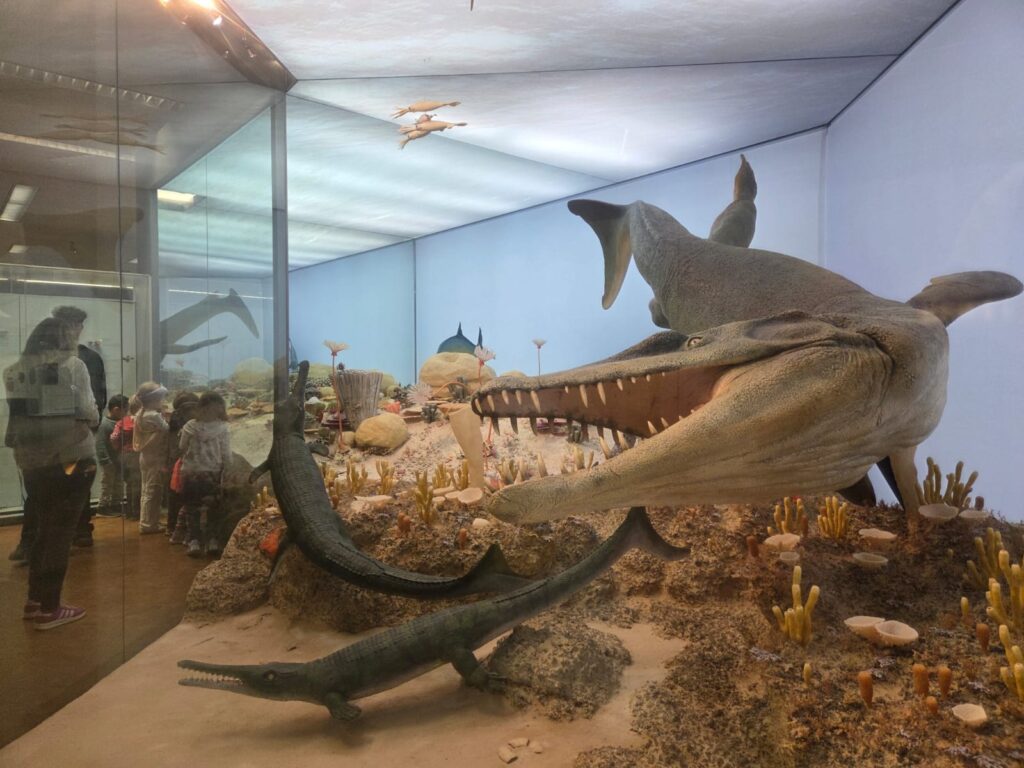
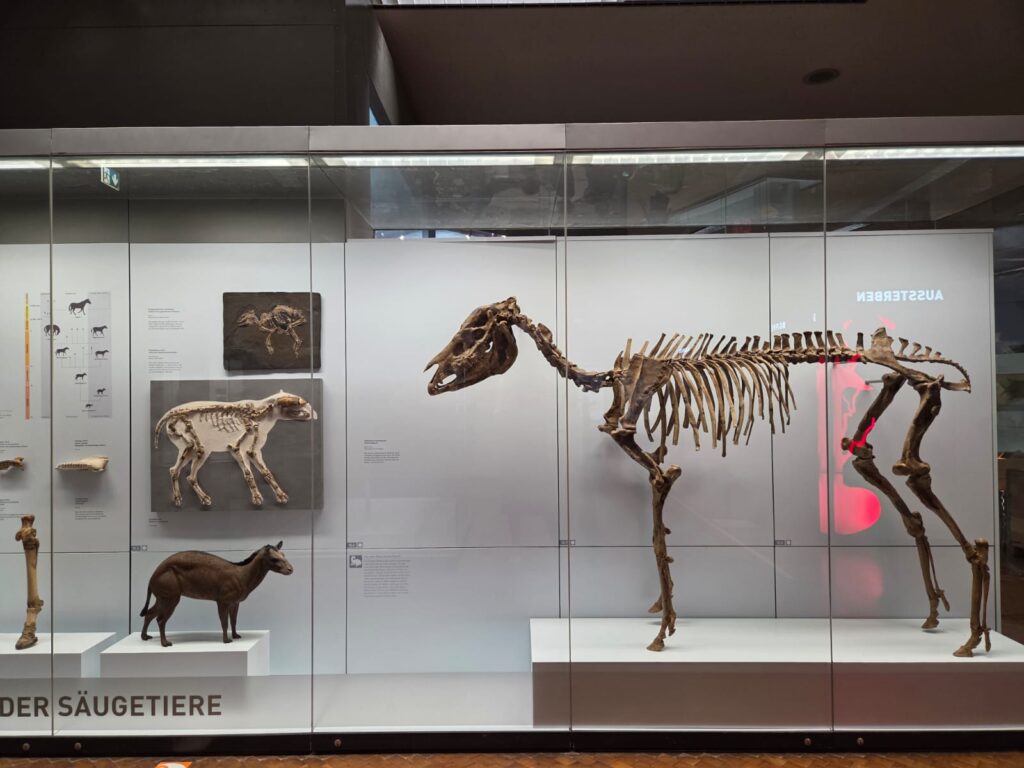
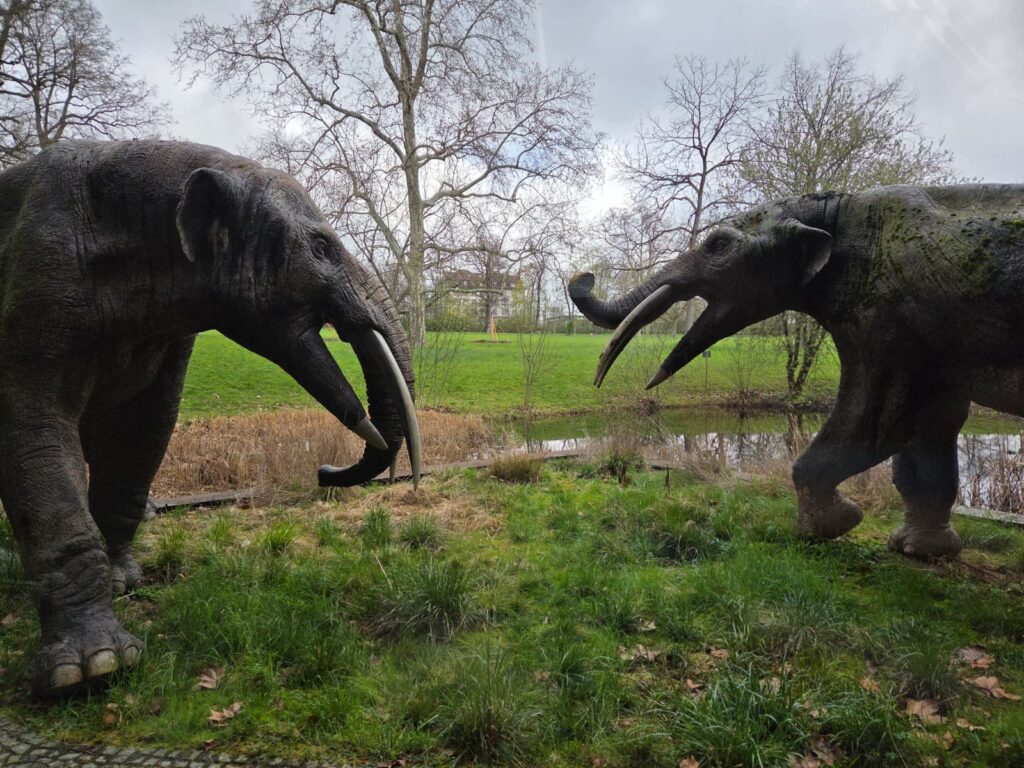
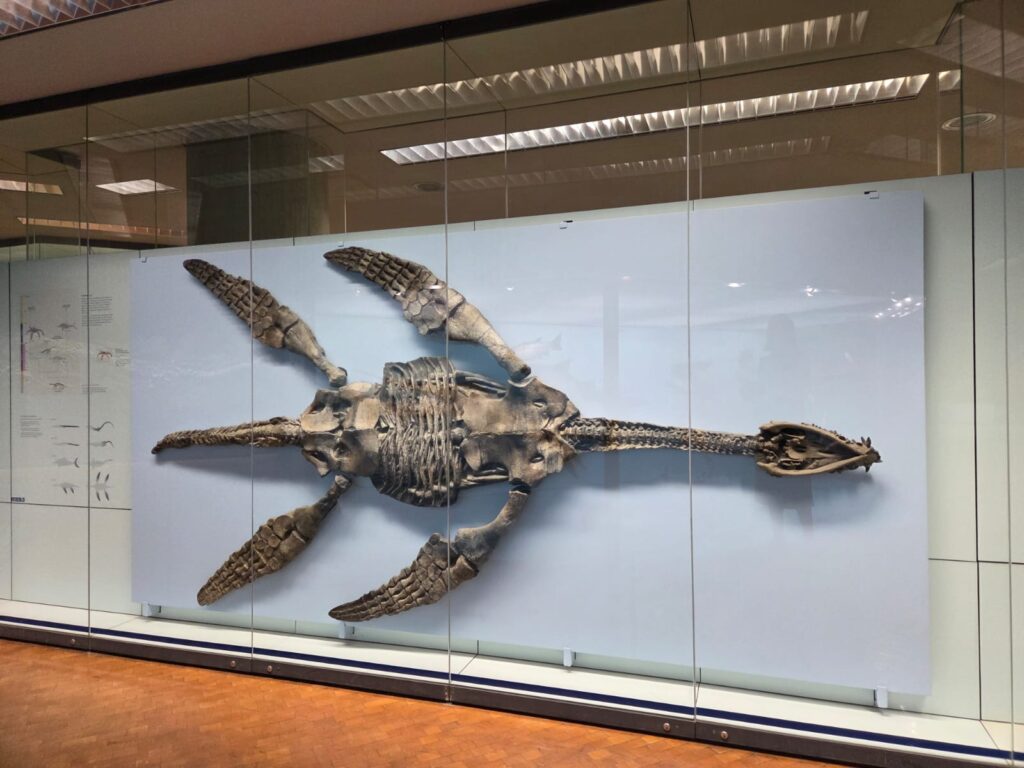
Once you get past this, you can start to appreciate all those impressive sights, as well as the wealth of other specimens and exhibits that form part of the permanent collection. The building is either of its time, or fitted into the landscape, or both. Either way, there are a lot of split levels and odd spaces that the exhibition team works with. The subject matter is split into different focus areas: underwater species, for instance, the evolution of feathers, extinction events. The list goes on.
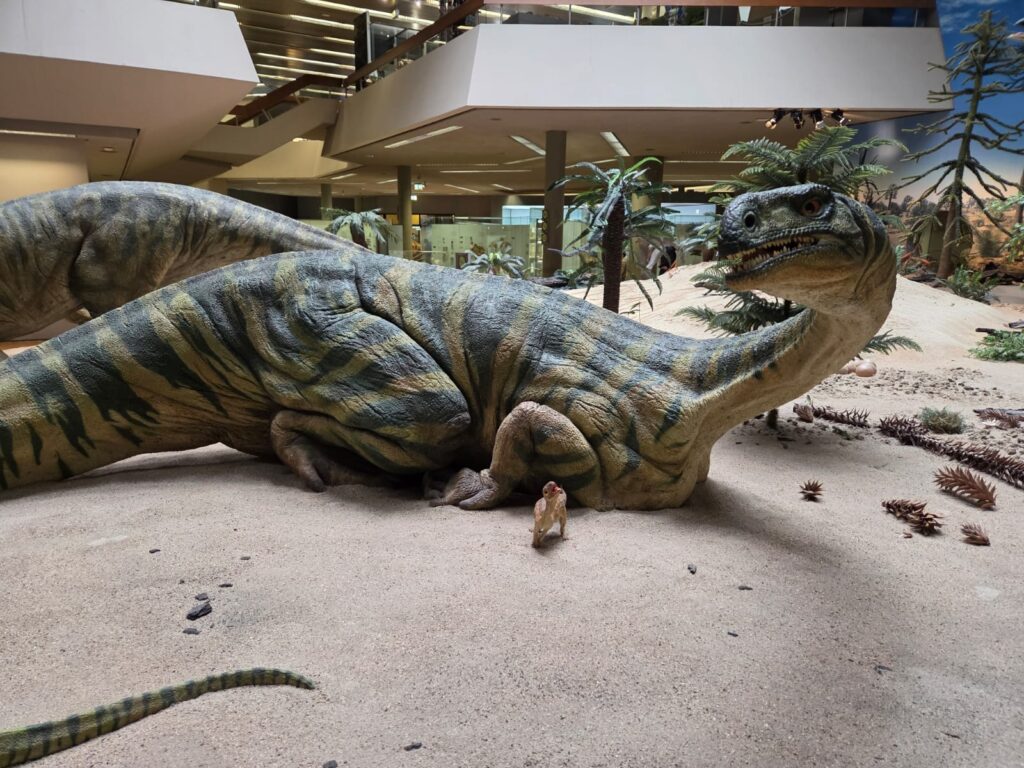
The museum is, as you might expect, geared towards visitors of all ages. There are visual displays and even a few animatronics to excite budding paleontologists. And more studious exhibits for older visitors. The cloakroom/facilities area I mentioned earlier has a space to eat packed lunches. Or there is a cafe which opens onto the park outside. There’s a bit of travel from central Stuttgart to get here (the U-bahn then a walk, for me). But once here you can make a solid half day or more of it.
A Few Highlights
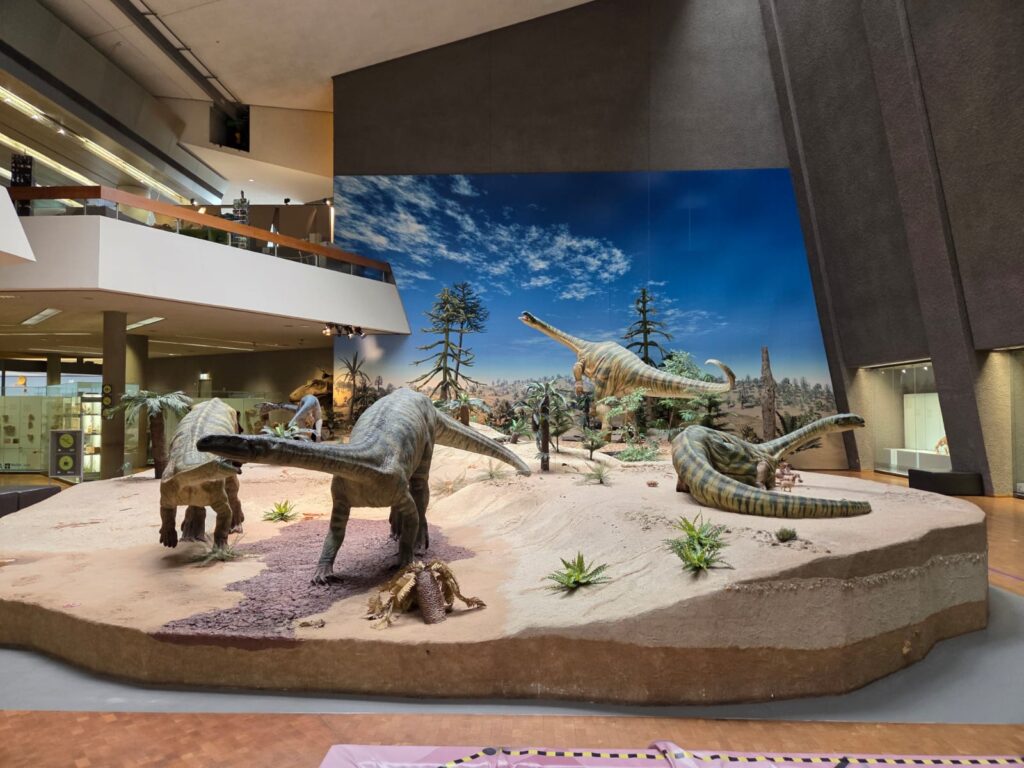
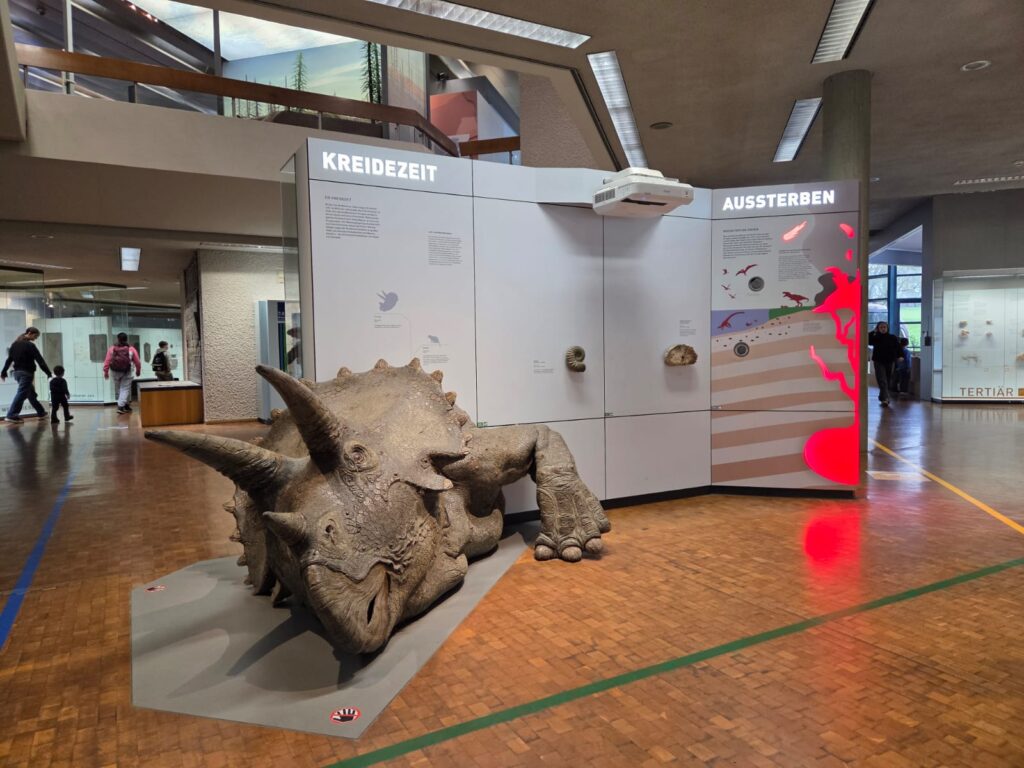
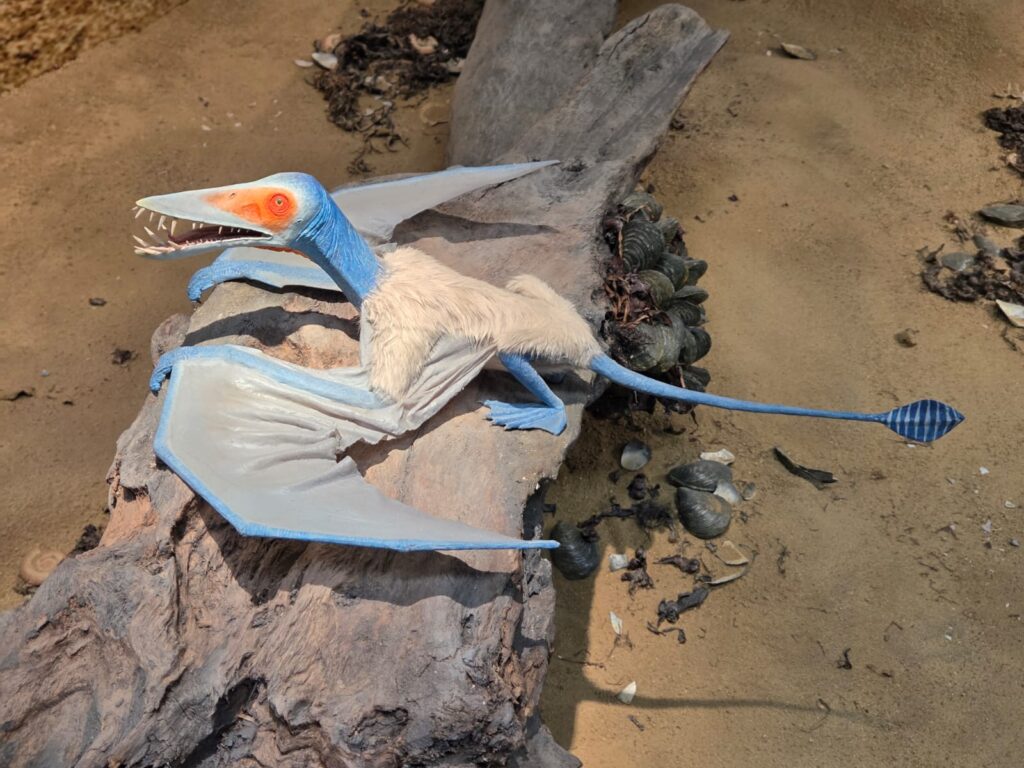
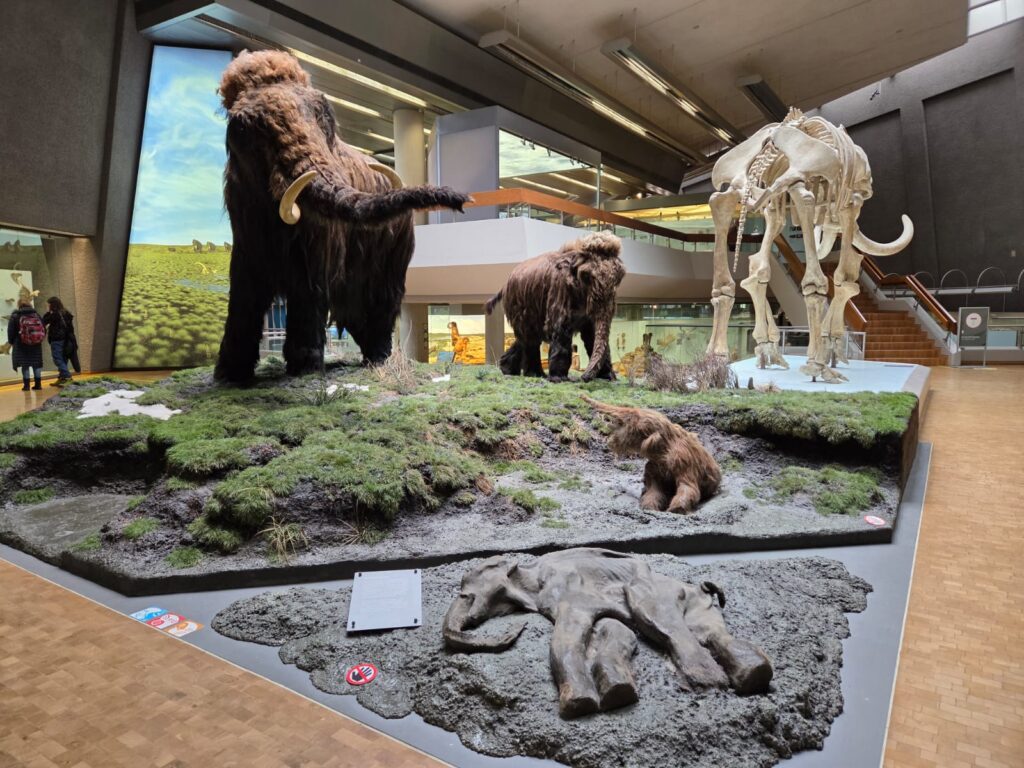
I started this post by saying that dinosaurs are really cool. They are, so the dinosaur dioramas, and the animatronic ones, were some of the highlights for me. The one I found the most impactful was not actually of dinosaurs, though, but a family of mammoths. A female mammoth is walking with two babies of different ages, one of whom has got stuck in mud. Given that the display is inspired by a famous specimen of a well-preserved baby mammoth, Lyuba, we know how the story is going to end. Very sad. Lyuba was discovered in 2007 in Siberia, and I actually saw her in a travelling exhibition when I lived in Korea years ago. It’s a small world.
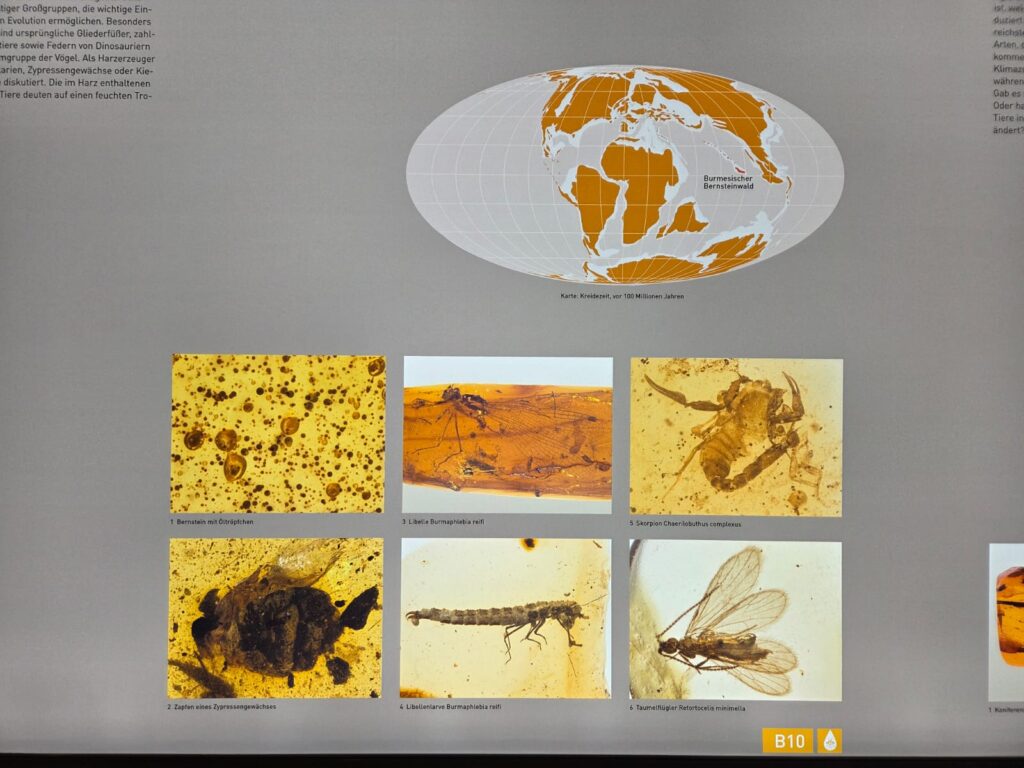
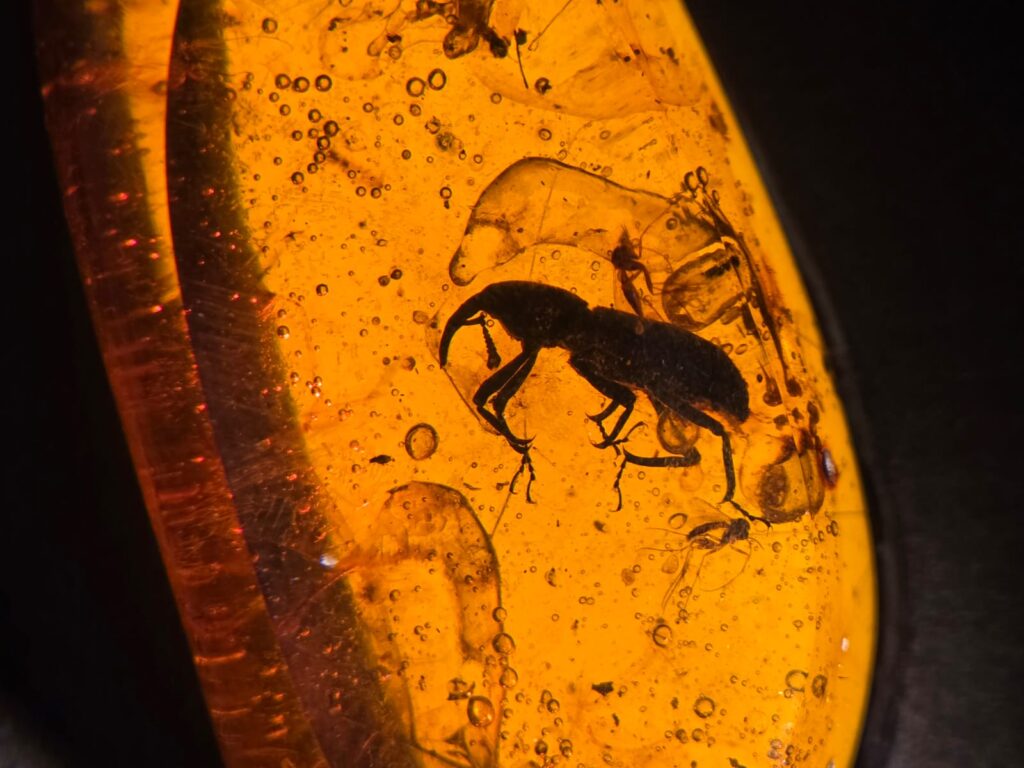
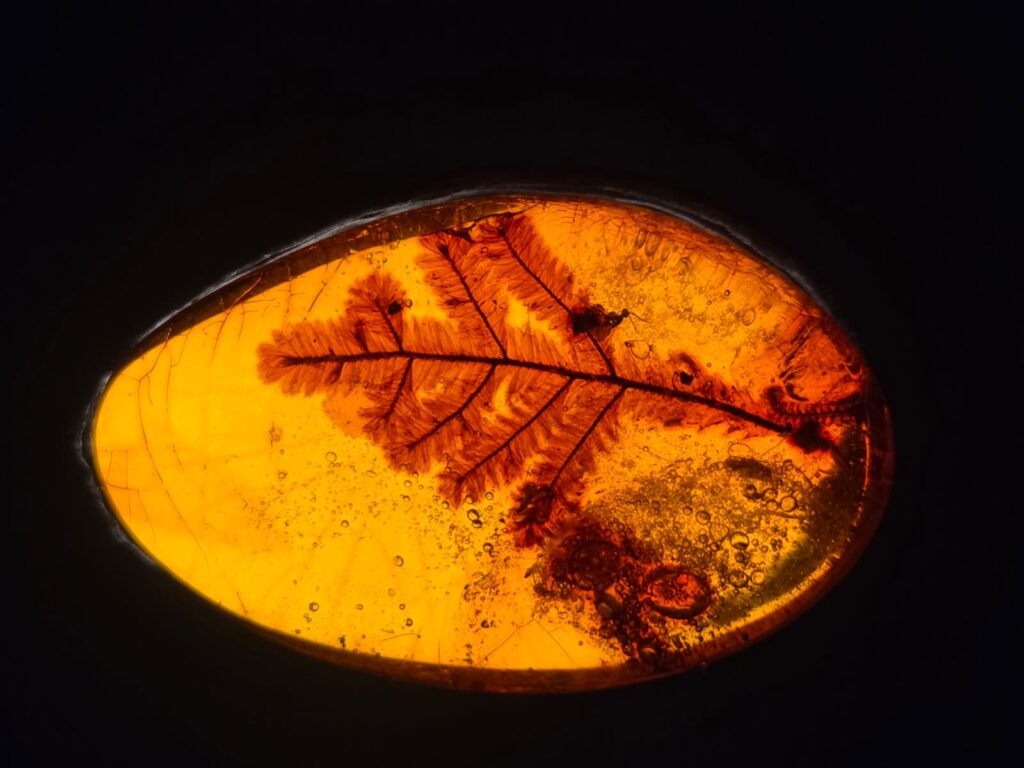
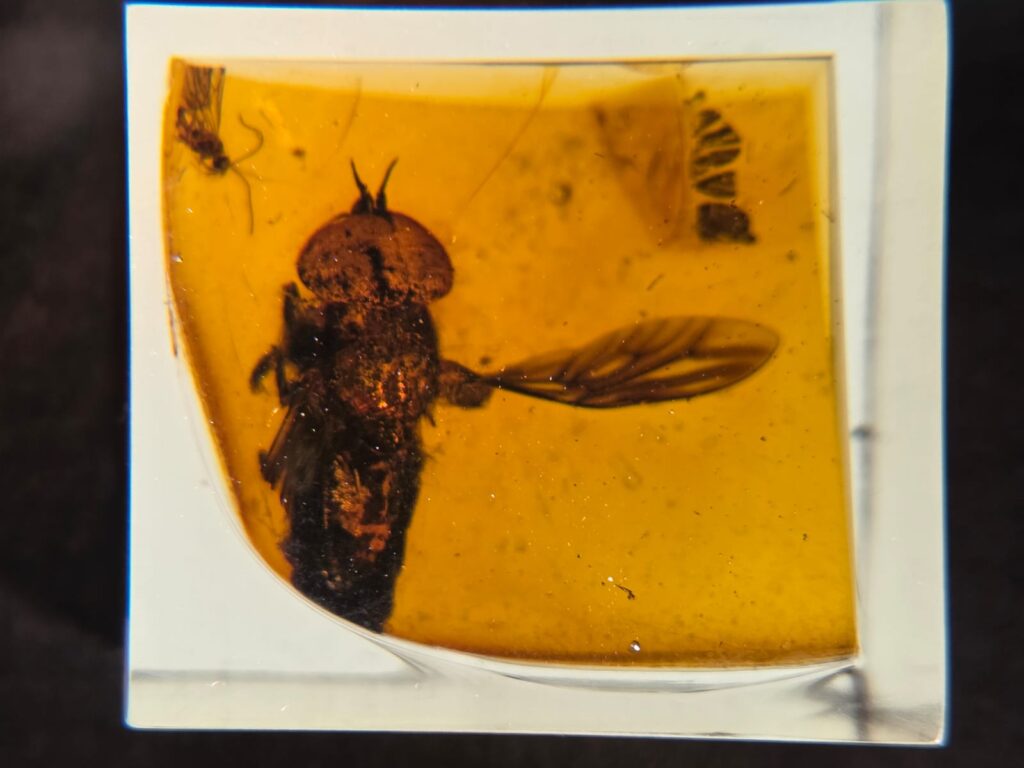
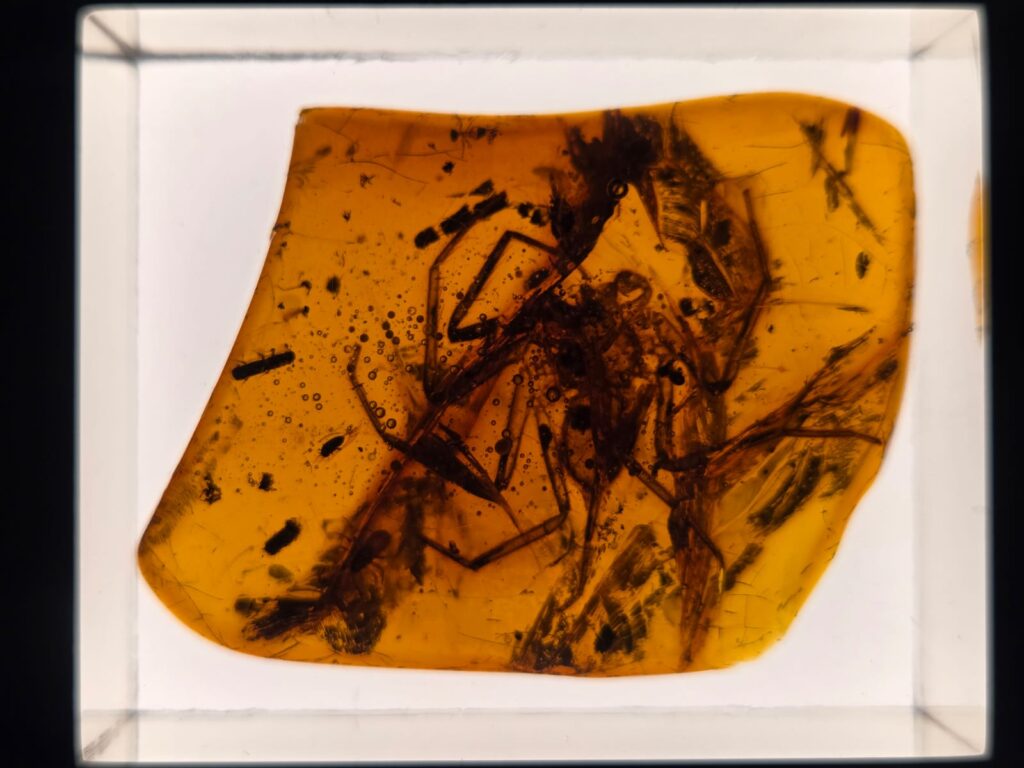
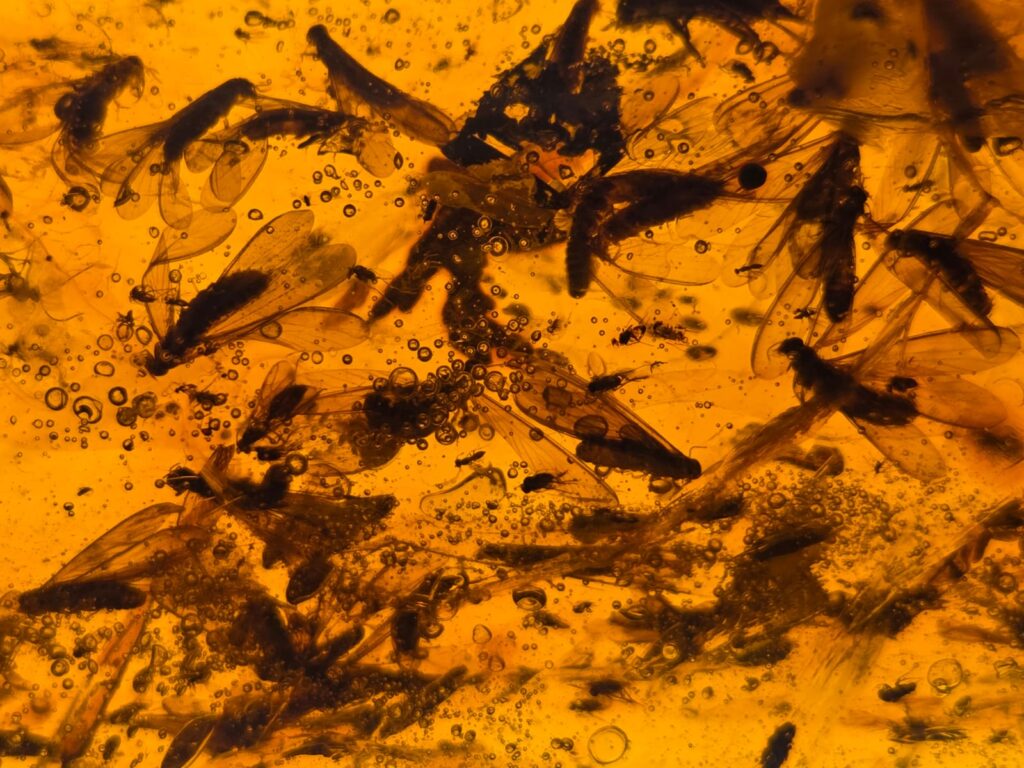
Another highlight for me was definitely the amber collection. The information on where amber is found in the world, the process of specimens becoming preserved in it, and what we can learn about ancient flora and fauna from studying it, is very interesting. Plus there are loads of specimens you can look at, magnified to see the details of the inclusions within. I lingered here, and it wasn’t just because I hadn’t yet figured out how to get into the museum proper.
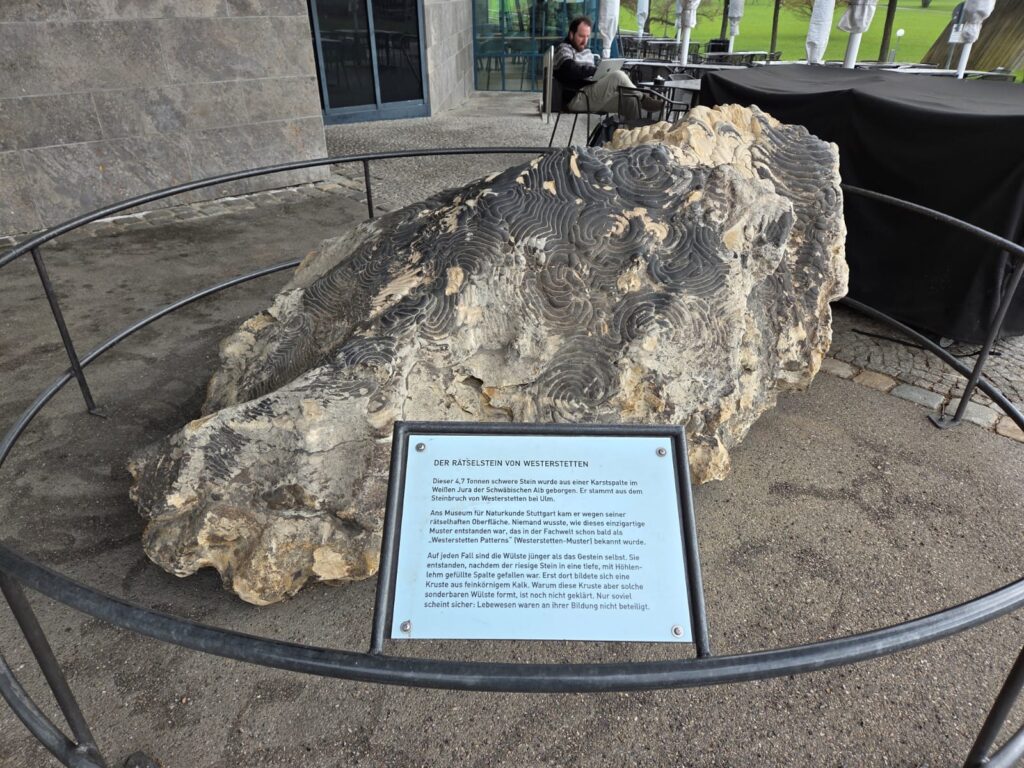
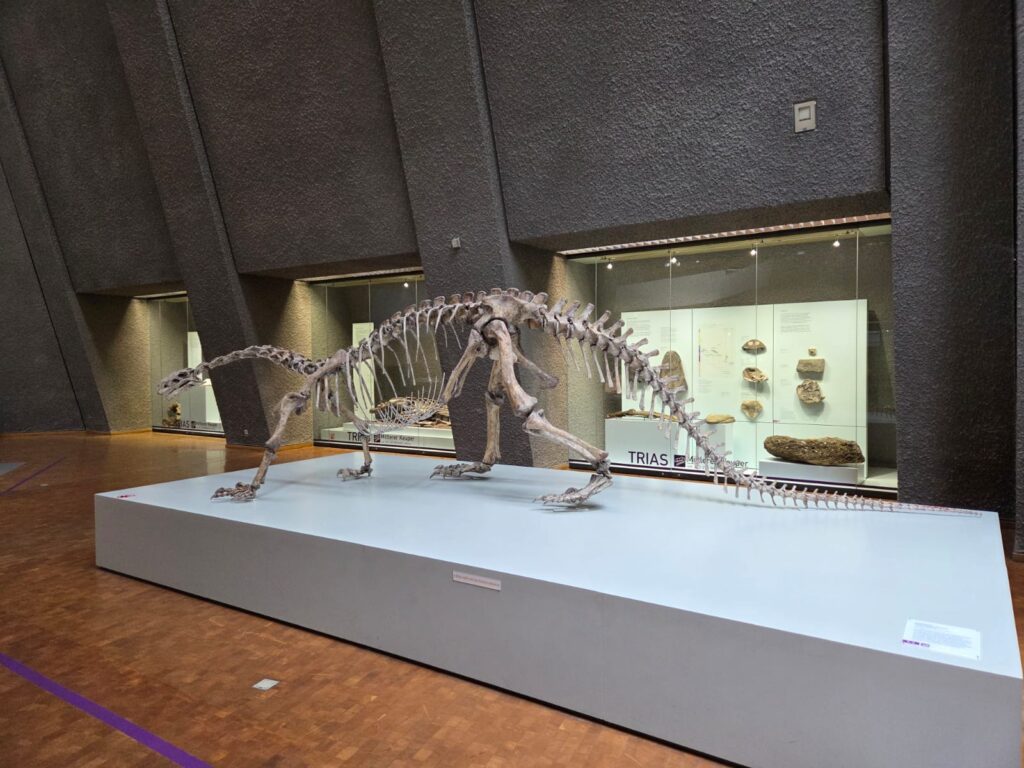
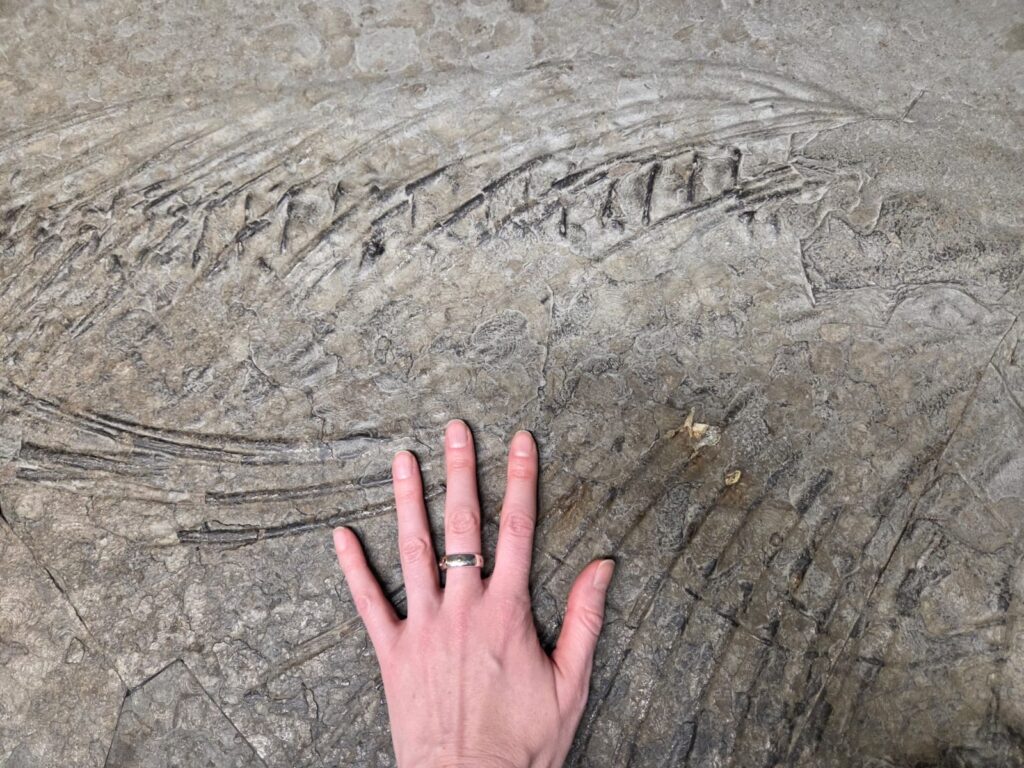
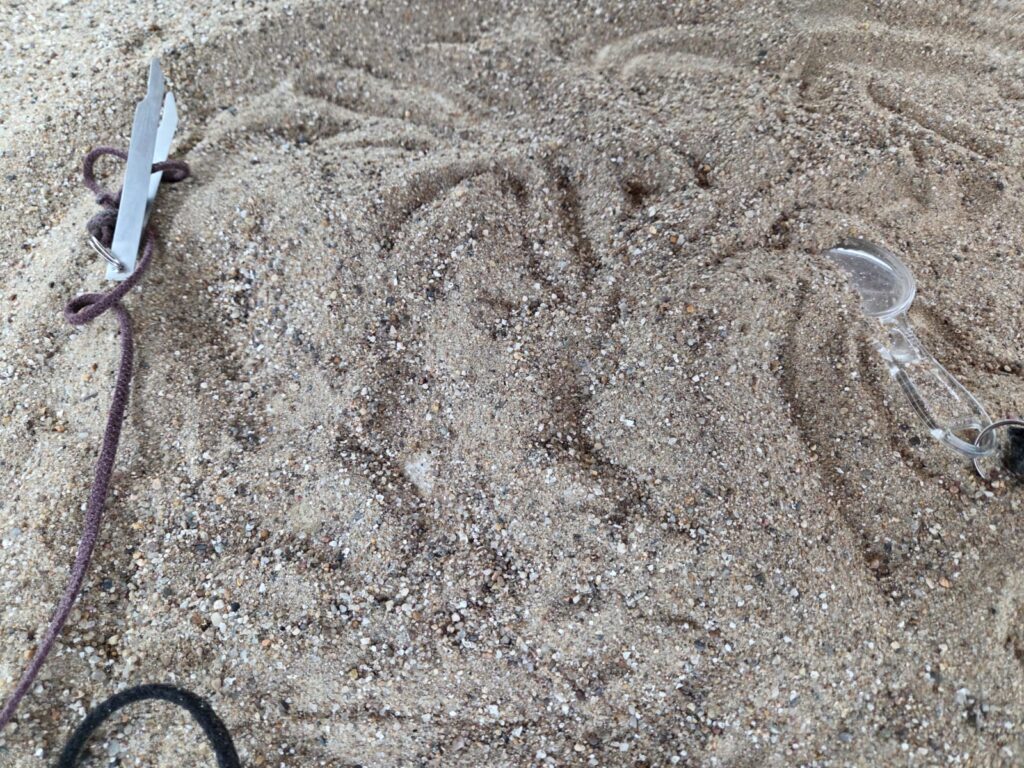
In terms of the fossils, there were three types that I enjoyed. One was the massive specimens, some almost the height of the museum. There were also one or two fossils you could touch. I love those connections to a time millions of years ago. And finally, there were the fossils you can take home with you! The museum has a couple of pits of sand, with strong lighting, tweezers and little bags so you can extract tiny ancient snail shells (or the shells of something, anyway), and take up to five home with you. It reminded me of the fossil pit I came across in Abbey Wood.
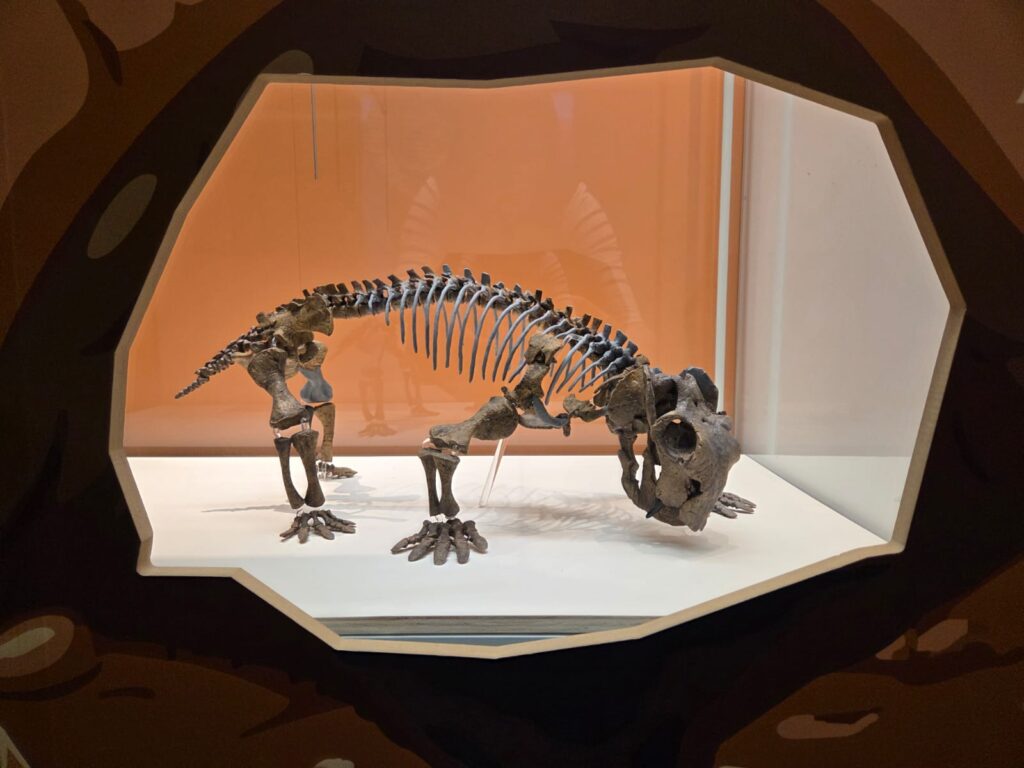
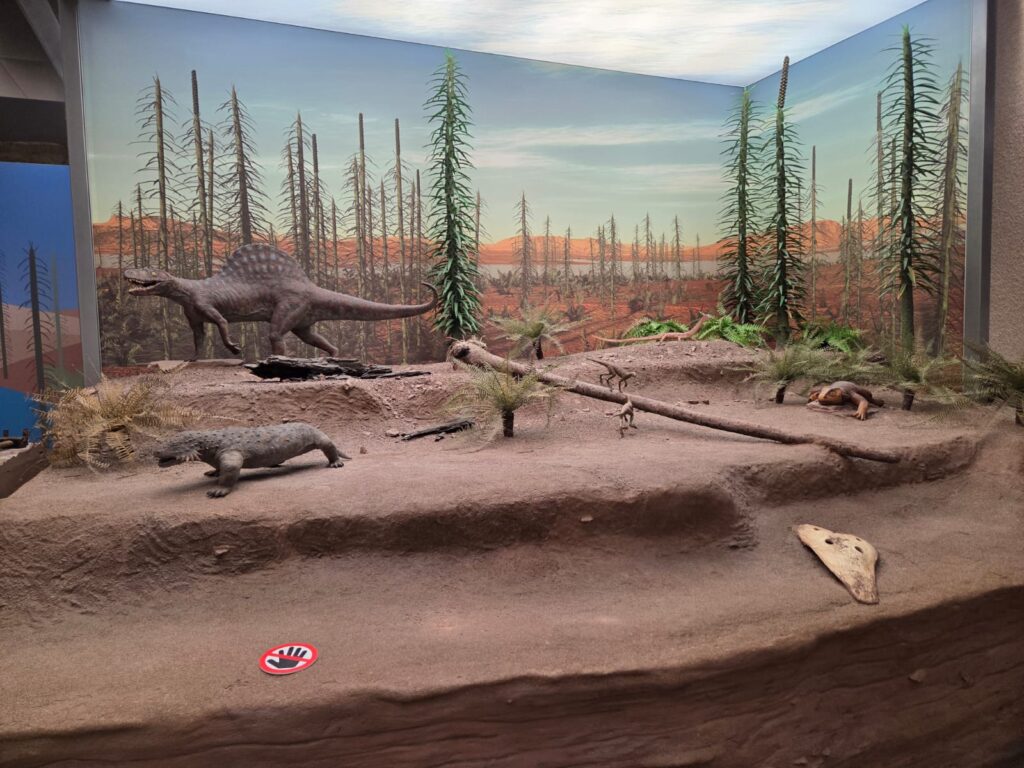
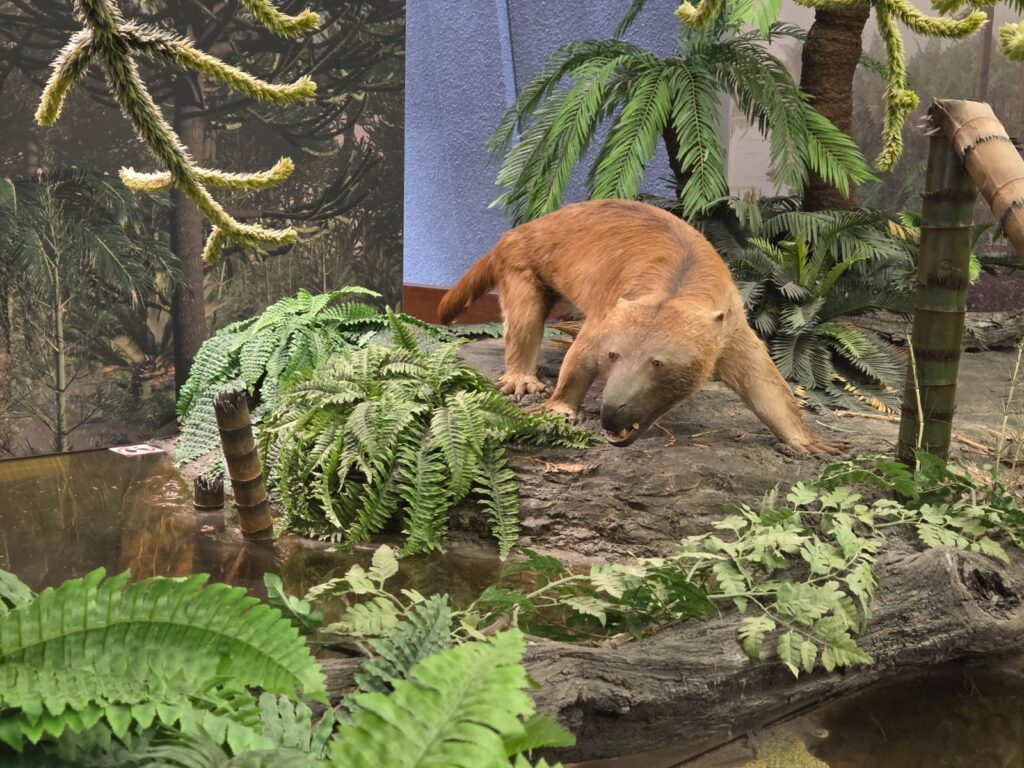
Triassic Life – Dawn of the Age of Reptiles
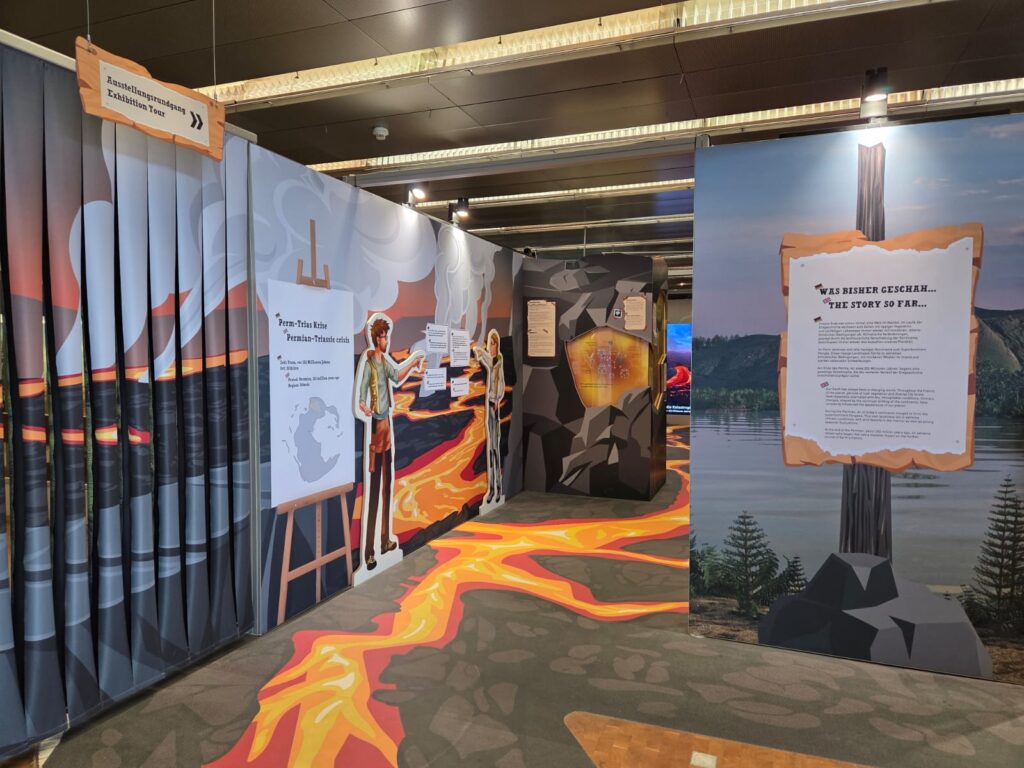
The temporary exhibition when I visited the Museum am Löwentor was Triassic Life – Aufbruch in die Welt der Saurier (A Journey into the World of Dinosaurs, but the English title is Dawn of the Age of Reptiles). I complained earlier about how the exhibition’s placement made the museum experience a bit confusing, and the architecture less impactful. But it was actually quite an interesting exhibition. Definitely pitched at younger visitors, but interesting.
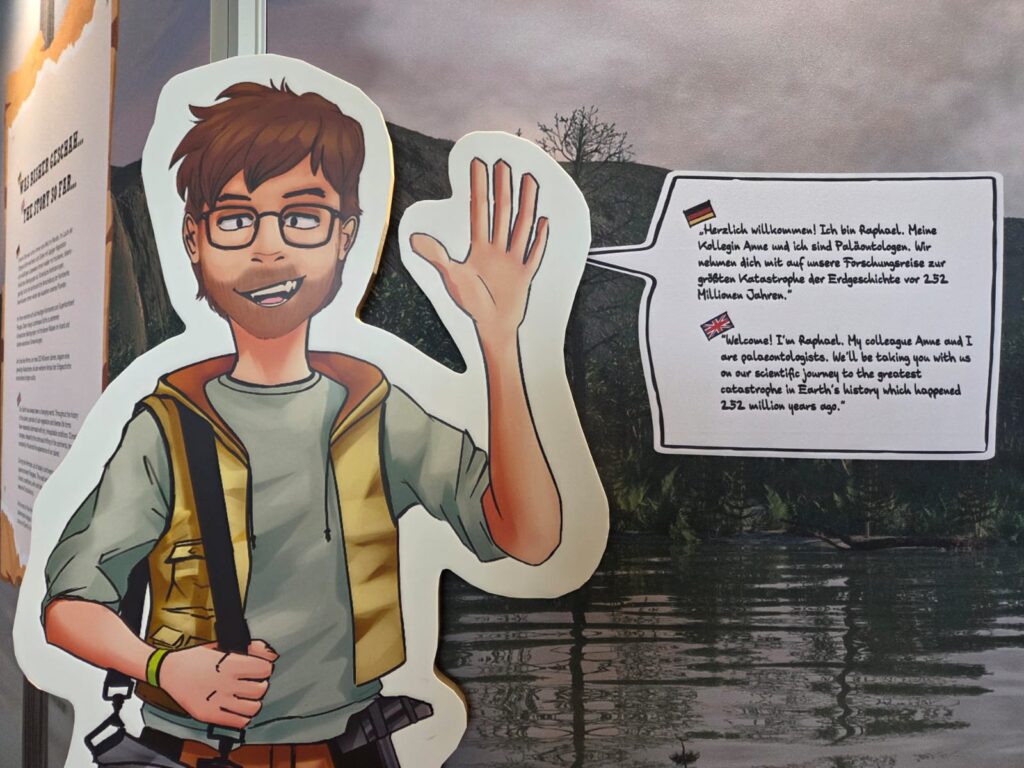
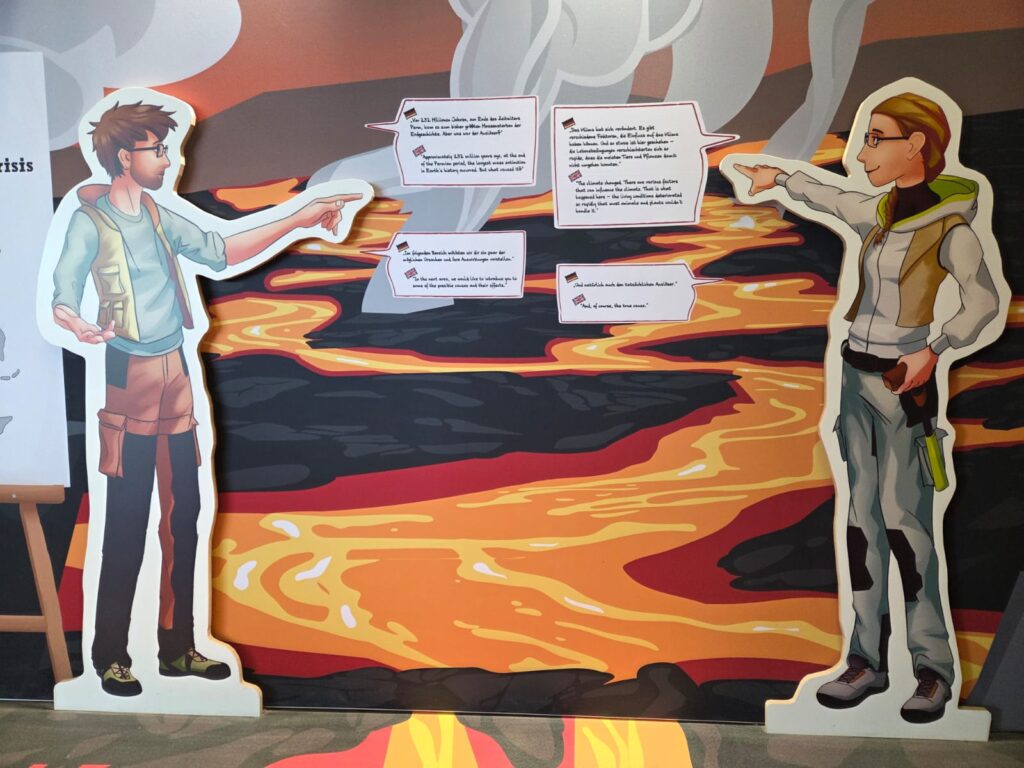
The central idea is that you, along with two paleontologists and some kind of ancient amphibian, are on a research expedition 250 million years into the past. In other words, during one of the Earth’s mass extinction events. First you investigate what caused this mass extinction. And then you look at how one ancient life form’s loss is another’s gain, and what positioned reptiles to flourish in the post-extinction world.
The three guides are presented as comic book characters, and explain different things about dinosaurs, mass extinctions, the climate, and reptile diversity. Parts of the permanent exhibition are incorporated into the temporary exhibition, which I guess is why it takes over the museum’s top floor. All the text panels are very clear, with German and English versions marked with flags.
I learned a lot in the exhibition. About how this mass extinction event was due, not to an asteroid as you might assume, but to volcanic activity causing the failure of carbon traps in Siberia. About 80% of marine species and 70% of land vertebrates went extinct. The survivors emerged into a new climate, but by diversifying and adapting (eg. erect limb posture, hair, feathers, increased metabolism), reptiles spread into every type of habitat. It’s a fun and informative format – perhaps the main downside is the volume of information to take in.
Triassic Life – Dawn of the Age of Reptiles on until 7 June 2026.
Final Thoughts on the Museum am Löwentor
Looking at my day and a bit in Stuttgart, I think I made some interesting museum choices, which gave me a well-rounded perspective on the city. The Staatsgalerie Stuttgart is the one that I would recommend for any first time visitor. It’s a great collection, in a central location, with statement architecture. Plus you can get local specialties in the cafe : always a bonus. The Weissenhofmuseum im Haus Le Corbusier is best either for architecture lovers, or return visitors. It was a great pick for me, but I wouldn’t recommend it for everyone. And the same goes, to a lesser degree, for today’s museum. There are plenty of other museums and galleries a first time visitor can see in central Stuttgart. Or if you want to go further afield, many people will pick one of the automotive museums.
But if you are into dinosaurs, or are travelling with children, the Museum am Löwentor is a good pick. The setting is nice as well – if I had more time it would have been nice to walk along the park past the other half of the Staatliches Museum für Naturkunde Stuttgart and along the Unterer Schlosspark back to the central city.
One thing I hadn’t been aware of before visiting is how rich in paleontological evidence this region is. Baden-Württemberg is famous for its fossils, particularly early Jurassic, including a number of impressive examples of marine life. Fossils, and fossil-rich sites like Holzmaden and Nusplingen have legal protection. The fact that a lot of what I was seeing came from this region I was visiting for the first time was also a factor in deciding to visit this museum. And it didn’t disappoint!
Trending
If you see this after your page is loaded completely, leafletJS files are missing.