
The Wallace Collection at War – The Wallace Collection, London
A lovely small exhibition at the Wallace Collection explores the WWII period: how the collections were safeguarded, and the uses to which Hertford House was put during wartime.
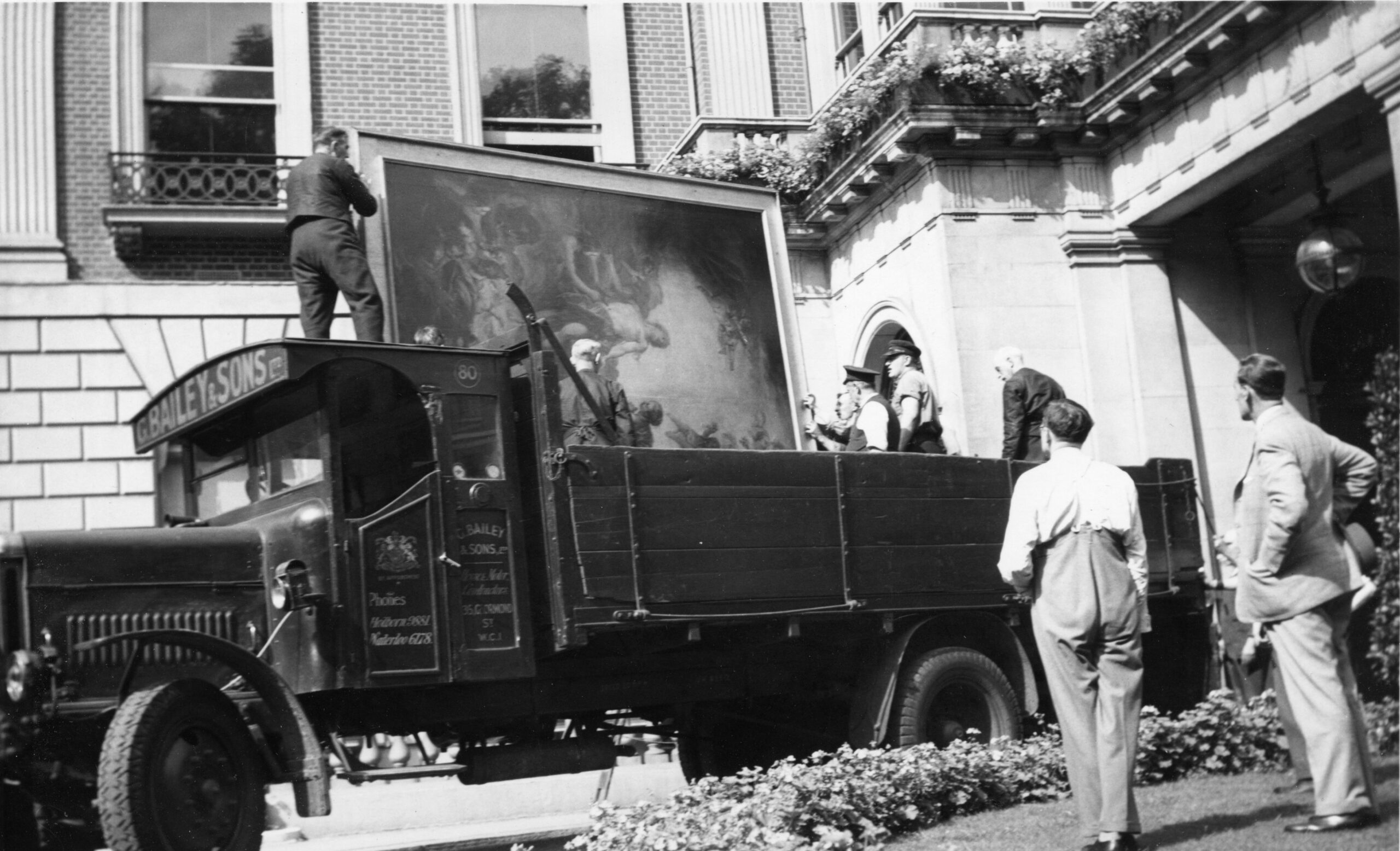
Lead image photo credit: Evacuation of Boucher’s The Rising of the Sun, late August or early September 1939 © The Wallace Collection
The Wallace Collection at War
I little thought, when I came to the Wallace Collection recently to see Caravaggio’s Cupid, that I would be back again so soon. But regular readers know I am a sucker for a focused, deep-dive exhibition. And The Wallace Collection at War fits the bill perfectly. The result of extensive research by Dr Alison Smith, the Wallace Collection’s Director of Collections and Research, this free display fills a gap in my knowledge about Hertford House during WWII, and also Britain’s wartime cultural agenda more generally.
The first question, naturally, is what became of Hertford House and its priceless treasures during the war? The Wallace Collection were not alone in having to work out a plan. As war became more and more inevitable in the late 1930s, all national museums began to finalise their plans. These generally involved shifting the most irreplaceable works (hopefully) far away from bombs, and shoring up the building as far as possible. Mines seem to be a favourite for temporary storage in times of crisis. They are underground, for a start, and I suppose must have stable atmospheric conditions. I wrote recently about Klimt’s Beethoven Frieze spending the war in a salt mine. The National Gallery, likewise, sent works to a disused slate mine near Blaenau Ffestiniog in Wales.
The Wallace Collection went in a slightly different direction, with works heading to Hall Barn in Buckinghamshire, and Balls Park in Hertford (and later to West Wycombe Park). There are some great images of paintings leaving Hertford House (in a slightly casual way by modern standards, some might say), and in their temporary home at Hall Barn. So far, though, the specifics are interesting, but the story – or stories of this kind – not unheard of. Museums the world over have gone to extraordinary lengths to protect important cultural heritage in times of war, while other works have been sadly lost to bombs or fires or other mishaps.
The Wallace Collection Joins the War Effort
The part of the story that was brand new, at least to me, was what happened to the empty national museum buildings. Because, far from being shuttered and waiting things out, they were put to work as part of the war effort. The Ministry of Works claimed Hertford House – now empty – as a venue for exhibitions. Rather a wide range of exhibitions, from an ‘agitprop‘ installation to historic arms and armour.
It is two of these exhibitions with which the remainder of today’s display concerns itself. Both took place in 1942. The first, Artists Aid Russia, was in fact the first wartime exhibition at Hertford House. The result of a collaboration between 23 different societies, it aimed to bolster public support and raise funds for the USSR as a newly-joined ally. Contributors ranged from very traditional artists to members of the left-wing Artists International Association.
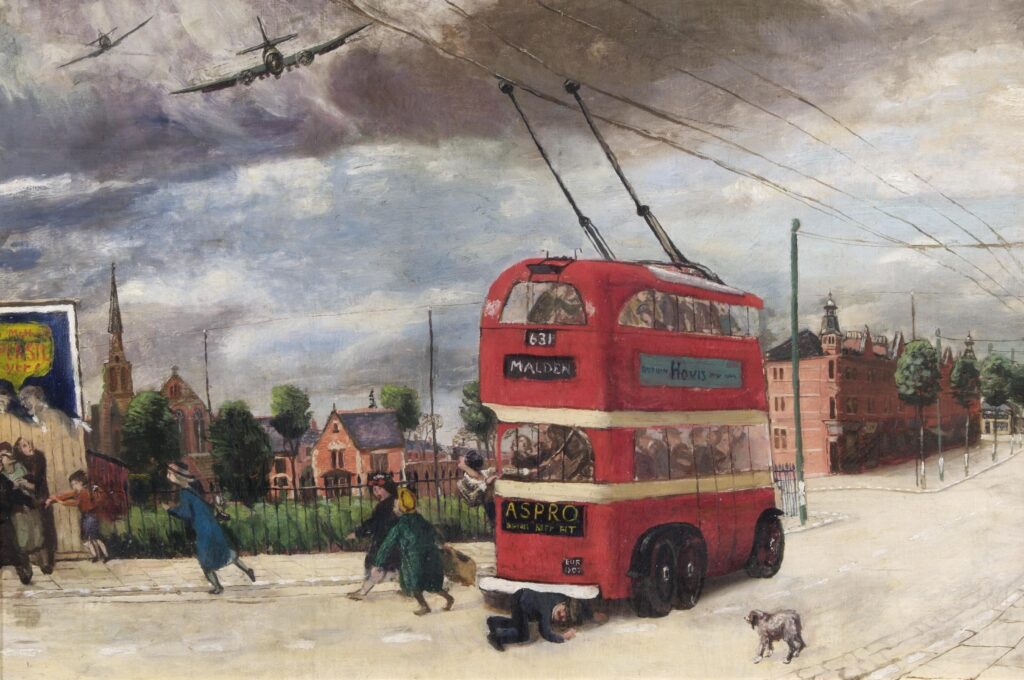
The Wallace Collection at War brings together a handful of the 904 works originally part of the exhibition. A painting by Carel Weight shows the disturbing effect of bombings on civilian populations. Ethel Gabain depicts women undertaking salvage work in Islington in a striking lithograph. Jacob Epstein contributed a few sculptures, one of which is here – a portrait of charismatic Soviet Ambassador Ivan Maisky, whose wife opened the exhibition. There’s also a quick sketch on cardboard by Arthur Shearsby, who witnessed bomb damage at the Palace of Westminster first-hand. Charles Murray’s watercolour is of Russian White Army soldiers, pulling their wounded behind them. Sir William Reid Dick’s portrait of his son John is the most traditional of the bunch, a beautiful work in marble.
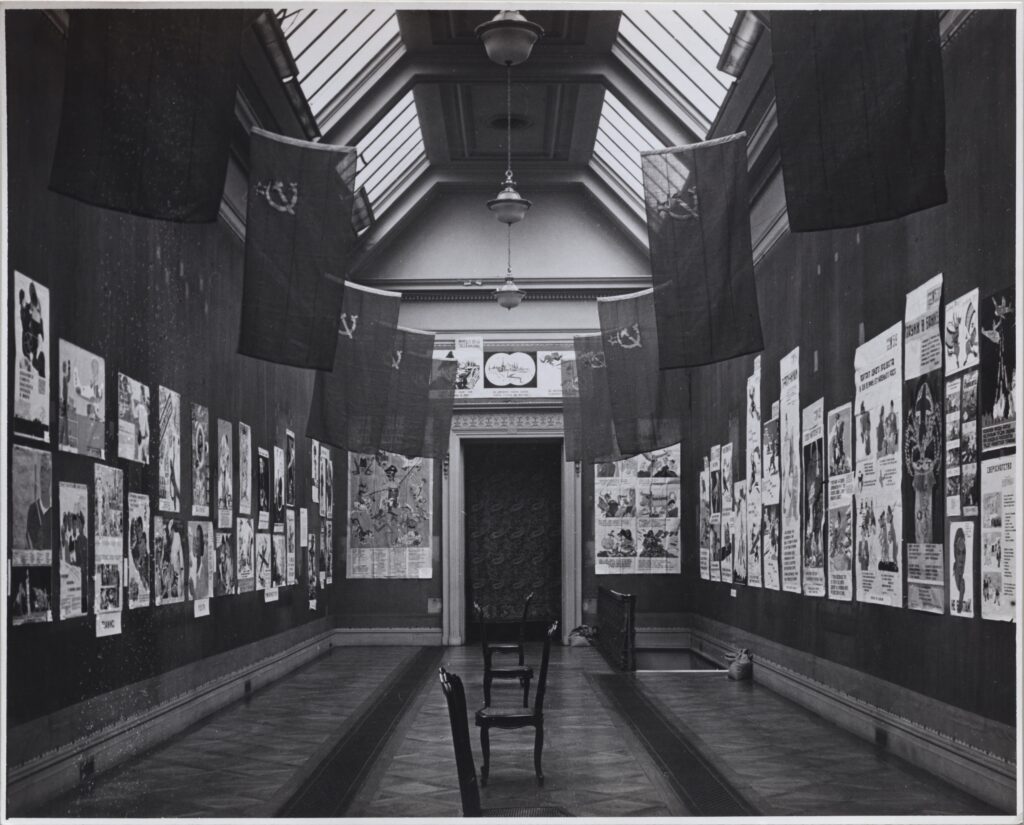
25 Years of Progress, installation photograph (East Gallery III) © Reproduced by kind permission of the National Trust
And a Little Bit of Agitprop at Hertford House
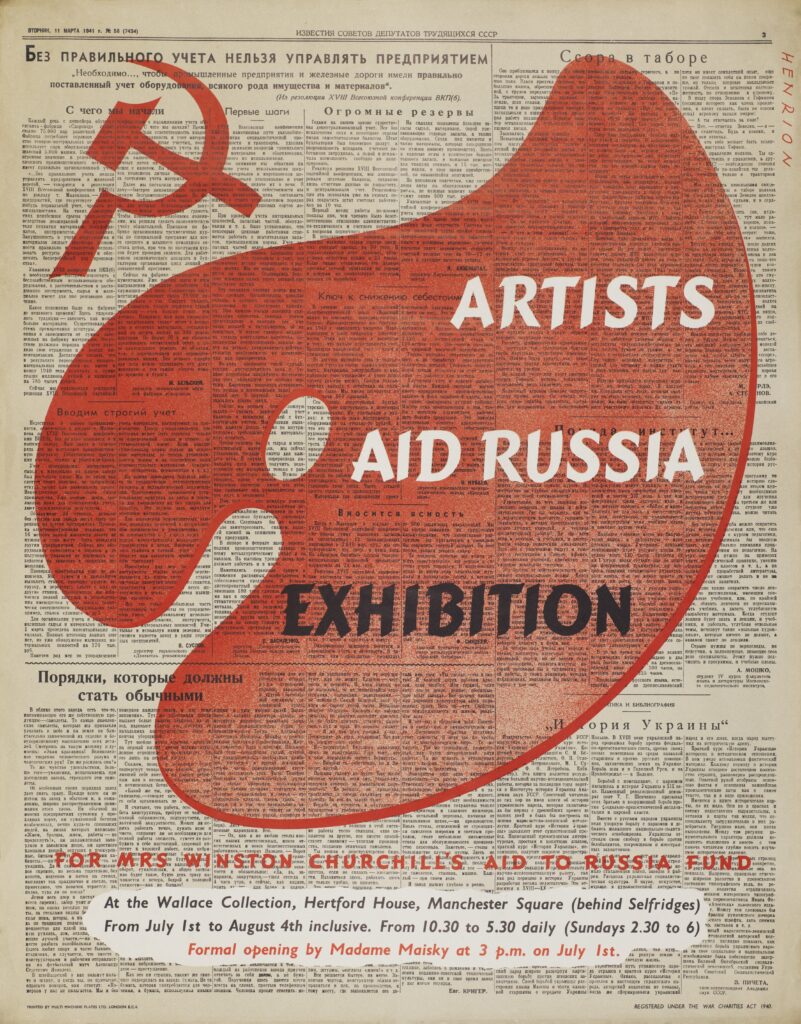
And finally for this first exhibition, there are other interesting materials that round out our understanding. The exhibition poster, first of all, one of two shown here which were designed by Henri Kay Henrion, who was released from internment as an enemy alien to design just such posters in aid of the war effort. The results are very striking and clever. There’s also a catalogue for the exhibition signed by Winston Churchill, and another for the exhibition Artists Aid China (1943). The last work was perhaps my favourite: an almost-reattributed sculpture by John Skeaping. Long a mystery object sitting in the Wallace Collection’s library, the research for this exhibition has possibly matched it to one of those 904 works – for some reason never collected. If it is indeed a portrait of Sonia Miller, she emerges with modernist confidence from her block of marble.
But there is one more exhibition under discussion today. This was Twenty-Five Years of Progress, which opened in November 1942. Surprising, perhaps, to find a Soviet-style ‘agitprop’ exhibition at Hertford House, celebrating the achievements of the USSR. Even more surprising, then, to find its designer was modernist architect Ernő Goldfinger. As well as the exhibition poster (the other by Henrion) there are some in situ shots showing walls lined with Soviet posters and Goldfinger’s innovative solution for ‘floating’ information panels.
As you can tell from my detailed description, The Wallace Collection at War is a rich and informative display. It filled a gap in my knowledge about Britain’s cultural landscape during WWII, and also the history of Hertford House and the Wallace Collection. Visitors can enjoy it as a stand-alone (and free) exhibition or, if they wait a few days longer, can pair it with Winston Churchill: The Painter – the first major retrospective of Churchill’s art.
Salterton Arts Review’s rating: 4/5
The Wallace Collection at War on until 25 October 2026.
Winston Churchill: The Painter on from 23 May to 29 November 2026.
More info on both exhibitions can be found here.
Trending
If you see this after your page is loaded completely, leafletJS files are missing.