
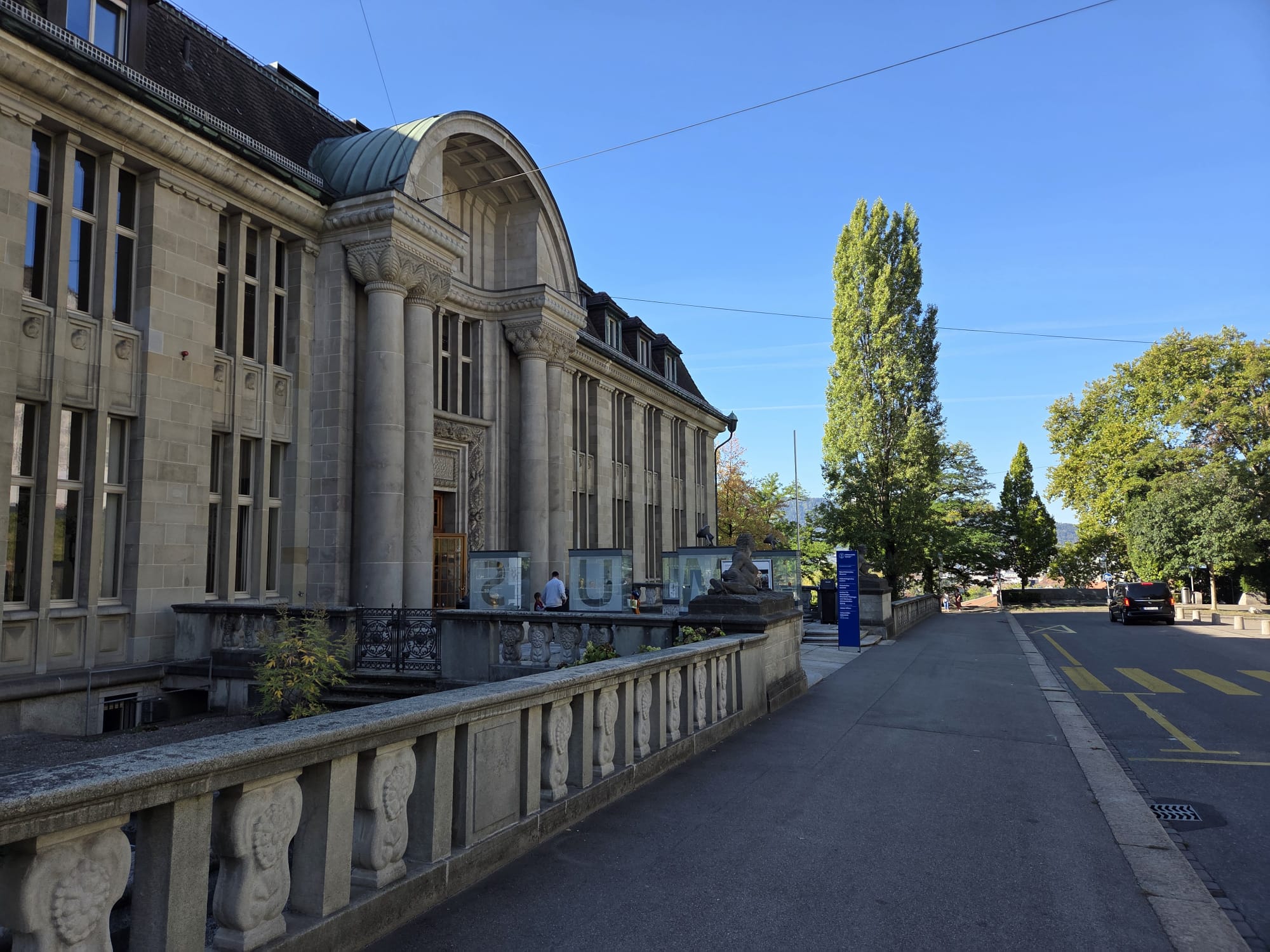
Naturhistorisches Museum der Universität Zürich (Natural History Museum of the University of Zurich)
The Naturhistorisches Museum der Universität Zürich brings together several historic collections to tell the story of natural history in the Zurich region and beyond.


An Accidental Museum Visit
I described the circumstances of my visit to the Naturhistoriches Museum der Universität Zürich in my last post. That post was a walking tour, following in the footsteps of octogenarian graffiti artist the Sprayer von Zürich. I was in this area to track down a few of Harald Naegeli’s works, including a particularly prolific set in a nearby carpark. Then, upon exiting the carpark, I found the Naturhistoriches Museum der Universität Zürich staring me in the face.
As I also described in my last post, I am particularly susceptible to a particular line of reasoning, which I frequently use on myself when deciding whether to visit a museum. You see, I had come to Zurich to see one particular exhibition at the Kunsthaus, and had made a concerted effort not to spend the rest of the weekend in museums, as the weather was lovely and even the Salterton Arts Review needs to change it up a bit. So I’d been on a pleasant boat ride, and the walking tour I mentioned. But, said my brain, even if you came back to Zurich, would you find yourself in this neighbourhood with time to kill? Can’t you just pop in and have a quick look around?
And so I did. Two further enticements were the fact that the museum is free to visit, and the fact that it was about time for me to find a bathroom. This wasn’t the first time and won’t be the last time I’ll visit a museum at least partly for this reason. Museums are a sort of community asset in this regard, particularly those which are unticketed. And, having got people through the doors, it’s much easier to get them to come and take a look around! The opportunity museum toilets represent is actually a topic of discussion in human centred design. But I’m getting sidetracked, and we need to talk about the museum.


An Old Museum Is Also A New Museum
The Naturhistorisches Museum der Universität Zürich was established in 2024. But it also a museum with roots going back to the 17th century. How can both of these things be true? It’s a question of collections and institutional history.
When I was writing about the Kunsthaus Zürich recently, I talked about how a museum whose collections began as the initiatives of private individuals rather than noble collections later nationalised, seemed to me to be very Swiss. Even today, Switzerland is a nation of direct democracy rather than ‘big government’. So, back in the 17th century, it was local citizens rather than princes who were collecting zoological specimens. People like Johann Jakob Scheuchzer, a physician and natural scientist, and Johannes von Muralt, a surgeon. Scheuchzer actually considered fossils to be evidence for the biblical Deluge, but I guess the important thing is that he collected them.
From the 1740s the Naturforschende Gesellschaft (Natural History Society) of Zurich began preserving and exhibiting private collections like these. 1833 saw the centralisation of the society’s collections, along with others from around the canton of Zurich. The university took over responsibility for them in 1908, establishing a Zoological Museum a few years later in 1914. The Zoological Museum and today’s museum building are one and the same – like the Kunsthaus, the museum was designed by local architect Karl Moser.
In 1956 the museum was split up into three – a Zoological Museum, Paleontological Museum, and Zoological Institute. The non-public bits moved elsewhere, while the Paleontological Museum shared space in the Karl Moser building, which was redesigned and expanded by architect Ernst Gisel between 1984 and 1991. The 2024 merger saw these three institutions come back together, and further combine with the Anthropological Museum and Botanical Museum, previously at different Universität Zürich campuses.
And there you have it! Private collections become one museum which becomes three institutions and then one institution again. An old museum and a new one all at the same time.


Museums Reunited, More Or Less
Having now learned a bit more about the evolution of the Naturhistorisches Museum der Universität Zürich, the experience I had as a visitor makes a bit more sense. Because it doesn’t really feel like one museum, it feels more like separate collections in one place.
When I first entered the museum, I was happy to see dinosaurs (both fossils and models). As you know from some of my earlier posts (like this one), I think dinosaurs are very cool and am always pleased to learn more about them. One point in the museum’s favour already! I didn’t spent time in the paleontology displays first, though. I headed around the perimeter of the museum, in a broadly left to right sweep, visiting the galleries in turn.
This is perhaps why I have such a feeling of disparate collections and topics. The first room I visited is one of the museum’s most high-tech displays. It is all about plant communication, with interactive technology, models, and specimens to examine. Visitors are encouraged to learn more about the natural world around them, and hopefully to protect it. The second room, after wandering through some more traditional displays of local Swiss fauna, is similarly high-tech. This installation teaches us about Neanderthals through three looping films, where animations intersperse with spotlights on objects, including models of skulls, remains of Ice Age fauna, and a Neanderthal tooth.
Two rooms, two very different focuses. And a bunch of Swiss ducks in between. This sort of continues around the museum – there’s a gallery of ‘masterpiece’ fossils, a display of fossils from the Monte San Giorgio deposit, a bit about dinosaurs, and then what feels like a separate museum as you head downstairs and see taxidermied animals from around the world. The Naturhistorisches Museum der Universität Zürich is small, but it covers so many topics that it feels like you could make multiple trips here and keep learning.


Switzerland And Its Fauna
I’ve been a bit flippant so far about the local focus within the museum, so I think it’s about time I do it justice. The Naturhistorisches Museum der Universität Zürich has a great collection of specimens of living and extinct fauna from the canton of Zurich and Switzerland more broadly.
Starting with the paleontological collection, the mammoths have to be the highlight. Just 20KM Northwest of Zurich, near the village of Niederweningen, a ‘Mammutloch’, or ‘mammoth pit’, was discovered in 1890. A composite skeleton assembled from the bones is on display, and is very impressive. In front of the composite skeleton, and equally impressive from a rarity point of view, is the skeleton of a newborn mammoth from the same location. There are other Ice Age mega fauna in the collection, including cave lions and bears, and wooly rhinoceros.
I’ve already mentioned the fossil deposit at Monte San Giorgio. This is located in the canton of Ticino on the other side of Zurich, but the university is a research hub for this UNESCO World Heritage site. The deposit contains marine fossils, and here we can see early ichthyosaurs and other Triassic species. The dinosaur fossils found in Switzerland aren’t only marine varieties, either, but also include the primitive dinosaur Plateosaurus.
Once you’ve got over your excitement at the paleontological specimens (or is that just me?), there are modern types of fauna to see as well. Mammals include deer, boars, foxes, badgers, chamois, and marmots. The birds are grouped by habitat, with interactive buttons allowing you to hear their calls. Reminds you really that a lot of animals had to die to make these displays, which is something I’m increasingly thinking about in natural history museums. To round out the local fauna, you can also find examples of Swiss amphibians, reptiles, and invertebrates.


A Few Highlights
There is a lot to like about the Naturhistorisches Museum der Universität Zürich. I’m going to share with you a few of the things I particularly enjoyed, in the order I saw them.
Firstly, I really liked the animation about Neanderthals. It’s an area of scholarship where we continue to make discoveries and rewrite mistaken assumptions of the past, so a good opportunity to learn. The creators have really thought about storytelling, and encourage us to empathise with their Neanderthal character. Given that, except for many African populations, most humans share DNA with Neanderthals, this is not an unreasonable ask. It’s a good demonstration of the link from artefact to knowledge and, if combined with the mammoths just outside, is probably my favourite part of the museum.
Secondly, I liked the gallery ‘Masterpieces: Meisterwerke der Natur’ (‘Masterworks of Nature’). This looks at fossils almost from an aesthetic-first point of view. The exhibition presents fifty fossils beautifully, with dimmed and dramatic lighting. Some are masterpieces because of their completeness, other for their density and the patterns that creates. My favourite was an iridescent ammonite, which is beautiful. You can see a virtual tour of the exhibition here, with both an Art and Nature comment for each of the masterworks.
The fifty fossils in the Masterpieces exhibition are on long-term loan from the Sauriermuseum Aathal. This is a public/private museum partnership, and brings me on to my last highlight. Also on loan from the Sauriermuseum Aathal are some very impressive dinosaur fossils. The latter museum, which is not far from Zurich, heads its own fossil excavations in Wyoming. I have my thoughts on fossils as something you can dig up yourself and own – I lean more towards the model where they are government property. But Wyoming, fittingly, has more of a cowboy approach. The long and the short of it is that the Naturhistorisches Museum der Universität Zürich benefits by being able to display impressive examples of Allosaurus, Hesperosaurus (a predecessor of Stegosaurus) and Diplodocus. I’m once again sorry to the fauna of Switzerland, but these are the big hitters for sure!


Goodbye to the Naturhistorisches Museum der Universität Zürich
So, having intended to just pop in, I had a good time at the Naturhistorisches Museum der Universität Zürich. I had not expected anything as impressive as the American dinosaurs. Or the mammoth, for that matter. The Masterworks of Nature were a beautiful moment and a new lens through which to appreciate fossils. And I got to know one of my Neanderthal ancestors, and learn up to date interpretations of their lives and culture.
That’s not bad for what is still a small institution, despite the merger of several museums. Is it cohesive? Not quite. But is it coherent? I think so, yes. You can see clearly within the museum how different collections have come together. But the museum gives space to each, and draws out of them their most important parts. In a way, it’s a bit of a Meisterwerke situation in itself. With long-term loans from the Sauriermuseum Aathal, what you see is of high quality.
Time for some of my usual caveats. My thoughts above are unsurprising, given my personal interest in anthropology and paleontology in particular. As I’ve said, zoology collections are becoming less comfortable for me over time. But still interesting. If you are an average visitor to Zurich, would I recommend this museum? I would say yes for anyone who’s going to be in the area. Less so if it’s significantly out of your way. For those in the vicinity, it is interesting and free to visit. Plus on Sundays there are free guided tours, including some in English. You could do a lot worse with a bit of spare time!
I have the Musée Visionnaire to thank really for my visit here. They are the ones who created the audio tour that inspired me to come to this part of town. They were also the subject of my final accidental museum visit in Zurich, and will be the subject of my next post.
Trending
If you see this after your page is loaded completely, leafletJS files are missing.