
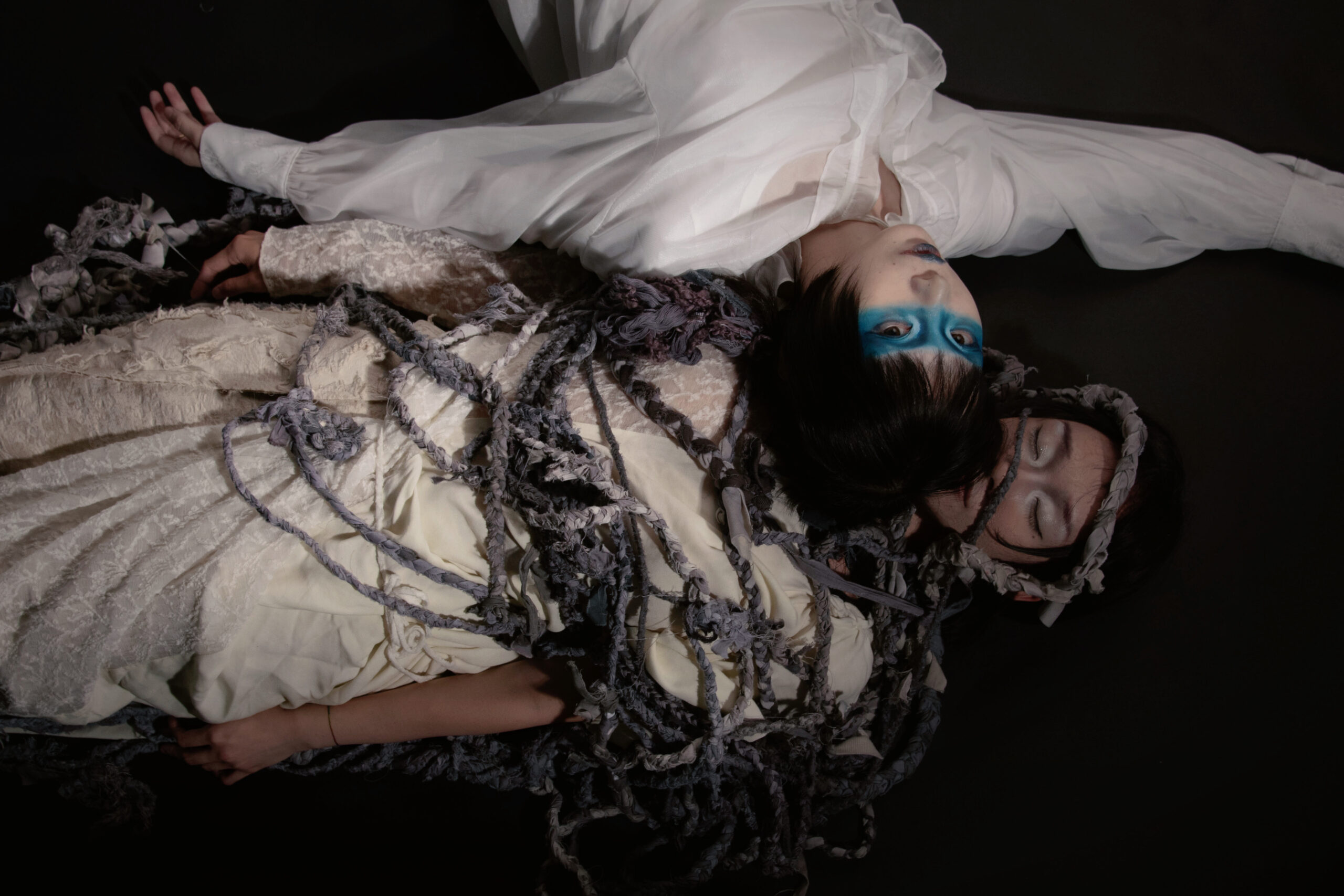
The Bride – Camden Fringe / Camden People’s Theatre, London
A third and final selection from the Camden Fringe, The Bride (蚕女) is a meditative and visually impressive work. Physical theatre and moving image combine to explore female identity and generational inheritance.
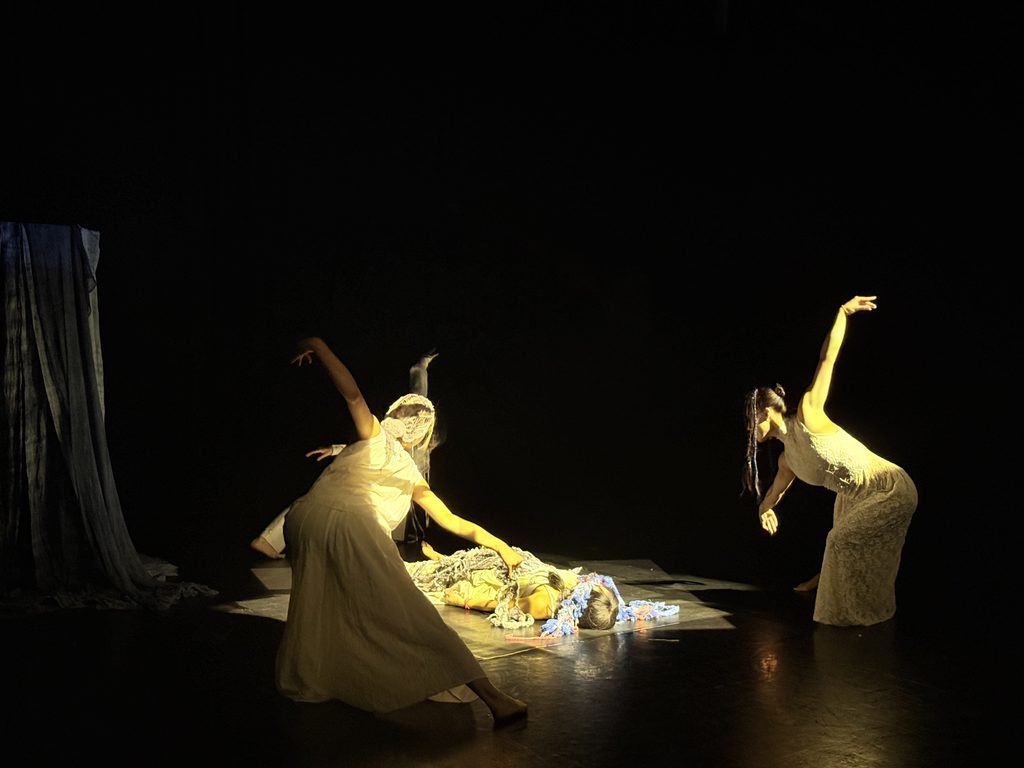
Other images supplied by the company.
The Bride (蚕女)
My third and final pick from this year’s Camden Fringe, and it’s very different from the others. Firstly, I was immersed in the life of Edgar Allen Poe, with a dramatic reading of The Raven. Next, a historical drama that taught me about Sweden’s church towns, including the titular Gammelstad. And finally, we have The Bride (蚕女). With over 450 shows forming the Camden Fringe programme across the month of August, I’ve barely scratched the surface. And yet I’ve continued, in my small sample, to enjoy the festival’s range and depth.
The Bride (蚕女) is a much more lyrical and physical work than my other two picks. The work of London-based interdisciplinary artist Yu Ai, The Bride (蚕女) follows Er’er as she returns to the mystical Silkworm Island following the death of her mother. As she confronts the island’s tradition and her own emotional journey, Er’er must learn self-reliance.
Ai directs and produces as well as performing in the work. She is joined by fellow performers Lei Ieok Mang, Shiting Tao, and Ziyao Geng. Chinese silk-making traditions form an important part of the work, and Ziyao Geng doubles as the company’s textile artist. Costumes are by Lu Wang. Moving images and sound form another important element of The Bride (蚕女). The music is by Thomas Calcutt and Yu-Hui Zong (the latter also performs the music in part), with Lijuan Kang as the moving image artist and lighting by Yiling Liu. In the context of Silkworm Island, as with many fringe productions, it takes a village of often multi-talented people to pull off a daring new work.
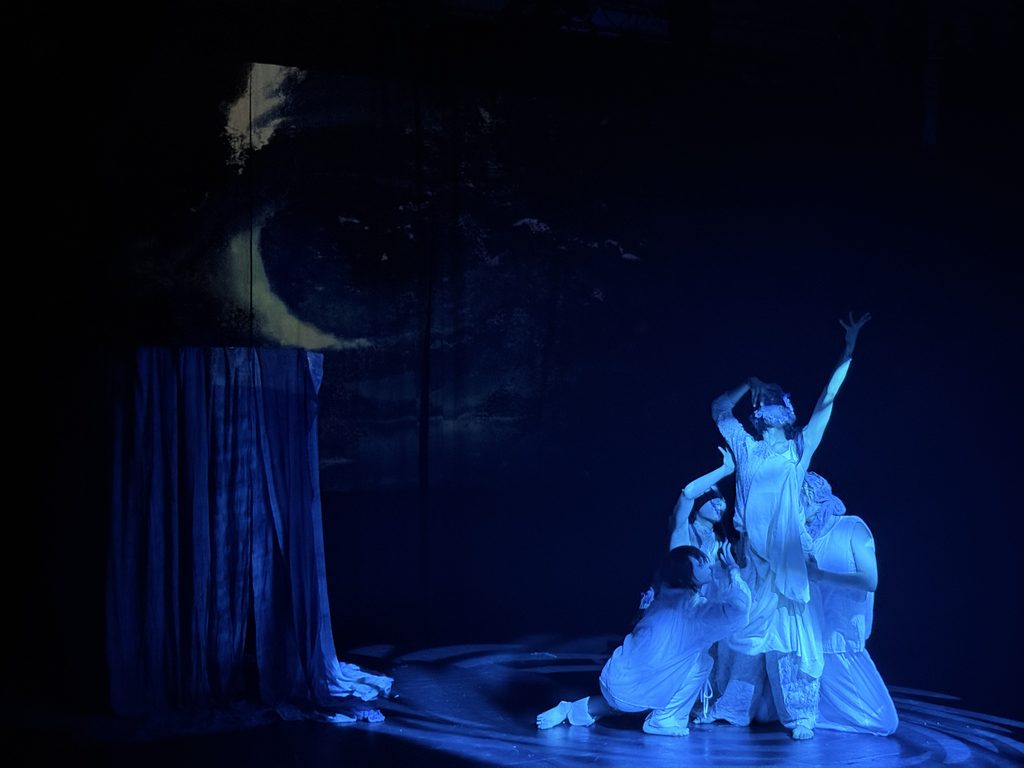
A World of Tradition and Transformation
Watching The Bride (蚕女) reminded me of two other performances I’ve had the pleasure of seeing: this one and this one. The three works have a point of commonality in that the creatives behind them are largely of Chinese origin. But it’s a lot more than that. All three rely on techniques of physical theatre to tell a story. They are also unafraid to push the boundaries of what is commonly seen on the London stage, to create something that is very unique. Did I always understand what I was seeing? No. But did I love that it was taking me out of my comfort zone and asking me to come along on an unfamiliar journey? Absolutely!
This was very much my feeling upon seeing The Bride (蚕女). I knew the broad outline of the story going into it – loss, a return to home, and a journey of self-discovery. I could see and appreciate the use of ritual movements within the choreography, as well as how movement, costume and moving image combined to create a world of tradition and transformation. Did I grasp “the truth behind the island’s traditions”, as the press description suggested I might? I’m not sure that I did. But it’s a work that rewards deep observation and an open spirit – I suspect I needed to immerse myself more fully in Er’er’s world. What I did grasp and appreciate was the beauty of the world Ai has created, and the power of physical theatre to convey emotion as well as plot.
Seeing a work with such a fiercely independent spirit is exactly what I love about theatre festivals. Ai clearly has a strong vision, and I hope to have further opportunities to see her work as it evolves. In the meantime, if you have the opportunity to see The Bride (蚕女) I suggest you take it. An hour in this otherworldly setting, bathed in the familiarity of ritual and the unfamiliarity of Er’er’s world, is an hour well spent.
Salterton Arts Review’s rating: 3.5/5
The Bride (蚕女) was on at Camden People’s Theatre as part of Camden Fringe on 23 and 24 August 2026.
Trending
If you see this after your page is loaded completely, leafletJS files are missing.