
-320°F – NODA MAP / Sadler’s Wells Theatre, London
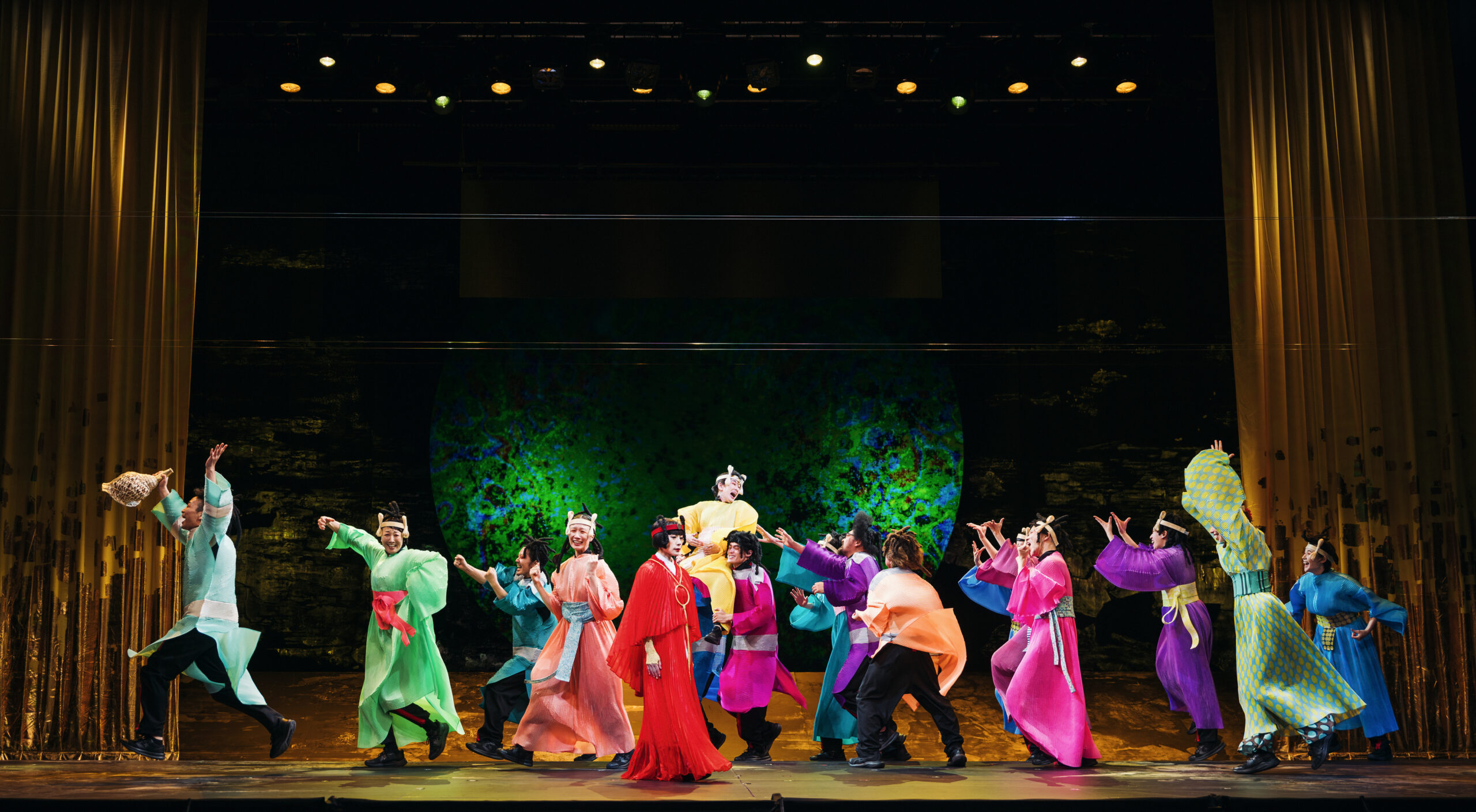
NODA MAP push science, science fiction, theatre, pretty much everything to its limits in -320°F, on in London now at Sadler’s Wells Theatre.
Japanese Theatre in London: −320°F
It’s been a minute since I saw anything at Sadler’s Wells! The original Sadler’s Wells, that is – I’ve been a couple of times now to their satellite location, Sadler’s Wells East. What can I say? Things have been busy here on the blog. What tempted me back was something outside of the theatre’s own programming. −320°F is a work by NODA MAP, in London for a limited time after debuting in Tokyo. It’s a great chance for UK audiences to see a truly unique work of theatre.
And when I say truly unique, I mean it. It was the description that drew me in: “a Faustian descent through myth, memory and other bad ideas”. I’m not sure it’s possible to describe the plot, but I’ll try to give you a sense of it in broad strokes. Help (Sadawo Abe) is an assistant to Professor Kyuri (Eri Fukatsu). Kyuri is attempting to find something called an ‘angel bone’, which she believes will unlock the secret to existence. Her research is funded by the Ooling-Hi Pharmaceutical Company, and originates in work by Dr. Bonewave (Isao Hashizume), who believes that bones have carried human memories since ancient times.
If it sounds complicated, it is. The programme has a diagram of the characters and their connections, as well as mapping which exist in modern, medieval, or ancient times. I think perhaps the reason there is no interval during the 2 hour 20 run time is the risk you’d lose the thread of it if you stepped away for a moment.
Complicated can be positive or negative in theatre, though. And here, I think it is largely positive. I say ‘I think’ because my brain is still processing what happened last night. That seems to be deliberate on the part of playwright and director Hideki Noda. Let me finish this first section with a quote from the programme:
“For some, the play might feel excessive; for others, it might bring them to deeply reflect on a past experience. Whilst someone might feel moved, another might find it overly simplistic. The varied end points of this theatrical journey mirror the diverse parts of our lives. Since the play speaks directly to the human experience, each audience member will reach the end with a deeply personal impression.”
Hideki Noda, −320°F programme
My Deeply Personal Impression
At the best of times, and despite my efforts to contextualise and leave my more biased thoughts aside, reviewing is a subjective and personal process. Today, more than ever, I am very acutely aware of that. So what was my deeply personal impression of −320°F?
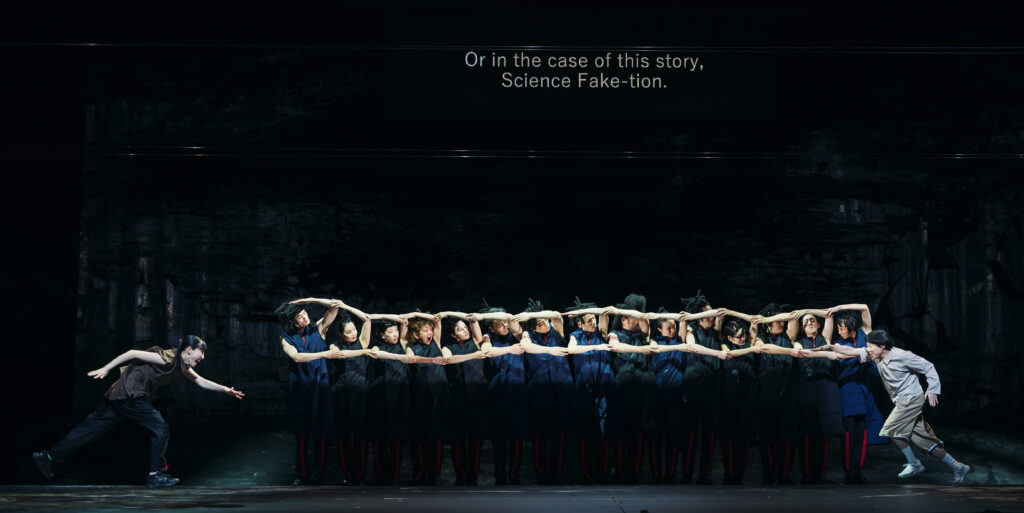
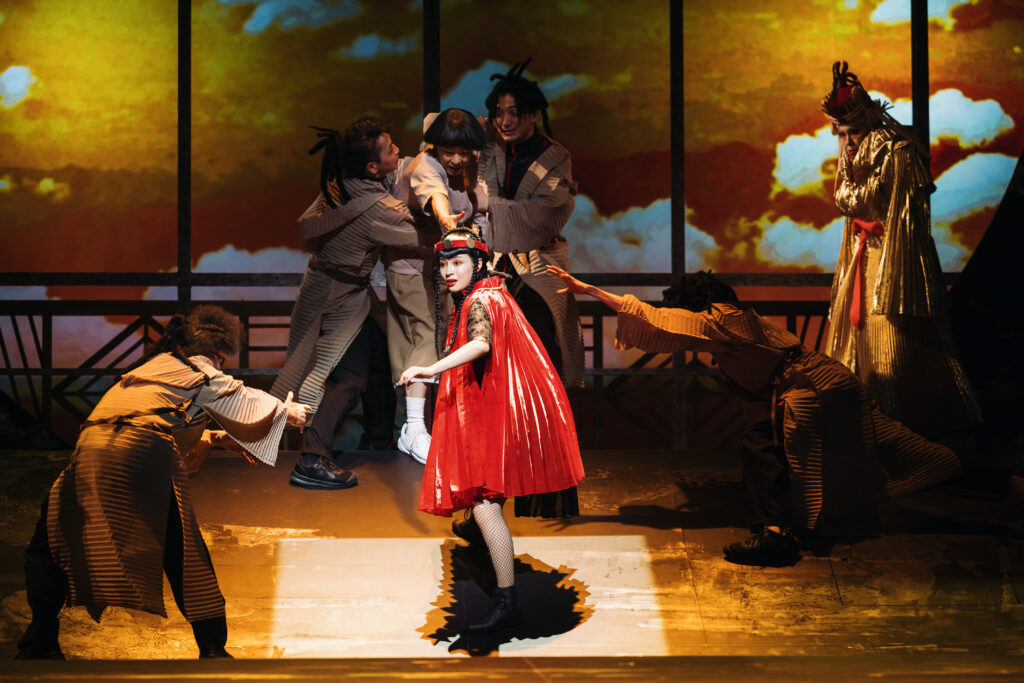
Firstly, I was entranced by how different it was by what I usually see. That is what I’d been hoping for, to be honest. And this difference touches almost all aspects of the production. It is worth seeing for the set design by Yukio Horio and costume design by Kodue Hibino alone. They immediately transport us into this world of science fiction (or science fake-tion). So too the movement and acting. There are absolutely stunning elements of physical theatre in −320°F, where the cast come together to form bones, wings, or moving creatures. A more challenging aspect for me as an audience member is that almost the entire play takes place at a fever pitch. There is comic relief, but little variation in the energy level.
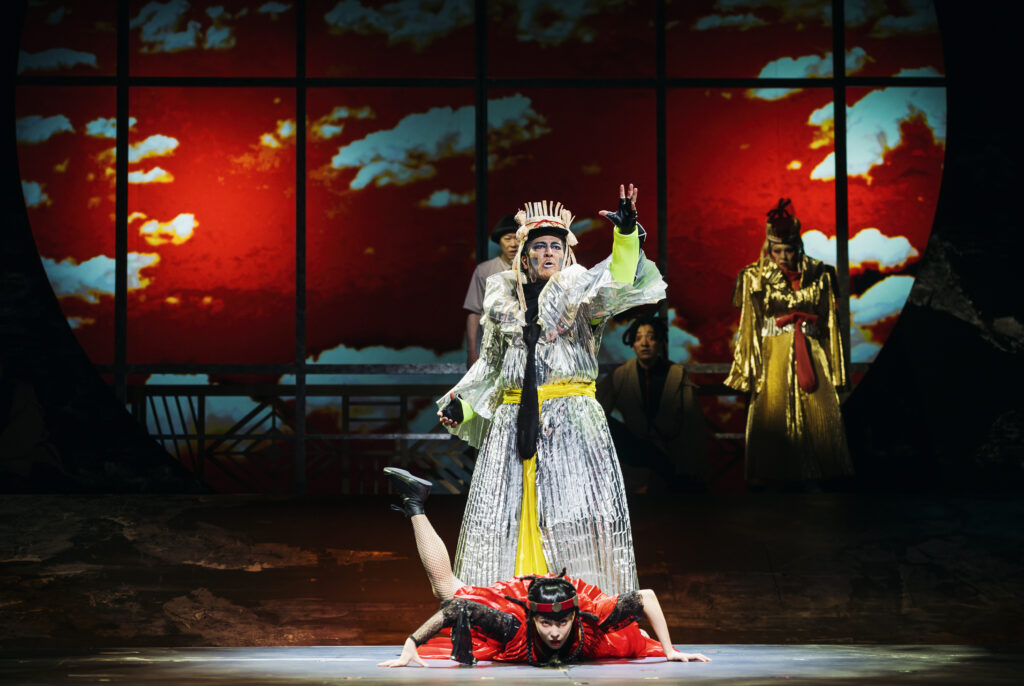
I found myself wondering if what I was experiencing, but not recognising, was a debt to Kabuki theatre. It’s not a form of theatre I have much experience of, but Noda certainly does. And the framework of elaborate costumes, loud and expressive movements, and specific acting styles for different characters certainly seems to fit.
I also appreciated that this elaborate story was a reckoning with questions of genetics and eugenics. The question of disability vs. reproductive choice is polemic and frequently in the news. And the play draws on the 2016 Yamayuri-en incident, recreating some elements of the attack verbatim. It’s a wild but effective way to explore attitudes to progress, perfection, inclusivity, and the right to live and participate in society. Although this theme emerges as the play progresses it is there from the very beginning, with the upending of the sign language interpreter role as narrator (Misaki).
What to Conclude?
Noda has fairly extensive experience bringing theatre to UK audiences. I think he trusts us, therefore, to navigate a very unfamiliar piece of theatre, however personal that journey might be. I do think there is a slight disadvantage to not speaking Japanese. Keeping up with the surtitles and the action is a balance, as always. I picked up after a while that the Japanese words for ‘gene’ and ‘angel’ are fairly similar. And I suspect the naming of the Oolong Empire is a joke that works in Japanese better than English. What I think this means is that there are nuances to the story that are harder to appreciate with a language barrier.
However, the opportunity to see a play that trusts its audience, demonstrates skilled acting in a style we don’t often get to see in London, and has stellar design, is one not to be missed. Open yourself up to the uncertainty, and be ready too to question your own beliefs on how the value of all human life measures up against ideas of medical and scientific progress.
Oh, I forgot to mention, this play also borrows from the tale of Faust and Mephisto. There’s a Pied Piper of Hamelin. And Cleopatra’s eggs of uncertain parentage. Perhaps Noda has himself accessed the ability to enter memories of past lives, to have been able to create a work of such limitless creativity?
Salterton Arts Review’s rating: 4/5
−320°F on until 11 July 2026. More info and tickets here.
Trending
If you see this after your page is loaded completely, leafletJS files are missing.